Have you ever stopped while typing and asked yourself whether it should be resetted or reset? It happens to almost everyone, and the confusion usually shows up when you’re talking about restarting a device or fixing a setting. The good news is that the answer is straightforward once you understand how this verb works.
The word reset shows up in everyday conversations, from tech support chats to simple daily tasks, so getting the right form matters more than most people realize. In this guide, we’ll clear up the mix-ups, explain why “resetted” doesn’t fit standard English, and show you how to use reset correctly in every tense. You’ll also see practical examples and simple memory cues that make the rule easy to remember.
Understanding What “Reset” Actually Means
Before we jump into the grammar side of things, it helps to know what “reset” really refers to.
The term reset describes the act of returning something to how it was before whether that’s restarting a device, starting fresh with a habit, or going back to square one in any situation. You’ll hear it everywhere: tech support, fitness routines, video games, and even mental health conversations.
Here’s how it shows up in everyday life:
- Tech troubleshooting: “My laptop kept glitching, so I had to reset it.”
- Wellness and habits: “He decided to reset his sleep schedule after weeks of late nights.”
- Team strategy: “The manager reset the game plan after halftime.”
- Video games: “We had to reset the checkpoint because we missed a clue.”
No matter the context, the core idea stays consistent you’re bringing something back to where it began.
🧠 A Quick Look at Its Origins
The word reset traces back to Middle English, formed by combining re- (which means “again”) and set. This pairing is important because it ties reset directly to the irregular verb set, which famously stays the same across all tenses. That little detail is actually the reason why “resetted” isn’t a real word and once you see that link, the grammar rule makes a lot more sense.
The Grammar Rule: “Reset” Is an Irregular Verb
English verbs are split into two main groups:
- Regular verbs – these add “ed” to form the past tense (e.g., jump → jumped).
- Irregular verbs – these break the mold and stay unchanged or shift unpredictably (e.g., hit → hit, put → put).
Reset falls into the irregular camp. It’s one of those verbs that looks exactly the same whether you’re talking about now, yesterday, or something that happened multiple times. That’s why “resetted” doesn’t exist in proper English.
Here’s how it works across different tenses.
| Verb Form | Example | Explanation |
| Base Form | I reset the router. | Present tense |
| Past Tense | I reset the router last night. | Past tense (unchanged) |
| Past Participle | I have reset the router twice today. | Perfect tense |
| Present Participle | I am resetting the router right now. | Continuous form |
See how “reset” stays the same in the base, past, and past participle columns? That consistency is what makes it irregular and why adding “ed” sounds wrong.
🧩 Why It Mirrors the “Set” Pattern
The root verb set works the exact same way:
- set → set → set
- reset → reset → reset
Because of this, linguists label reset as a compound irregular verb it simply copies the behavior of set. Once you understand that connection, the grammar becomes much easier
The Correct Past Tense of “Reset”
This is where a lot of people get tripped up. It’s natural to think that “resetted” must be right since most English verbs just tack on “ed” when talking about the past.
But reset doesn’t play by those rules.
The past tense of “reset” is simply “reset.”
Here’s how it looks across different scenarios:
| Tense | Example Sentence |
| Simple Present | I reset my device every week. |
| Simple Past | I reset my device yesterday. |
| Present Perfect | I have reset it several times this month. |
| Past Perfect | I had reset it right before the system crashed. |
| Future | I will reset it again tomorrow morning. |
👉 Key takeaway: The word stays identical no matter the tense once you lock in this pattern, you’ll never second guess it again.
Reset vs. Resetted: The Real Grammar Clarification
So here’s the question everyone wants answered: Can you ever use “resetted”?
Quick answer: No.
Detailed answer: In standard English today, resetted isn’t recognized by any major dictionary or grammar resource. It’s labeled as nonstandard and grammatically incorrect.
Here’s what the authorities say:
- Merriam-Webster – confirms that reset serves as the base form, past tense, and past participle.
- Cambridge Dictionary – classifies reset as irregular (reset, reset, resetting).
- Oxford English Dictionary – makes no mention of resetted as a legitimate word.
The explanation is straightforward: reset comes directly from set, which never takes an “ed” ending. Because reset inherits that same structure, adding “ed” breaks the rules of English word formation.
Why “Resetted” Sounds Right (But Isn’t)

So what makes people reach for “resetted” in the first place?
It comes down to how our minds process language. We naturally lean toward regular patterns, so when we encounter a verb, the instinct is to add “ed” and move on.
Here’s what’s actually happening: irregular verbs survived because English developed messily over centuries, borrowing from old Germanic roots. Words like set, hit, cost, split, and reset held onto their ancient forms instead of adapting.
“Language doesn’t evolve based on rules it evolves based on use.” John McWhorter, Linguist & Author
Bottom line: resetted might feel right to your ear, but it doesn’t align with how English grammar actually works.
Pronunciation of “Reset” in All Tenses
Here’s another layer that trips people up: the pronunciation stays the same no matter what.
In phonetic terms, reset is said as /ˈriːˌsɛt/ or “REE-set.”
It sounds exactly the same whether you’re talking about something that already happened or something you do regularly:
- “I reset my router last night.” (past)
- “I reset my router whenever it acts up.” (present)
Same spelling. Same sound. That consistency is what makes irregular verbs like this surprisingly straightforward once you get the hang of them.
Common Grammar Mistakes with “Reset” and How to Avoid Them
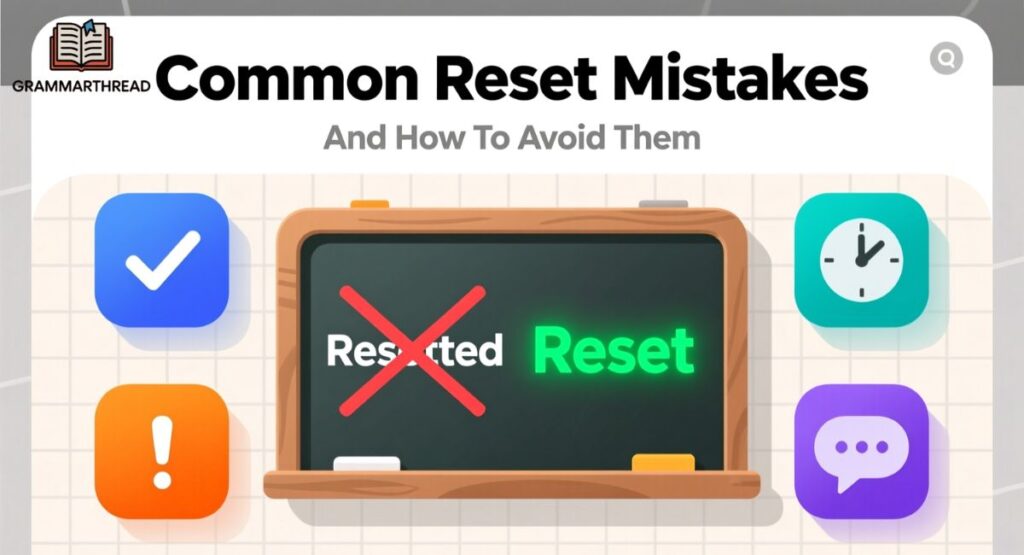
Here are a few typical errors people make when using “reset” and the easiest ways to correct them.
❌ Mistake 1: Writing “Resetted” Instead of “Reset”
Wrong: She resetted her password yesterday.
Right: She reset her password yesterday.
Fix: Keep in mind that reset never adds “-ed.” Think of it like set if set doesn’t change, neither does reset.
❌ Mistake 2: Using the Wrong Tense with “Reset”
Wrong: He reset his phone next week.
Right: He will reset his phone next week.
Fix: Because reset looks identical in both present and past forms, you need context clues like “yesterday,” “next week,” or “already” to show the correct tense.
❌ Mistake 3: Confusing Verb and Noun Usage
Wrong: I did a reset my computer.
Right: I did a reset on my computer.
Fix: Decide whether you’re using reset as a verb (“I reset it”) or a noun (“I did a reset”) don’t mix the two in the same phrase.
Similar Irregular Verbs That Never Change Form
If you’ve struggled with reset, don’t worry it’s part of a bigger group. English includes quite a few verbs that look exactly the same no matter the tense.
Here’s a handy chart to help you spot the pattern:
| Base Form | Past Tense | Past Participle | Example |
| set | set | set | I set my alarm an hour ago. |
| let | let | let | They let us leave early. |
| put | put | put | She put the keys on the counter. |
| cut | cut | cut | He cut the rope in half. |
| hit | hit | hit | I hit the brakes just in time. |
| shut | shut | shut | We shut the windows last night. |
| reset | reset | reset | I reset my laptop this morning. |
Pattern to remember: Verbs ending in -set, -ut, or -it often follow this unchanging rule, so when you spot those endings, there’s a strong chance the verb stays the same across all tenses.
How to Remember the Rule Easily
Looking for a simple way to lock in this grammar rule? Try these strategies.
💡 Mnemonic:
“Ends in set? Then ed’s not met!”
✏️ Practice Tip:
Create a short sentence using reset in three different tenses:
- Present – I reset my password regularly.
- Past – I reset it last week.
- Perfect – I have reset it multiple times.
Repeating this exercise helps your brain internalize the pattern.
🧘 Analogy:
Picture reset like flipping a switch you flip it on or off, but you’d never say you “on-ed” or “off-ed” the light. The same principle applies to verbs like reset.
Real-World Examples in Different Contexts
Here’s how reset appears across various everyday situations.
| Context | Example Sentence |
| Technology | “I reset my tablet when the screen froze.” |
| Sports | “The team reset their formation after halftime.” |
| Psychology | “He reset his outlook following a tough week.” |
| Business | “The startup reset its priorities after the funding round.” |
| Gaming | “We reset the checkpoint to explore another path.” |
These examples highlight how reset fits naturally into different areas from troubleshooting gadgets to reframing personal habits.
Expanding Your Grammar: Similar Irregular Verbs to Learn
To strengthen your command of English, explore other verbs that work just like reset. Here’s a helpful overview:
| Verb | Meaning | Example |
| upset | to cause emotional distress | The news upset everyone at the meeting. |
| offset | to balance out or compensate | The savings offset the higher costs. |
| beset | to plague or surround | The launch was beset by delays. |
| set | to position or establish | She set the books on the shelf. |
| reset | to bring back to original state | I reset the thermostat this morning. |
Each of these verbs follows the same pattern and remains identical across all tenses, making them easier to manage once you recognize the trend.
Common Usage Case Study
Case Study: Tech Support Conversation
Scenario: A user reaches out to support and says, “I resetted my device but the problem didn’t go away.”
Support Agent: “Got it you reset your device. Just so you know, the correct past tense is reset. Let’s take another look at what might be causing the issue.”
Lesson: Even in technical conversations, sticking to proper verb forms keeps your communication clear and polished.
How “Reset” Works in Formal vs. Informal English
Here’s the good news: reset follows the same grammar rules whether you’re writing a professional email or texting a friend.
In both formal and informal settings, the verb stays consistent. You won’t find any shortcuts or slang variations that change its form—reset is always reset, no matter the audience or tone.
Formal contexts:
- Business communication: “We reset the project timeline following the stakeholder review.”
- Academic writing: “The researchers reset the experimental parameters to ensure accuracy.”
- Technical documentation: “The system was reset to factory defaults before deployment.”
Informal contexts:
- Casual conversation: “I reset my sleep schedule over the weekend.”
- Text messages: “Just reset my phone—let me know if this message goes through.”
- Social media: “Time to reset and start fresh this Monday.”
The only real difference is the surrounding language and sentence structure. In formal writing, you’ll use more complete sentences and professional vocabulary. In casual settings, you might drop words or use contractions but the verb itself never changes.
This consistency is actually helpful. Unlike some words that shift meaning or form depending on context, reset remains reliable across every type of communication. Whether you’re drafting a report or chatting with a coworker, you can trust the same grammar rule every time.
Quick Recap: What You’ve Learned
- ✅ “Reset” is irregular and stays unchanged (reset–reset–reset).
- 🚫 “Resetted” doesn’t exist in standard English or any major dictionary.
- 💡 Rely on context words like “yesterday” or “next week” to show tense, since the verb itself doesn’t shift.
- 🔁 Other verbs like set, put, and hit follow the exact same rule.
- 🧠 Easy reminder: “Ends in set? Then ed’s not met.”
Frequently Asked Questions
What is the correct past tense of reset?
The correct past tense of reset is “reset.” It doesn’t change form.
Is resetted a real word?
No. “Resetted” isn’t accepted in standard English.
How do you use reset in a past sentence?
You can say, “I reset my phone yesterday.” The word stays the same.
Why does reset not change in past tense?
It’s an irregular verb, so the past form is identical to the present.
Is it wrong to say resetted?
Yes. It’s considered a grammatical error.
What’s the difference between reset and resetted?
“Reset” is correct. “Resetted” is incorrect and not used in proper English.
How do you pronounce reset in the past tense?
You pronounce it the same way as the present form.
Can reset be used in all tenses?
Yes. The form stays “reset” for base, past, and past participle.
Conclusion
So here’s the takeaway. The debate about resetted or reset is simpler than it looks.“Resetted” isn’t used in standard English, and reset keeps the same form in every tense. Once you understand this pattern, the verb becomes one of the easiest irregulars to work with. You can say I reset it yesterday or I have reset it many times without second-guessing yourself.
Now that you know the rule, try using reset in a few sentences of your own. It only takes a minute, and it helps lock the pattern into memory.
Read Next: Window Seal or Sill? A Simple 2026 Guide to Tell Them Apart Fast

Welcome to GrammarThread. I am Julian Mercer, an AI-powered SEO and content writer with 4 years of experience. I help websites rank higher, grow traffic, and look amazing. My goal is to make SEO and website design simple and effective for everyone. Let’s achieve more together!