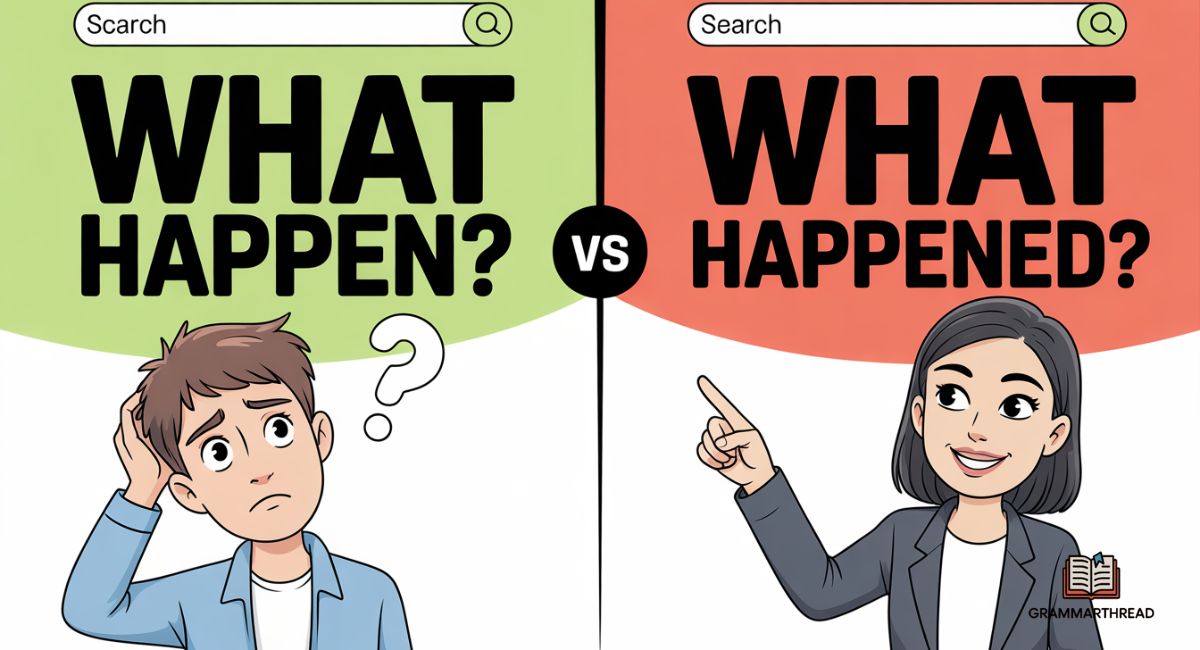
Ever paused while typing and wondered whether what happen or what happened is the right choice? It’s a small difference, but it changes the meaning in everyday conversations, texts, and even professional writing. Many people mix them up because the forms look similar, yet they work in completely different ways.
Understanding when to use each one makes your sentences clearer and helps you sound confident. You’ve probably seen both versions online, heard them in videos, or even said them yourself without thinking about the grammar behind them.
This guide walks you through the logic, the tense, and the real-life usage so the rule finally sticks. Let’s explore why this tiny change matters and how to get it right every time.
Mastering the Basics: How English Verb Tenses Actually Work
Verb tenses form the core structure of English grammar. They let you express when an action happens whether it’s in the past, present, or future.
Here’s a quick breakdown:
- Present tense describes actions happening right now or things that occur regularly.
- Past tense refers to actions that have already taken place.
- Future tense points to actions that are yet to come.
Let’s use the verb “walk” as an example.
| Tense | Base Form | Example Sentence |
| Present | walk | I walk to work every morning. |
| Past | walked | She walked home after the meeting. |
| Future | will walk | They will walk to the park tomorrow. |
When you say “What walk?” it sounds incomplete because it lacks proper tense. But when you’re asking about something that already took place, you need the past form “What walked?” or more naturally, “Who walked there?”
This is why choosing the right tense matters. It gives your sentence clarity and helps listeners understand exactly when you’re talking about.
Where the Mix-Up Comes From
The mix-up happens because of the way English structures questions.
A lot of learners overlook that English questions often flip word order or require a helper verb such as do, did, or does.
Plus, in several other languages, tense shifts aren’t always marked by a distinct suffix like “ed.” That’s why “What happen?” may feel natural to non-native speakers, even though it breaks standard English grammar rules.
Common Mistakes
- ❌ What happen at the party last night?
- ✅ What happened at the party last night?
Even fluent English speakers sometimes drop the “ed” sound in casual conversation due to rapid speech patterns, making it sound like “What happen?” But from a grammar standpoint, that’s still incorrect. The past tense marker is necessary for clarity and proper sentence formation.
A Closer Look: How the Verb “Happen” Really Works
Let’s explore how “happen” functions in English sentences.
Happen means to take place or come about. It’s classified as an intransitive verb, meaning it never takes a direct object. You cannot say “She happened the event.” That simply doesn’t work.
What you can say instead:
- ✅ Something unusual happened to her.
- ✅ Everything happened so fast.
- ✅ Mistakes happen all the time.
Present vs. Past
- Present: Good things happen when you least expect them.
- Past: A strange incident happened during the meeting yesterday.
See how the “ed” ending shows the action is already complete.
This distinction is crucial because mixing up present and past forms creates confusion about timing. When you’re asking about a completed event, the past tense (“What happened?”) is the only grammatically correct choice. The present form only works when talking about regular occurrences or ongoing situations.
The Right Way to Ask Questions Using “Happen”
Forming questions in English might seem tricky, but the pattern becomes clear once you understand the basic rule.
You just need to recognize two main question types: subject questions and object questions.
Subject Question
You’re asking directly about the subject (the person or thing performing the action).
✅ What happened?
No helper verb is required here because “what” itself acts as the subject.
Object Question
You’re asking about the object (the thing affected by the action).
✅ What did happen? (used for emphasis)
Example: A: “Nothing went wrong!” B: “Are you sure? Then what did happen?”
Incorrect Form
❌ What happen?
This lacks a tense indicator, making it grammatically incorrect.
| Type | Example | Correct? | Why |
| Subject Question | What happened? | ✅ | “What” serves as the subject; no helper verb required. |
| Object Question | What did happen? | ✅ (uncommon) | Used to add emphasis or express doubt. |
| Incorrect | What happen? | ❌ | Missing the past tense marker “ed.” |
Understanding this distinction helps you avoid one of the most common grammar mistakes. The subject question form is what you’ll use 95% of the time in everyday conversation.
Everyday Conversations: How People Really Use “What Happened”
Native speakers rely on “What happened?” constantly it’s among the most frequently used questions in everyday conversation.
Examples in Daily Speech
- “So, what happened at the meeting today?”
- “What happened between you two? Things seem tense.”
- “Whoa! What happened to your bike?”
Tone and Emotion
- Curiosity: “Tell me, what happened after that?”
- Shock: “No way what happened?!”
- Concern: “Are you okay? What happened?”
The way you say it often communicates more than the words themselves whether you’re expressing surprise, worry, or simple interest. On the other hand, “what happen” rarely shows up in standard English writing or speech, though you might catch it in casual text messages or creative contexts like music lyrics.
This flexibility makes “What happened?” incredibly useful. You can adjust your voice and emphasis to fit almost any situation, from light curiosity to genuine alarm.
Frequent Grammar Errors and What Causes Them
Even proficient learners struggle with this because English question formation doesn’t always follow intuitive patterns.
Here are the most typical mistakes:
- Omitting “ed” → “What happen” rather than “What happened.”
- Adding double tense markers → “What did happened” instead of “What happened.”
- Misusing “do/does” → “What does happened” ❌
Let’s correct these one by one:
| Wrong | Correct | Why |
| What happen at school? | What happened at school? | Past tense needed |
| What did happened there? | What did happen? or What happened? | Don’t combine did with ed |
| What does happened yesterday? | What happened yesterday? | “Does” only works in present tense |
Quick Tips to Avoid Mistakes
- ✅ Use ed when talking about completed actions.
- ❌ Never pair did with ed in the same verb.
- ✅ Pay attention to time indicators like yesterday, earlier, or last week.
The key is recognizing that English only marks tense once per question. If you use “did,” the main verb stays in base form. If there’s no helper verb, add “ed” to show past tense.
Reading the Signs: Choosing Between “Happen” and “Happened”
The simplest method to choose between happen and happened is to spot the time signals within your sentence.
| Time Clue | Correct Form | Example |
| Usually | happen | Accidents happen when you rush. |
| At this moment | is happening | A storm is happening right now. |
| Last week | happened | A power outage happened on Tuesday. |
| Previously | happened | The same issue happened months ago. |
If the action is ongoing or occurs regularly, go with happen or happens. If the action is finished and in the past, use happened.
These time markers act as your roadmap. Words like “always,” “often,” or “every day” point to present tense, while “yesterday,” “before,” or “last year” signal that you need the past form. Once you train yourself to notice these clues, picking the right tense becomes almost automatic.
What Language Experts Have to Say
Leading grammar resources such as Oxford English Grammar and the Collins Dictionary confirm that the simple past form “happened” should stand alone when “what” functions as the subject, with no helper verb needed.
“When what acts as the subject in a question, no auxiliary verb is required.” Oxford Guide to English Grammar
This explains why “What happened?” is grammatically sound, while “What did happened?” violates standard rules.
Merriam-Webster further clarifies that “happened” describes an action that has already taken place, whereas “happen” refers to recurring or general events.
These expert sources align on one key point: the structure of your question depends entirely on whether “what” is asking about the subject or adding emphasis. Understanding this distinction helps you avoid the most common errors learners make with this verb.
Real Example: How Grammar Shapes Communication
Let’s picture two friends chatting over text.
Scenario: Maria’s phone screen cracked yesterday.
Incorrect Version: Tom: “What happen to your phone?” Maria: “I dropped it yesterday.”
Correct Version: Tom: “What happened to your phone?” Maria: “I dropped it yesterday.”
See how the correct version flows smoothly and sounds complete, while the incorrect one feels awkward and incomplete. That’s the impact of using the right tense.
This small difference affects how native speakers perceive your English skills. The proper past tense signals that you understand the timing of events and can communicate clearly about them. It’s not just about following rules it’s about being understood naturally and effortlessly in real conversations.
Self-Check: Put Your Grammar Skills to the Test
Let’s see if you can identify the right answer.
- What ___ at the party last night? • a) happen • ✅ b) happened
- Miracles ___ every day. • ✅ a) happen • b) happened
- What ___ in the final chapter? • ✅ a) happens • b) happened
- Something strange ___ this morning. • ✅ a) happened • b) happen
- Nobody knows what will ___ tomorrow. • ✅ a) happen • b) happened
How did you score? If you answered 4 or more correctly, you’ve got a solid grasp on verb tenses!
Each question tests a different timing scenario past events, habitual actions, future uncertainty, and ongoing situations. If you missed any, go back and look at the time clues in each sentence. They’re your best guide for choosing the right form.
Quick Fixes: Eliminating Common Grammar Slip-Ups
Here’s a simple grammar reference to keep your sentences accurate and polished:
✅ Checklist:
- Use “happen” for ongoing or routine actions.
- Use “happened” for completed events.
- Never pair “did” with “ed.”
- Strengthen your skills by converting sentences across different tenses.
| Incorrect | Correct | Explanation |
| What happen there? | What happened there? | Apply past tense ending. |
| What did happened yesterday? | What did happen yesterday? | Avoid marking tense twice. |
| What does happened now? | What happens now? | “Does” only works with present tense. |
Memory trick:
“When it’s done and through, add -ed to show it’s true!”
This checklist gives you a reliable framework for self-editing. Run through it whenever you’re uncertain about tense, and you’ll catch most errors before they make it into your final draft.
Understanding Related Forms: “Has Happened” vs. “Happened
You might encounter “has happened” in place of “happened.” Here’s the distinction between them:
| Form | Usage | Example |
| happened | simple past – an event that’s over | An accident happened this morning. |
| has happened | present perfect – linked to the current situation | An accident has happened on the highway! |
Choose “has happened” when the outcome still affects or matters right now.
The present perfect form creates a bridge between past and present. For instance, “Something has happened to my car” suggests the problem is still relevant maybe you’re stuck or need help. Meanwhile, “Something happened to my car” simply reports a past event without implying current consequences.
How “Happen” Affects Tone and Clarity in Everyday Talk
The way you use “happen” doesn’t just show grammar skills it shapes how people understand your message and respond to you.
Tone Variations
- Casual curiosity: “What happened over there?” (relaxed, interested)
- Urgent concern: “What’s happened?!” (alarmed, needing quick answers)
- Polite inquiry: “May I ask what happened?” (formal, respectful)
Clarity Impact
Using the correct tense removes ambiguity. Compare these:
| Unclear | Clear | Why It Matters |
| What happen with your job? | What happened with your job? | Past tense shows you’re asking about a specific event. |
| Things happen yesterday. | Things happened yesterday. | Proper tense matches the time reference. |
| What happen next? | What happens next? | Present tense indicates you’re asking about usual patterns. |
Real Conversation Flow
When you say “What happened?” correctly, people immediately understand you’re asking about a past event. They can answer directly without confusion. But “What happen?” makes listeners pause they’re processing whether you meant past, present, or if you’re still learning English.
This matters in professional settings, casual chats, and written communication. The right form keeps your meaning crystal clear and helps conversations flow naturally without awkward pauses or clarification requests.
Frequently Asked Question
What’s the difference between “what happen” and “what happened”?
“What happen” is incorrect. “What happened” is the right past-tense question.
Why do people say “what happened” instead of “what happen”?
Because “happen” needs the past form in this question, and that form is “happened.”
Is it ever correct to say “what happen”?
Not in standard English. It should always be “what happened.”
Why does “what happened” have an extra “ed”?
Because you’re asking about something that already took place.
Can I use “what happen” in present tense?
You’d need “What happens?” for present tense, not “what happen.”
How do you ask about something that just occurred?
You say “What happened?” even if it was a moment ago.
Is “what’s happened” different from “what happened”?
Yes. “What’s happened?” focuses on very recent events.
Why does “what happen” sound wrong?
The verb doesn’t match the grammar. English needs either “happens” or “happened.”
Conclusion
Understanding the difference between what happen or what happened gives your writing a smoother, more natural flow. Once you get how the base verb and the past form work, your sentences become clearer and your meaning stays sharp. Even fluent speakers mix them up at times, so there’s no need to overthink it. Keep reading, listening, and practicing in real situations and the correct form will become instinct.
Now that you know the right way to use each one, try paying attention to how people use these phrases around you. A little awareness goes a long way toward better grammar.
Read Next: Ourselves or Ourself? The Complete Guide to Getting It Right in 2026

Welcome to GrammarThread. I am Julian Mercer, an AI-powered SEO and content writer with 4 years of experience. I help websites rank higher, grow traffic, and look amazing. My goal is to make SEO and website design simple and effective for everyone. Let’s achieve more together!