Calm usually reminds us of quiet moments, steady reactions, and people who stay centered even when life gets messy. But real life isn’t always smooth, and there are plenty of moments when the opposite of calm fits better. Knowing how to describe those louder, tenser, or more charged situations helps you explain things more clearly, whether you’re talking about a stressful day at work, a heated argument, or a scene full of activity.
Words that capture this feeling include anxious, tense, restless, chaotic, and many others. Each one shows a different shade of intensity. In the sections ahead, you’ll see how these expressions work in everyday conversations, writing, and real-world examples. By the end, you’ll know exactly which opposite of calm to pick for any situation.
What Does ‘Calm’ Mean and Why Should You Know Its Antonyms?
The term ‘calm’ describes a peaceful, quiet state where there’s no chaos or intense feelings. It captures moments of stillness and emotional balance, whether you’re talking about a person’s mood, the atmosphere of a place, or how a situation unfolds.
When someone is calm, they’re relaxed, steady, and not easily shaken by stress or pressure. You’ll find this word used in different ways: as a describing word (like “a calm morning”), as an action (such as “calm down before the meeting”), or as a thing itself (for instance, “the calm before the storm”).
Getting a solid grasp on what ‘calm’ truly means helps you better understand the words that mean the opposite.
So why does knowing opposite words matter? Opposites give our conversations and writing more color and depth.
They help us paint complete pictures by showing contrasts, which makes our ideas clearer and more interesting. When you know what sits on the other side of ‘calm,’ you can accurately describe feelings like restlessness, turmoil, chaos, intensity, or nervousness.
Building a strong vocabulary of opposites sharpens how you write, boosts how you speak, and lets you express yourself with pinpoint accuracy. For anyone serious about mastering English, learning to spot and use opposites is a skill that pays off every single day.
Breaking Down the Different Types of Antonyms
Opposite words, which we call antonyms, fall into distinct categories depending on how they relate to their counterparts. Knowing these structural variations makes it easier to pick the right opposite word for any situation you’re writing or talking about.
Here are the primary categories of antonyms:
- Complementary Antonyms: These pairs work in absolute terms where one automatically rules out the other. There’s no in-between zone. Take ‘on’ and ‘off’ as an example. A light switch is either on or off, never both at once.
- Gradable Antonyms: These opposites sit on a sliding scale where you can have degrees in between. ‘Large’ and ‘small’ fit this category since something can be medium-sized, fairly large, or quite small. The level of contrast can shift.
- Relational Antonyms: These words show a connection from flipped viewpoints. ‘Parent’ and ‘child’ work as relational opposites because one role defines the other. Likewise, ‘lend’ and ‘borrow’ represent the same transaction from different angles.
- Reversional Antonyms: These opposites suggest motion in contrary directions. ‘Lock’ and ‘unlock’, or ‘wrap’ and ‘unwrap’ demonstrate this pattern clearly.
When you’re looking at antonyms for ‘calm,’ you’ll mostly deal with gradable and complementary types. Gradable opposites let you show different levels of unrest or energy, while complementary ones might capture a total lack of peace, like complete pandemonium or hysteria.
Understanding these structural patterns sharpens your ability to choose words that communicate exactly what you mean.
What’s the Opposite of Calm? Exploring Different Categories
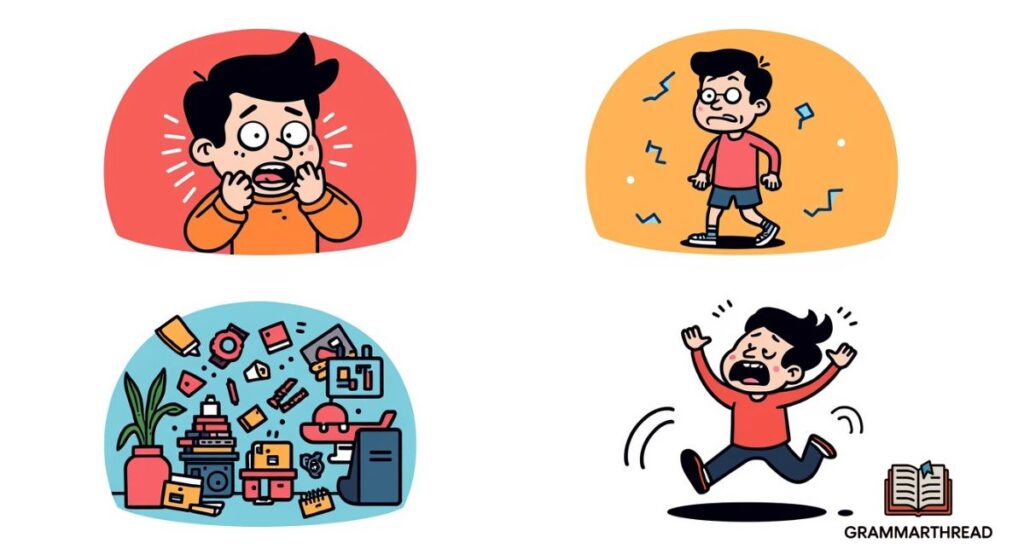
The opposite of calm can be sorted into distinct groups depending on which quality of peacefulness they contradict. Each group captures a unique dimension of unrest or disruption.
Agitated Antonyms
These opposites paint a picture of someone who’s unsettled, bothered, or internally stirred up. They point to a missing sense of inner calm and typically show outward signs of fidgeting or tension.
Agitated words focus on the breaking of a peaceful mindset, bringing attention to mental or emotional strain. Terms like ‘rattled,’ ‘unsettled,’ and ‘frazzled’ belong here.
These words often describe people who are fighting to stay composed when facing challenges or pressure.
Excited Antonyms
These opposites reflect a condition of elevated energy, passion, and stimulation. They stand apart from the quietness and steadiness that define ‘calm.’ Excited words usually carry feelings of expectation, keenness, or joy.
Terms like ‘enthusiastic,’ ‘energized,’ and ‘pumped’ express this surge of emotion and movement. They commonly describe individuals anticipating something wonderful or feeling bursts of positive intensity.
Disturbed Antonyms
These opposites signal a condition of being interrupted, thrown off balance, or bothered. They suggest that peace and silence have been broken, usually by outside influences.
Disturbed words put emphasis on the loss of stability, creating feelings of discomfort or unrest. Terms like ‘unsettled,’ ‘bothered,’ and ‘restless’ fit this group.
They draw attention to how external pressures negatively affect someone’s internal equilibrium.
Violent Antonyms
These opposites portray a state of powerful force, hostility, and chaos. They sit at the furthest end from the gentleness and stillness of ‘calm.’ Violent words frequently suggest raw physical energy and upheaval, showing the most dramatic contrast to tranquility.
Terms like ‘turbulent,’ ‘fierce,’ and ‘wild’ belong in this category. They represent the strongest forms of disorder and commotion.
Anxious Antonyms
These opposites communicate a state of concern, jitters, and restlessness. They oppose the steadiness and mental clarity that come with ‘calm.’ Anxious words typically suggest dread of uncertainty or stress about what might go wrong.
Terms like ‘uneasy,’ ‘tense,’ and ‘on edge’ capture this sense of discomfort and expectation of trouble. They describe individuals who are consumed with possible dangers or obstacles and can’t settle their minds.
Real-World Examples of Calm’s Opposites
To show you how antonyms of calm work in practice, here are organized examples sorted by category. These samples reveal how each opposite word fits into various situations to express particular meanings.
Agitated Antonyms Examples
The table below shares sentence examples using agitated opposites of ‘calm.’ Every sample shows how these terms describe conditions of disturbance or inner turmoil.
| Antonym | Example Sentence |
| Perturbed | The unexpected change in plans perturbed him deeply. |
| Flustered | She got flustered when asked to speak without preparation. |
| Discomposed | The harsh criticism left him feeling discomposed. |
| Ruffled | Her confidence was ruffled by the dismissive comment. |
| Disturbed | He was disturbed by the strange sounds coming from upstairs. |
| Agitated | The passengers grew agitated after the third flight delay. |
| Upset | She looked visibly upset after reading the email. |
| Annoyed | He was annoyed by the repetitive questions. |
| Irritated | The scratchy fabric made her feel irritated all day. |
| Exasperated | The manager was exasperated by the team’s repeated mistakes. |
| Bothered | She appeared bothered by something nobody else noticed. |
| Worried | He was worried about making the rent payment on time. |
| Anxious | She felt anxious waiting for the medical results. |
| Uneasy | He felt uneasy walking through the empty parking garage. |
| Restless | The toddler was restless after being cooped up inside. |
| Fidgety | She turned fidgety sitting through the lengthy meeting. |
| Edgy | He was feeling edgy from lack of sleep. |
| Tense | The mood at the dinner table was noticeably tense. |
| Stressed | She was feeling stressed juggling work and family demands. |
| Frustrated | He grew frustrated trying to solve the technical problem. |
| Disquieted | The ominous message disquieted her throughout the evening. |
| Unsettled | She felt unsettled after hearing the concerning rumors. |
| Discomforted | He was discomforted by the prolonged awkward pause. |
| Displeased | She was displeased with how the situation was handled. |
| Discontented | He remained discontented despite getting the promotion. |
Excited Antonyms Examples
The table below offers sentence examples using excited opposites of ‘calm.’ These samples highlight how these words express elevated energy and positive anticipation.
| Antonym | Example Sentence |
| Thrilled | He was thrilled when his proposal got approved. |
| Animated | She became animated talking about her travel adventures. |
| Eager | The students were eager to start the field trip. |
| Enthusiastic | He was enthusiastic about launching the new initiative. |
| Exuberant | The fans were exuberant celebrating the playoff win. |
| Exhilarated | She felt exhilarated finishing her first marathon. |
| Elated | He was elated learning about his acceptance letter. |
| Jubilant | The crowd was jubilant when the results were announced. |
| Ecstatic | She was ecstatic discovering she’d won the contest. |
| Delighted | He was delighted running into a childhood friend. |
| Pleased | She was pleased seeing her garden in full bloom. |
| Happy | The kids were happy playing at the beach. |
| Joyful | The reunion was a joyful gathering of old friends. |
| Merry | They enjoyed a merry holiday feast together. |
| Cheerful | He maintained a cheerful attitude despite setbacks. |
| Lively | The festival atmosphere was incredibly lively. |
| Vibrant | The neighborhood had a vibrant arts scene. |
| Energetic | The puppy was energetic after its afternoon rest. |
| Dynamic | The startup had a dynamic and innovative culture. |
| Passionate | She was passionate about wildlife conservation. |
| Zealous | He was zealous in his commitment to social justice. |
| Fervent | She was a fervent advocate for education reform. |
| Ardent | He was an ardent collector of vintage guitars. |
| Avid | She was an avid fan of classic literature. |
| Impassioned | She delivered an impassioned plea for change. |
Disturbed Antonyms Examples
The table below presents sentence examples using disturbed opposites of ‘calm.’ These samples demonstrate how these words convey disruption or mental discomfort.
| Antonym | Example Sentence |
| Troubled | He was troubled by the investigative report findings. |
| Agitated | The customer became agitated over the billing error. |
| Disquieted | The eerie silence in the house disquieted her. |
| Unsettled | The conflicting stories left him feeling unsettled. |
| Disrupted | The presentation was disrupted by technical difficulties. |
| Interrupted | His concentration was interrupted by constant notifications. |
| Rattled | She was rattled by the unexpected confrontation. |
| Disconcerted | He was disconcerted by her sudden mood shift. |
| Bothered | She was bothered by the lingering headache. |
| Worried | He was worried about his daughter traveling alone. |
| Anxious | She felt anxious before the major exam. |
| Apprehensive | He was apprehensive about the dental procedure. |
| Nervous | She felt nervous stepping onto the stage. |
| Frightened | The child was frightened by the lightning storm. |
| Scared | He was scared walking through the haunted attraction. |
| Terrified | She was terrified watching the suspense thriller. |
| Alarmed | He was alarmed by the smoke detector going off. |
| Panicked | The shoppers panicked during the security alert. |
| Hysterical | She became hysterical witnessing the near collision. |
| Distressed | He was distressed learning about the company layoffs. |
| Miserable | She felt miserable dealing with the chronic pain. |
| Depressed | He was depressed throughout the gloomy winter months. |
| Despondent | She felt despondent about her career prospects. |
| Dismayed | He was dismayed by the project’s cancellation. |
| Unhappy | She was unhappy with the renovation outcome. |
Violent Antonyms Examples
The table below displays sentence examples using violent opposites of ‘calm.’ These samples show how these words describe powerful force and extreme disruption.
| Antonym | Example Sentence |
| Tumultuous | The hurricane brought tumultuous seas and flooding. |
| Stormy | They endured a stormy partnership filled with conflict. |
| Frenzied | The shoppers became frenzied during the clearance sale. |
| Turbulent | The airplane encountered turbulent air pockets. |
| Tempestuous | The board meeting was tempestuous and confrontational. |
| Riotous | The celebration turned riotous after midnight. |
| Chaotic | The emergency room was chaotic during the crisis. |
| Disorderly | The protest became disorderly and required police intervention. |
| Unruly | The passengers were unruly during the delayed flight. |
| Rampant | Misinformation was rampant on social media platforms. |
| Raging | The wildfire was raging through the forest. |
| Ferocious | The dog displayed a ferocious bark at strangers. |
| Savage | The criticism in the review was savage and cutting. |
| Vehement | She voiced a vehement disagreement with the policy. |
| Fierce | The rivalry between the teams was fierce. |
| Intense | The negotiations were intense and exhausting. |
| Extreme | The drought conditions were extreme this season. |
| Violent | The demonstration turned violent near the courthouse. |
| Aggressive | His sales tactics were overly aggressive. |
| Belligerent | He became belligerent after a few drinks. |
| Combative | She adopted a combative stance during the debate. |
| Quarrelsome | He developed a quarrelsome reputation at work. |
| Wrathful | She responded in a wrathful manner to the accusation. |
| Furious | He was furious discovering the billing fraud. |
| Enraged | She was enraged by the discriminatory treatment. |
Anxious Antonyms Examples
The table below lists sentence examples using anxious opposites of ‘calm.’ These samples illustrate how these words capture states of worry and nervous tension.
| Antonym | Example Sentence |
| Apprehensive | He was apprehensive about the risky investment. |
| Worried | She was worried about her son’s overseas deployment. |
| Nervous | He felt nervous meeting his future in-laws. |
| Anxious | She was anxious before the job evaluation. |
| Uneasy | He felt uneasy about the sudden leadership change. |
| Restless | She was restless throughout the overnight train ride. |
| Fidgety | He became fidgety in the waiting room. |
| Edgy | She was feeling edgy after the tense conversation. |
| Tense | The courtroom atmosphere was tense during testimony. |
| Stressed | He was feeling stressed managing multiple projects. |
| Frustrated | She was frustrated by the bureaucratic delays. |
| Concerned | He was concerned about the company’s financial health. |
| Distressed | She was distressed hearing about the natural disaster. |
| Perturbed | He was perturbed by the last-minute schedule changes. |
| Agitated | She became agitated searching for her misplaced passport. |
| Disquieted | He was disquieted by the threatening voicemail. |
| Unsettled | She felt unsettled by the office gossip. |
| Frightened | The child was frightened by the barking dog. |
| Scared | He was scared of public speaking situations. |
| Terrified | She was terrified of flying in small planes. |
| Alarmed | He was alarmed by the security breach notification. |
| Panicked | The hikers panicked when they realized they were lost. |
| Hysterical | She became hysterical after the frightening incident. |
| Overwrought | He was overwrought dealing with family drama. |
| Beset | She was beset by financial worries and health concerns. |
How to Use Antonyms of Calm Correctly
When picking antonyms of ‘calm,’ you need to think about the situation and the exact shade of meaning you’re trying to express. Here are some practical guidelines to follow:
- Match intensity levels: Pick an opposite that fits how severe the situation is. For instance, use “unsettled” when describing minor disruption and “chaotic” when things are completely out of control.
- Think about what caused it: Certain opposites suggest something outside triggered the state (like “disrupted”), while others point to feelings that come from within (like “worried”). Use the word that correctly identifies where the unrest originated.
- Watch the tone: Some opposites carry heavy negative weight (like “violent”), whereas others can feel more neutral or even positive (like “enthusiastic”). Pick the term that matches the mood you’re creating in your message.
- Don’t pile on similar words: Stay away from stacking multiple opposites that basically say the same thing. Go with the sharpest and most powerful single choice.
- Create contrast for impact: Opposites work great when you want to highlight the absence of peace. For instance, “The previously calm neighborhood erupted into chaos within minutes.”
Keeping these guidelines in mind will help you select the best opposite for ‘calm’ in whatever context you’re working with, making sure your message comes across clearly and powerfully.
Mistakes People Make With Calm’s Opposites
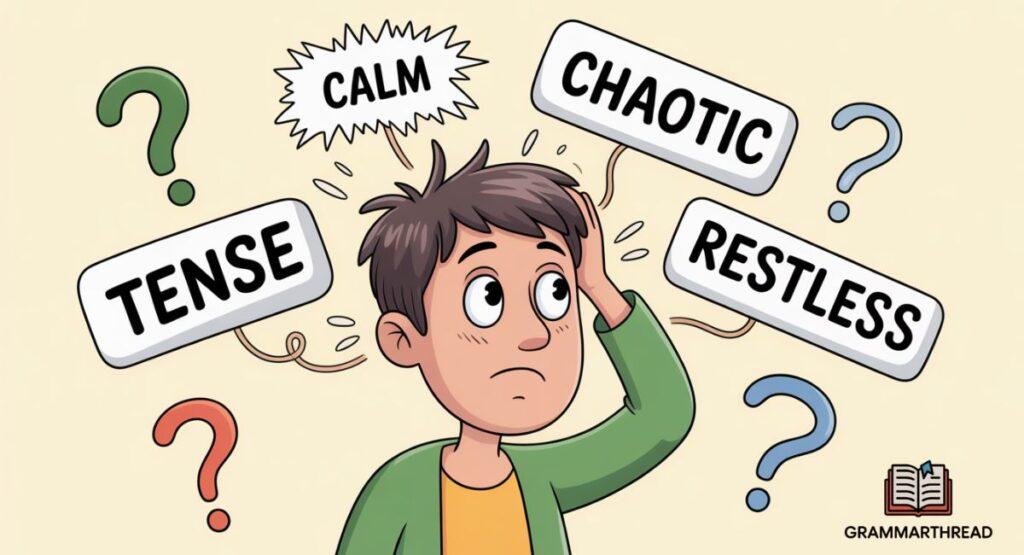
Even people who speak English fluently occasionally stumble when choosing antonyms of ‘calm.’ Here are typical errors and strategies to steer clear of them:
Picking the wrong strength level: Selecting an opposite that’s either too intense or too mild for what you’re describing.
• Incorrect: “She was hysterical over the small typo.”
• Correct: “She was bothered by the small typo.”
Mixing up similar words: Using opposites that share some overlap in meaning but carry different emotional weight.
• Incorrect: “He was thrilled about the disappointing results.”
• Correct: “He was dismayed about the disappointing results.”
Using the wrong register: Choosing overly casual or stiff opposites when the situation calls for something different.
• Incorrect (Formal): “The audience got super pumped during the lecture.”
• Correct (Formal): “The audience became engaged during the lecture.”
Forgetting about context: Not paying attention to the surrounding words when selecting an opposite.
• Incorrect: “The calm ocean was serene.” (This is redundant, not contrasting)
• Correct: “The calm ocean became rough.”
Staying alert to these frequent slip-ups will help you dodge mistakes and apply opposites of ‘calm’ with greater skill and accuracy.
Practice Exercises
Put your knowledge of antonyms for ‘calm’ to the test with these practice exercises. Select the best opposite from the choices given to complete each sentence correctly.
Exercise 1: Fill in the Blanks
| Question | Options | Answer |
| 1. Following the heated argument, he was far from __________. | (a) calm (b) disturbed (c) relaxed (d) tranquil | (b) disturbed |
| 2. The fans were __________ when their favorite team entered the stadium. | (a) calm (b) enthusiastic (c) serene (d) still | (b) enthusiastic |
| 3. The sudden crash __________ everyone in the quiet library. | (a) calmed (b) startled (c) relaxed (d) settled | (b) startled |
| 4. The __________ weather conditions forced the cancellation of all flights. | (a) calm (b) gentle (c) turbulent (d) peaceful | (c) turbulent |
| 5. She felt increasingly __________ waiting for the medical test results. | (a) calm (b) worried (c) comfortable (d) tranquil | (b) worried |
| 6. The previously __________ neighborhood turned into a construction zone overnight. | (a) stormy (b) quiet (c) disrupted (d) peaceful | (c) disrupted |
| 7. Despite everyone’s efforts to reassure him, he stayed surprisingly __________. | (a) relaxed (b) peaceful (c) collected (d) panicked | (d) panicked |
| 8. The homeowner grew more __________ watching the storm approach. | (a) settled (b) composed (c) alarmed (d) placid | (c) alarmed |
| 9. The __________ mood at the meeting made everyone uncomfortable. | (a) pleasant (b) relaxed (c) strained (d) gentle | (c) strained |
| 10. The kids were anything but __________ after eating all that candy. | (a) tired (b) calm (c) energetic (d) sleepy | (a) tired |
Exercise 2: Sentence Completion
Complete the following sentences using an appropriate antonym for ‘calm’.
| Question | Answer |
| 1. Rather than staying calm, she grew more __________ with each passing minute. | anxious/stressed |
| 2. The typically calm horse turned __________ when thunder rumbled overhead. | spooked/agitated |
| 3. The __________ waves crashed against the shore with tremendous force. | violent/fierce |
| 4. He remained __________ throughout the entire presentation, his hands shaking visibly. | nervous/tense |
| 5. The __________ spectators erupted in celebration when the final whistle blew. | ecstatic/thrilled |
| 6. The usually __________ office environment descended into chaos during the power outage. | orderly/organized |
| 7. Rather than showing a __________ response, she reacted with a __________ and defensive tone. | hostile/aggressive |
| 8. The unexpected announcement left everyone feeling __________ about their job security. | uneasy/apprehensive |
| 9. The formerly calm street became __________ once the festival crowds arrived. | hectic/chaotic |
| 10. The __________ storm swept across the coast, damaging homes and flooding streets. | ferocious/raging |
Advanced Topics: Nuances and Connotations
When you reach an advanced level, grasping the fine distinctions and emotional undertones of antonyms for ‘calm’ becomes essential for clear and effective expression. Take “restless” and “frazzled” as examples both point to an unsettled condition, yet “restless” suggests physical fidgeting and an inability to stay still, while “frazzled” indicates mental exhaustion and being emotionally worn down.
In the same way, “enthusiastic” typically brings positive associations, whereas “hysterical” usually signals something negative a loss of emotional control. Recognizing these delicate variations helps you select exactly the right word to express what you actually mean.
Another sophisticated element involves understanding how your setting shapes which opposite you should use. When talking about someone’s feelings, “tense” works well, but when describing weather or natural settings, “fierce” or “tempestuous” might be the better fit.
Additionally, think about how formal your situation is. In professional or academic writing, terms like “disquieted” or “disconcerted” often sound more appropriate, whereas in everyday conversation, simpler choices like “on edge” or “rattled” feel more natural.
Real-Life Scenarios Where ‘Calm’ and Its Antonyms Change Meaning
The meaning of ‘calm’ and its opposites can shift dramatically depending on the real-world situation you’re describing. Understanding these contextual changes helps you communicate more accurately and avoid awkward misunderstandings.
Medical Settings
In healthcare environments, “calm” takes on life-or-death significance. A doctor might say a patient is “calm” to indicate stable vital signs and no distress. However, if that same patient becomes “agitated,” it could signal pain, confusion, or a medical emergency requiring immediate attention. Meanwhile, “anxious” in this context specifically points to pre-procedure nervousness rather than general worry.
Weather and Nature
When describing natural conditions, the opposites of calm carry physical weight. A “calm” morning means still air and glassy water, perfect for sailing. But when conditions turn “violent” or “turbulent,” you’re talking about dangerous force crashing waves, howling winds, or conditions that threaten safety. “Stormy” specifically suggests rain and thunder, not just wind.
Workplace Dynamics
In professional settings, “calm” often means controlled and professional. If a meeting atmosphere becomes “tense,” it signals underlying conflict or high stakes. When someone is “stressed,” they’re overwhelmed by workload. But if they’re “frantic,” they’ve lost their ability to prioritize and function effectively. Each term carries distinct implications for how colleagues should respond.
Parent-Child Interactions
With children, “calm” means cooperative and emotionally regulated. A “restless” child is simply energetic and needs movement. An “agitated” child is building toward a meltdown and needs intervention. An “excited” child is positively stimulated, which is healthy in moderation. Parents quickly learn these distinctions matter when choosing how to respond.
Social Gatherings
At events, “calm” might actually feel boring or flat. An “animated” party is lively and engaging exactly what you want. But if things become “chaotic” or “riotous,” the energy has crossed into unmanageable territory. “Enthusiastic” describes positive group energy, while “frenzied” suggests things have spiraled beyond control.
Recognizing how context reshapes these words allows you to read situations accurately and choose language that matches the reality you’re describing.
Frequently Asked Questions
What is the opposite of calm?
The opposite of calm includes words like tense, anxious, restless, or chaotic.
What word describes someone who is not calm?
A person who is not calm can be described as nervous, agitated, or stressed.
What is the opposite of calm in English?
Common opposites include excited, frantic, uneasy, or disturbed.
What do you call a situation that is not calm?
You can call it chaotic, noisy, tense, or out of control.
What is a stronger opposite of calm?
Intense words like frantic or panicked work as stronger opposites.
What’s the opposite of feeling calm?
Feeling anxious, worried, or unsettled expresses the opposite state.
What is another term for not being calm?
Terms like jittery, jumpy, or uneasy describe a lack of calm.
What is the opposite of calm behavior?
Calm behavior contrasts with impulsive, restless, or heated behavior.
What’s the opposite of a calm environment?
A busy, loud, or chaotic environment is its clear opposite.
Conclusion
Understanding how to use the opposite of calm gives you more control over your language and helps you describe tense or energetic moments with accuracy. Once you know the shades of meaning behind these words and how they fit into different situations, your writing and conversations become clearer and more expressive.
Paying attention to context and intensity makes a big difference, and avoiding common mix ups keeps your message sharp. Keep exploring new terms, notice how they appear in everyday speech, and practice using them in your own sentences. Try a few examples today and see how your communication improves.
Read Next: Other Ways to Say Just a Friendly Reminder: Meaning & Examples

Welcome to GrammarThread. I am Julian Mercer, an AI-powered SEO and content writer with 4 years of experience. I help websites rank higher, grow traffic, and look amazing. My goal is to make SEO and website design simple and effective for everyone. Let’s achieve more together!