
“Deem Fit” might sound a bit formal at first, but it’s one of those phrases you’ll hear everywhere once you start looking for it. When someone in a position of responsibility chooses an action they deem fit, they’re relying on informed judgment rather than a rigid rulebook. Think of a supervisor adjusting a workflow, or an HR manager selecting the most suitable candidate each decision reflects what feels appropriate in that moment.
Understanding this phrase matters because it highlights how professionals balance guidelines with real-world nuance. Whenever you’ve had to make a call based on context rather than instructions, you’ve used the same logic. Exploring how “Deem Fit” works in daily communication can help you write clearer policies, navigate workplace decisions, and interpret authority with confidence.
Where You’ll Actually See “Deem Fit” Being Used
The phrase “deem fit” shows up most often in professional settings where someone needs to make a judgment call or exercise their authority. It’s the go-to expression when decisions require discretion. You’ll typically find it in:
- Legal texts: Court rulings, statutory regulations, and judicial orders
- Official government communications: Administrative directives and public policy statements
- Corporate documentation: Employee handbooks, service agreements, organizational charters
- Higher education materials: Institutional policies and faculty committee resolutions
Real-World Usage Examples
| Setting | How It’s Used |
| Legal | The judge may apply sanctions deemed fit under current law. |
| Government | Authorities shall take measures deemed fit to ensure community welfare. |
| Business | The board retains authority to implement modifications deemed fit. |
| Academic | The committee may introduce policy adjustments deemed fit for student welfare. |
How “Deem Fit” Works Grammatically
Getting a handle on the grammatical mechanics of “deem fit” makes it easier to use confidently in formal communication.
Working with Different Tenses and Voices
- Present Tense: The committee deems it fit to postpone the meeting.
- Past Tense: She deemed it fit to withdraw her application.
- Passive Voice: The proposal was deemed fit for approval.
Building Your Sentences
- With an object: The panel deemed the candidate fit for promotion.
- Without an object: Leadership responded as they deemed fit.
Quick Writing Tip
Don’t overcomplicate your phrasing. Straightforward language works best, particularly in professional and legal contexts where clarity matters most.
“Deem Fit” in Legal and Official Contexts
Within legal frameworks, “deem fit” holds considerable authority. It’s frequently employed to indicate judicial flexibility or institutional decision-making power.
Typical Legal Phrases
- “As the authority may deem fit”
- “When deemed fit by the court”
- “Such measures deemed fit given the situation”
These phrasings grant judges, legal professionals, and policymakers the flexibility to decide and respond according to evidence, legislation, and surrounding circumstances.
Quote: “The tribunal possesses the authority to implement such measures as it may deem fit and appropriate.” – Supreme Court of India
Real Court Cases Using “Deem Fit”
Let’s look at how “deem fit” has appeared in actual legal proceedings:
Case: ABC Ltd. v. DEF Industries (2020)
- Jurisdiction: UK High Court
- Usage: “The court may grant whatever remedies it deems fit to ensure fairness.”
- Outcome: This wording allowed the court flexibility to order equitable relief beyond damages, including restraining orders.
Case: Federal Trade Commission v. Smith Enterprises (2019)
- Jurisdiction: US Federal Court
- Usage: “The commission may pursue whatever enforcement measures it deems fit.”
- Outcome: Regulators gained authority to impose financial penalties and mandate cessation of violating practices.
“Deem Fit” vs. “See Fit”: What’s the Difference?
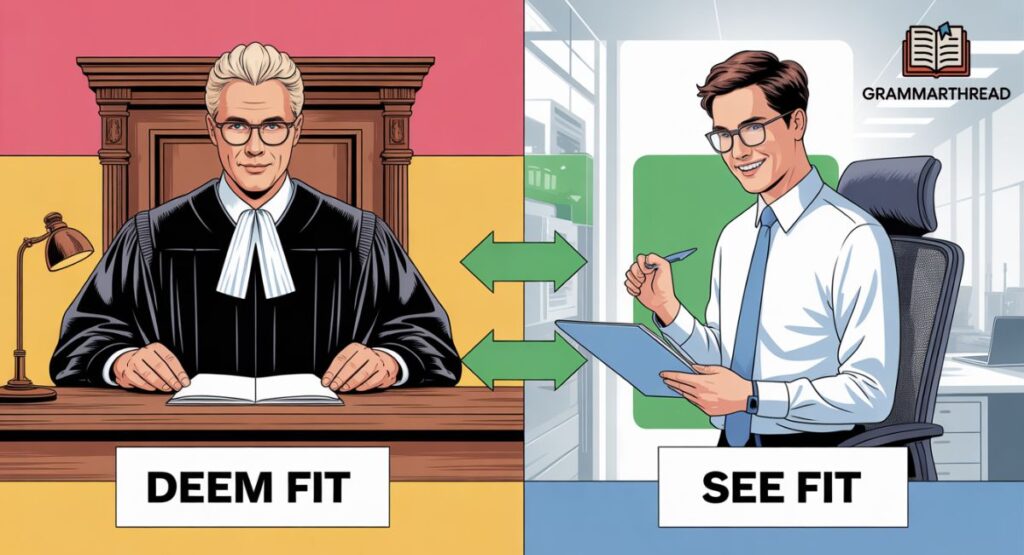
While “deem fit” and “see fit” appear similar on the surface, they carry distinct nuances worth understanding.
| Expression | Formality Level | Tone | Where It’s Used |
| Deem Fit | High | Formal, authoritative | Legal texts, official records, corporate policies |
| See Fit | Medium | Conversational, adaptable | Daily communication, professional emails, general business |
Comparison Examples
- The judge deems it fit to grant bail. ✔
- You can proceed as you see fit. ✔ (More relaxed)
Tip: Stick with “deem fit” when drafting formal documents and switch to “see fit” for everyday professional exchanges.
“Deem Fit” vs. “Deem Fit and Proper”: Are They the Same?
Not quite. These expressions carry different implications and are used in distinct ways.
Key Distinctions
- Deem fit: Appropriate for a particular circumstance.
- Deem fit and proper: Appropriate in both capability and ethical standards – commonly found in compliance language.
Side-by-Side Comparison
| Expression | Found In | What It Means |
| Deem fit | Employment policies, judicial rulings | Acceptable or reasonable choice |
| Deem fit and proper | Banking oversight, professional licensing | Qualified in skills and integrity |
Regulatory Example: The Securities and Exchange Commission mandates that individuals in leadership positions be deemed fit and proper before approval.
Can You Use “Deem Fit” and “Deemed Fit” Interchangeably?
Not really. The distinction comes down to timing and grammatical voice.
- “Deem fit” = Current tense, active construction
- “Deemed fit” = Past form, passive construction or completed action
Usage Examples
- The board deems him fit for the position. ✔ (Present moment)
- He was deemed fit following the review. ✔ (Already happened)
Choosing the incorrect form can shift your sentence’s timeframe or emphasis. In formal or legal contexts, this matters because it can affect how your message is understood or interpreted.
Practical Sentence Examples of “Deem Fit”
Here’s how “deem fit” appears across different professional fields:
Legal
- The tribunal may apply whatever sanctions it deems fit.
- Remedies shall be as the magistrate deems fit and equitable.
Business
- Leadership retains authority to implement modifications it deems fit.
- Your role may be adjusted as deemed fit by senior management.
Government
- The Governor may convene the assembly as she deems fit.
- Authorities may enforce measures deemed fit to preserve public safety.
Academic
- The panel will decide consequences it deems fit for violations.
- Learners may be reassigned when deemed fit by the dean’s office.
Matching Tone and Formality to Your Audience
This phrase carries a distinctly professional tone and works best in:
- Legal communications
- Formal institutional notices
- Contractual agreements or regulations
- High-level organizational announcements
Keep it out of personal messages, everyday chats, or casual online posts.
Simpler Option for Everyday Situations: Rather than writing “I deem it fit to participate,” go with “I believe it’s appropriate to participate.”
Alternative Phrases and Synonyms
If you’re adjusting your style or speaking to a different audience, these alternatives to “deem fit” can work well:
Comparable Terms (Context-Dependent)
- Regard as appropriate
- View as suitable
- Assess as acceptable
- Conclude as proper
- Authorize
Similar Phrases
- As one thinks best
- At one’s own discretion
- In one’s opinion
- As circumstances require
Common Errors to Avoid

Watch out for these frequent mistakes when using “deem fit”:
- ✅ Incorrect: She deems fit to cancel the event. ❌ Object is missing
✔ Correct: She deems it fit to cancel the event. - ✅ Incorrect: They deemed fit the proposal. ❌ Improper placement
✔ Correct: They deemed the proposal fit. - ✅ Incorrect: I deem fit that’s unnecessary. ❌ Broken construction
✔ Correct: I deem that unnecessary.
Tip: “Deem” requires a direct object – so say “deem it fit” or place your object between “deem” and “fit.”
Simplifying “Deem Fit” for Today’s Business Writing
Sometimes “deem fit” sounds overly stiff. Here’s how to adjust for better readability or a lighter tone:
| Original Phrase | Updated Version |
| Measures will be taken as deemed fit. | We’ll implement suitable measures. |
| The applicant was deemed fit for hire. | The applicant was cleared for hiring. |
| Adjustments shall be made as deemed fit. | Adjustments will be made as needed. |
Reserve “deem fit” for situations where formal language truly fits the setting and purpose.
Where “Deem Fit” Comes From: A Brief History
The expression “deem fit” has deep roots in English legal and administrative language, dating back several centuries.
Origins in Old English and Law
The word “deem” comes from the Old English “dēman,” meaning to judge or form an opinion. It was commonly used in early legal proceedings where authorities needed to express judgment or make determinations.
Evolution Through Legal Systems
- Medieval courts: Judges used “deem” to indicate their rulings and assessments.
- 17th-18th centuries: The phrase “deem fit” became standardized in British legal documents and royal decrees.
- Colonial influence: English common law spread the expression to former colonies, including the United States, India, and Commonwealth nations.
Modern Usage
Today, “deem fit” remains embedded in legal frameworks worldwide. While everyday English has moved toward simpler alternatives, the phrase retains its authority in formal settings where discretion and judgment must be clearly documented.
Notable shift: Modern business communication increasingly favors plainer language, but “deem fit” persists in contexts requiring traditional formality or legal precision.
Frequently Asked Questions
What does “deem fit” mean?
It means deciding something is appropriate or suitable based on judgment rather than strict rules.
When should I use the phrase “deem fit”?
Use it in formal or professional writing when someone in authority makes a discretionary decision.
Is “deem fit” a legal term?
It’s commonly used in legal contexts to show that a judge or official is acting within their judgment.
What’s the difference between “deem fit” and “see fit”?
Both mean choosing what’s appropriate, but “see fit” is slightly more casual.
Can I use “deem fit” in everyday conversation?
You can, but it may sound formal; it works best in official or structured communication.
Does “deem fit” mean someone is qualified?
Not exactly it means something is considered suitable, not necessarily that a person is qualified.
Why does “deem fit” sound formal?
Because it’s often used in legal, governmental, and policy language where precision matters.
Is “deemed fit” just past tense?
Yes, it refers to something previously judged or considered appropriate.
Conclusion
The phrase “deem fit” carries weight because it blends authority with thoughtful judgment, making it a staple in legal, corporate, and policy-driven writing. Understanding what it means, where it comes from, and when to use it helps you communicate with precision. It also prevents common mix-ups between variations like deemed fit or see fit, which can shift tone and clarity.
When you choose this phrase intentionally, your writing feels more credible and professionally aligned with decision-making contexts. As you draft your next memo, policy, or formal document, try applying these insights and see how your wording strengthens once you use deem fit with purpose.
Read Next: Opposite of Calm: The Most Effective Antonyms with Clear Examples

Welcome to GrammarThread. I am Julian Mercer, an AI-powered SEO and content writer with 4 years of experience. I help websites rank higher, grow traffic, and look amazing. My goal is to make SEO and website design simple and effective for everyone. Let’s achieve more together!