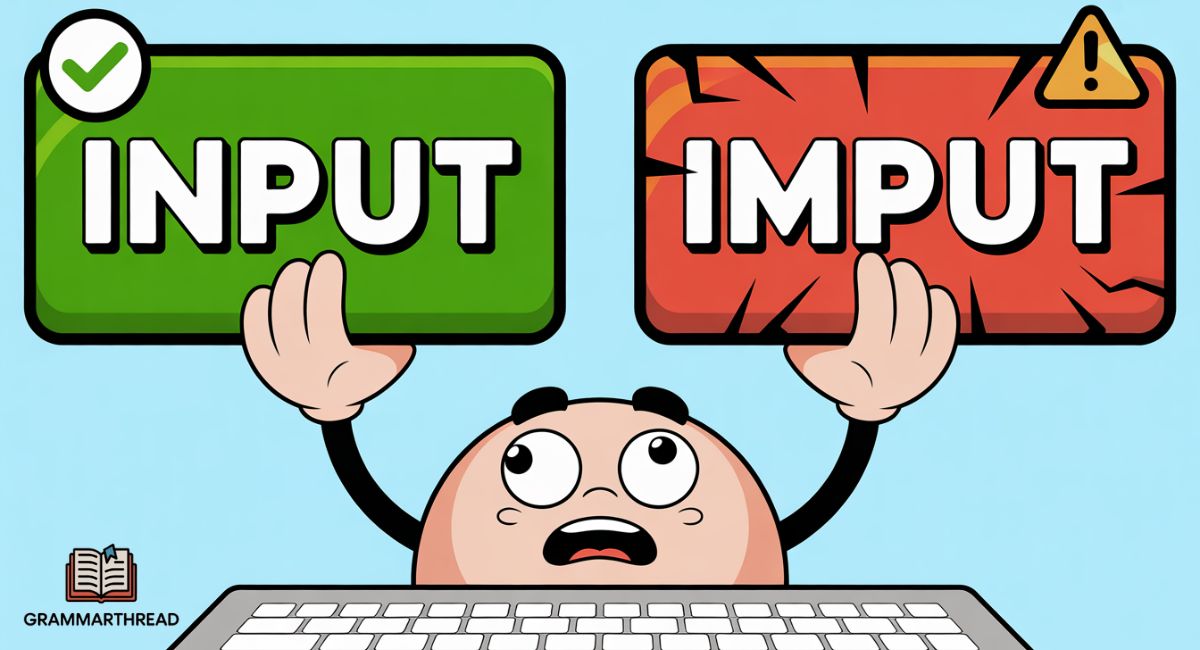
In today’s fast-moving online world, small spelling mistakes can leave a bigger impression than you expect. One of the most common examples is Input or Imput, a tiny difference that can quietly affect how professional or careful you appear. Many people type quickly, trust autocorrect, and move on without noticing the error until it is too late. You may have seen it in emails, forms, comments, or even work documents.
If you have ever paused to check whether “input” looks right, you are not alone. This confusion happens because the words sound similar when spoken, but only one is correct. In daily writing, business communication, and digital tasks, using the right spelling matters more than most people realize.
This guide breaks down the correct usage, explains why “imput” is wrong, and helps you avoid this mistake with confidence.
Input Is the Only Correct Spelling – Here’s Why
Let’s get straight to the point: “Input” is the only proper way to spell this word. “Imput” is simply a mistake one that happens when people mishear the word, pronounce it quickly, or rely too heavily on spellcheck that doesn’t catch everything.
You’ll find “input” in every reputable dictionary. “Imput,” on the other hand? It doesn’t appear in any credible language reference or grammar guide.
Quick reference:
| Word | Is it Correct? | Definition |
| Input | Yes | Data or information fed into a system, or contributions shared in a discussion or decision-making process. |
| Imput | No | Not a recognized word in English. Typically results from typos or misheard speech. |
Why “Imput” Seems Correct (Even Though It Isn’t)
Have you ever typed “imput” while working on a project and wondered why it looked wrong?
The reason is simple: “imput” comes from phonetic mix-ups, where the way we pronounce words doesn’t always align with their actual spelling.
What’s Behind This Common Error?
- Mispronunciation: Many people pronounce it as “im-put,” which makes the “n” sound disappear entirely.
- Fast-paced speech: When talking quickly or using certain regional accents, “input” naturally morphs into something that sounds like “imput.”
- Unreliable autocorrect: Older keyboard apps and text editors sometimes failed to flag “imput” as incorrect, letting the mistake slip through.
The Origins of “Input” – Where This Word Comes From
Knowing where “input” comes from can help you remember the correct spelling and use it with confidence.
- First appearance: The word emerged in the early 1900s
- Word formation: Created by joining “in” and “put” together
- Common contexts: Technology, computing, data entry, and everyday discussions about feedback or contributions
The term “input” essentially means placing something inside a system or process. When you look at it this way, the spelling becomes completely logical and easy to remember.
Can “Input” Be a Noun and a Verb? (Yes, It’s Both)
“Input” is one of those versatile words that works as both a noun and a verb, depending on how you use it in a sentence.
Examples of “Input” as a Noun
| Sentence | Explanation |
| “We appreciate your input during the meeting.” | “Input” means contribution, advice, or suggestions from someone. |
| “A mouse is a common input device for computers.” | It describes equipment that sends information into a system. |
Examples of “Input” Used as a Verb

| Sentence | Explanation |
| “Please input your login details to access the account.” | “Input” functions as an action word meaning to type or enter information. |
| “He input all the numbers before closing the file.” | Shows “input” being used in past tense form. |
Grammar Tip: When writing in past tense, “input” is the preferred choice over “inputted.”
Correct: He input the code yesterday.
Also Acceptable: He inputted the code yesterday. (though less frequently used)
How “Input” Is Used in Technology and Computing
This is where the word truly comes into its own.
“Input” plays a critical role in tech, especially across areas like:
- Software development
- Data analytics
- User experience design
- Mobile and web applications
Common “Input” Terms in Tech:
| Term | Meaning |
| Input Device | Hardware designed to send data into a computer (like a keyboard, scanner, or trackpad) |
| User Input | Data or commands provided by someone using software or an app |
| Input Field | A box or space in an interface where users type information |
| Data Input | The process of entering numbers, text, or instructions into a program |
“A system without input is like a car without fuel it has potential but can’t move forward.” Tech wisdom
2 / 2
Using “Input” in Communication and Professional Environments
Beyond technology, “input” is commonly heard in workplaces, classrooms, and everyday discussions.
Examples:
- “Your input on this proposal would be really valuable.”
- “The manager asked everyone to share their input before finalizing the plan.”
- “Customer input played a key role in redesigning our website.”
So What About “Imput”? Let’s Settle This: It’s Not Valid
Regardless of context or circumstance, “imput” is simply incorrect. You won’t find it recognized in:
- Merriam-Webster
- Oxford English Dictionary
- Cambridge Dictionary
- Google Ngram Viewer (shows virtually no legitimate usage)
Whenever you encounter “imput,” you can safely assume it’s an error whether from a typing slip or someone mishearing the word.
Real Examples: Where “Imput” Actually Appears (And Causes Problems)
Let’s look at some actual situations where this spelling mistake showed up and what happened as a result.
Case Study: Company Newsletter Blunder
A consulting agency sent out a newsletter to 500 subscribers containing the line:
“Please share your imput on our upcoming services.”
Result: Several recipients pointed out the error, damaging the company’s reputation for attention to detail.
Lesson: Double-check your work. A single letter can undermine your credibility.
Case Study: Job Application Oversight
On a candidate’s resume:
“Handled daily data imput for inventory management systems.”
Result: The application was rejected because hiring managers saw it as careless and unprofessional.
Lesson: Always use “input.” Spelling mistakes on resumes are dealbreakers for most employers.
Side-by-Side Look: “Input” vs “Imput”
| Feature | Input | Imput |
| Spelling | Correct | Incorrect |
| Dictionary Recognition | Yes | No |
| Appropriate for Professional Documents | Yes | Never |
| Safe for Business Communication | Yes | No |
| Acceptable on Resumes | Yes | Avoid at All Costs |
Grammar Guide: How to Write “Input” in Past Tense
Many people get confused about the correct past tense form of “input.” Here’s what you need to know:
- Input (recommended): They input all the information last night.
- Inputted (correct but less common): She inputted the data before leaving the office.
Note: Leading style guides such as APA and the Chicago Manual of Style recommend using “input” for past tense rather than “inputted.”
Easy Memory Trick: Remember “Input” Every Time
Try this straightforward method:
“When you place something inside it’s ‘input.'”
This approach makes sense and helps you remember both the spelling and the meaning behind the word.
Can Spellcheckers Detect “Imput”? Here’s What to Know
Today’s writing tools like Grammarly, Microsoft Word, and Google Docs will usually catch “imput” as a mistake. However, automated checks aren’t foolproof.
Checklist to Prevent This Error:
- Review your writing yourself before hitting send
- Set up autocorrect to replace “imput” with “input” automatically
- Treat grammar checkers as helpful assistants, not substitutes for careful editing
What Language Experts Say About Spelling Accuracy
“Precision in language mirrors precision in thinking.” Noam Chomsky
“Mistakes in spelling during professional communication aren’t trivial they influence how others see you.” Anne Trubek, linguist and writer
“‘Input’ shows what you bring to the table. ‘Imput’ shows what you take away from your reputation.” Anonymous copy editor
How “Input” Is Used in Academic and Scientific Fields
“Input” frequently shows up in scholarly research and technical disciplines:
- Economics: “The analysis examined capital input relative to output efficiency.”
- Engineering: “Accurate input parameters are essential for system performance.”
- Psychology: “External input from the environment shapes behavioral patterns.”
It’s a well-established term that appears regularly in peer-reviewed publications and academic discourse.
The Importance of “Input” in SEO, User Experience, and Digital Marketing
In web content, app design, and online marketing, using accurate terminology is critical:
- In SEO: Terms like customer input, text input, and input data help search engines understand and rank your content.
- In UX design: Properly labeled “input boxes” improve usability and prevent user errors.
- In eCommerce: Input checks make sure customers provide valid information such as phone numbers or payment details.
Quick Reference: All the Key Facts in One Place
| Aspect | Input | Imput |
| Recognized Word | Yes | No |
| Grammar Function | Noun, Verb | N/A |
| Used in Technology | Yes | No |
| Grammatically Correct | Yes | No |
| Appropriate for Resumes | Yes | Never Use |
| Past Tense Form | Input / Inputted | N/A |
| Easy Recall Method | “Place in” = Input | N/A |
How to Pronounce “Input” (And Why It Leads to Spelling Mistakes)
Understanding the correct pronunciation of “input” can help you avoid common spelling errors.
The Correct Pronunciation:
- Standard pronunciation: /ˈɪn.pʊt/ (IN-put)
- Emphasis: The stress falls on the first syllable “IN”
- The “n” sound: This is clearly pronounced between the two syllables
Why Pronunciation Creates Confusion:
- Fast speech: When people talk quickly, the “n” can blend into the following sound, making it sound like “im-put.”
- Regional accents: Certain dialects naturally soften or drop the “n” sound during casual conversation.
- Nasal sounds: The transition from “n” to “p” happens quickly in your mouth, which can make the “n” less distinct when spoken aloud.
This phonetic blending is why many people mistakenly write “imput” even though they’re saying the word correctly. Slowing down and emphasizing that “n” sound when you speak can reinforce the proper spelling in your mind.
Frequently Asked Question
Is it input or imput?
The correct spelling is input. Imput is a common typing mistake and not a real English word.
Why do people confuse input with imput?
Because both sound similar when spoken and fast typing often leads to spelling slips.
Is imput ever correct in English?
No. Imput does not appear in dictionaries and is always considered an error.
What does input mean in simple words?
Input means putting information, data, or ideas into a system, form, or discussion.
Is input a noun or a verb?
Input works as both. You can give input or input data into a system.
Does spellcheck catch imput?
Most modern spellcheck tools flag imput as incorrect, but some may miss it in casual writing.
Is input used in technology?
Yes. Input is widely used in computing for data entry devices and user actions.
Conclusion
When deciding between input or imput, the answer is straightforward. Only “input” is correct. It is a real word with a clear meaning, a solid origin, and wide use in everyday language, technology, education, and business.“Imput” appears only as a typing slip or a sound based mistake and has no place in proper writing. Getting this right protects your credibility and keeps your message clear. A simple reminder helps: if you are putting something in, you are giving input. Before you hit send or publish, take a second look. That small habit can sharpen your writing and make your communication more confident and professional.
Read Next: Deepest Sympathy – Definition, Meaning & Examples

Welcome to GrammarThread. I am Julian Mercer, an AI-powered SEO and content writer with 4 years of experience. I help websites rank higher, grow traffic, and look amazing. My goal is to make SEO and website design simple and effective for everyone. Let’s achieve more together!