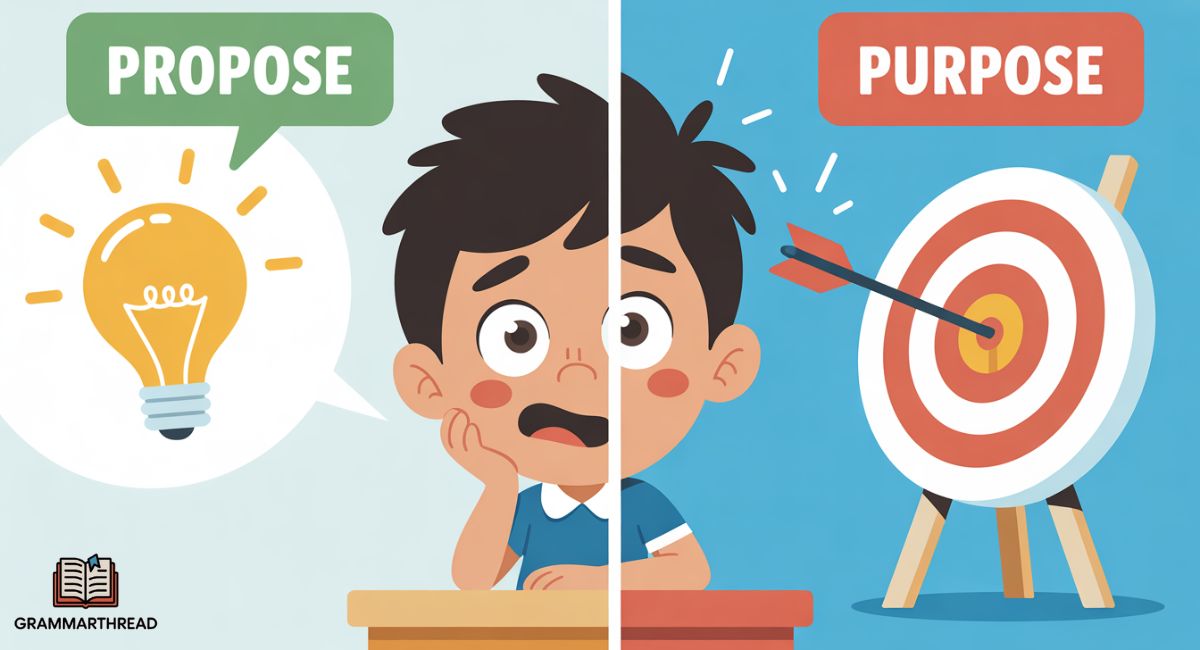
In everyday writing, one of the easiest mistakes to make is mixing up ideas and intent. That is exactly where the confusion in Propose vs. Purpose begins. If you have ever written a class assignment, a work email, or a formal document and paused over phrases like proposal for or proposal of, you are not alone. These words sound close, but they guide the reader in very different directions.
Understanding this difference matters because small wording choices shape clarity. Saying what you plan to do is not the same as explaining why you are doing it. In real life, from student proposals to professional reports, this distinction affects tone, meaning, and credibility. Once you see how propose points to action and purpose points to intention, your writing becomes more precise and confident.
Understanding the Core Definitions of Propose and Purpose
Let’s get the fundamentals straight. While “propose” and “purpose” both relate to plans and reasoning, they serve completely different roles in how we communicate and structure our thoughts.
Here’s how they break down:
| Term | Part of Speech | Definition | Example Sentence |
| Propose | Verb | To put forward a suggestion or recommendation for others to think about | She plans to propose a new strategy during the conference. |
| Purpose | Noun | The underlying reason or goal that drives an action or existence | The purpose of our discussion is to find common ground. |
Key Difference:
- Propose = Something you actively do (an action word)
- Purpose = The motivation behind what you do (a concept or goal)
These two words aren’t swappable. When you propose something, you’re making a suggestion or presenting an idea. But behind every proposal, there should be a clear purpose the “why” that justifies your suggestion. Think of it this way: you propose with purpose, but you don’t purpose a plan. One is the action, the other is the driving force.
Digging into Etymology: Where Did These Words Come From?
Words carry history, and tracing their roots helps us grasp their true meanings. When you look at where “propose” and “purpose” originated, the distinction between them becomes crystal clear.
Propose
- Derives from the Latin word proponere, which translates to “to set forth.”
- Break it apart: Pro (ahead) + ponere (to position)
- Initially meant presenting an idea to others essentially laying out a suggestion for consideration.
Purpose
- Stems from the Latin propositum, which means “something set forth or planned.”
- Transformed into Middle English as purpos, then evolved into its current form.
- Over centuries, its meaning narrowed to focus on intent, reasoning, or the desired outcome.
This historical context reveals something important:
- Propose describes an active step you take.
- Purpose reflects a deeper reason or objective that drives behavior.
Knowing their etymological journey helps you see why one is about action while the other is about direction. They complement each other but serve entirely different functions in communication.
What Does “Propose” Really Mean in Context?
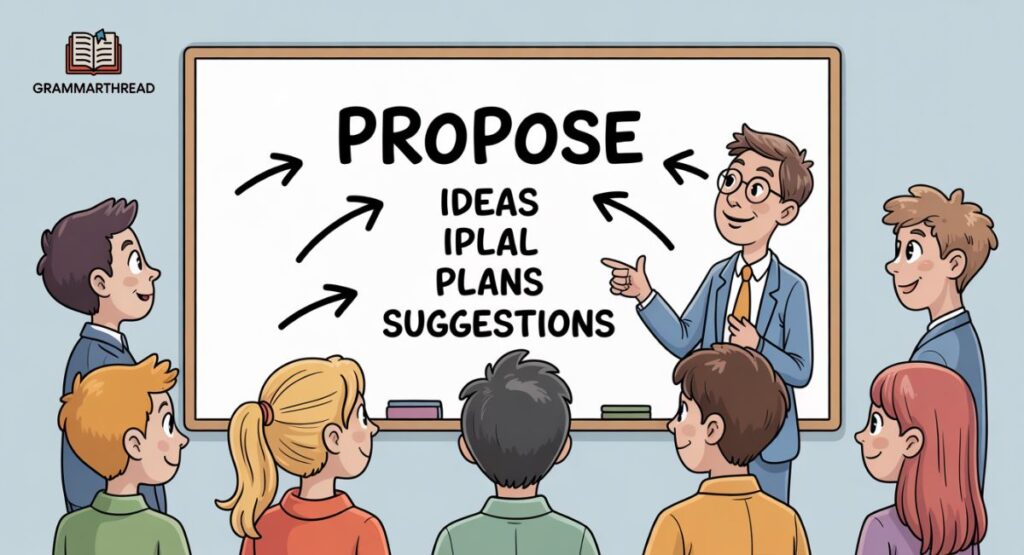
“Propose” functions as a verb, and it’s quite dynamic. It means to offer up a suggestion, present a recommendation, or introduce an idea for others to consider.
Common Situations Where “Propose” Is Used:
- Academic: Presenting a dissertation topic or research question.
- Professional: Introducing a marketing initiative, project roadmap, or financial forecast.
- Personal: Asking someone to marry you, or suggesting a weekend getaway.
Sample Sentences:
- The team leader proposed a creative solution to the workflow problem.
- They proposed to each other during a sunset beach walk.
- The researcher proposed a fresh method for analyzing consumer behavior.
Related Forms:
- Proposal (noun) – The formal suggestion or written plan you present.
- Proposer (noun) – The individual making the recommendation.
Idioms and Expressions:
- Propose a toast – Invite others to raise their glasses in celebration of someone.
- Propose a solution – Put forward an answer to resolve an issue.
- Propose legislation – Introduce a new bill or law for consideration.
Each usage shares the same core idea: you’re actively putting something forward. Whether it’s a business concept, a life commitment, or a celebratory gesture, “propose” always involves initiating action and inviting response.
What Does “Purpose” Mean and How Do We Use It?
“Purpose” serves as a noun. It represents the underlying reason, goal, or intention that explains why something exists or happens.
Common Uses of “Purpose”:
- Students: Identify the purpose of a research paper or lab assignment.
- Teachers: Clarify the purpose behind a curriculum choice or classroom exercise.
- Professionals: Ensure their work reflects a broader mission or personal calling.
Example Sentences:
- The purpose of this survey is to understand customer satisfaction.
- He discovered his purpose through volunteering at local shelters.
- Can you explain the purpose of scheduling this workshop?
Related Words:
- Purposeful – Acting with deliberate intent and focus.
- Purposeless – Operating without clear direction or meaning.
- On purpose – Doing something deliberately or knowingly.
Every action, decision, or project benefits from a well-defined purpose. It’s what transforms random activity into meaningful work. When you understand your purpose, you’re not just going through the motions you’re moving toward something that matters.
Propose vs. Purpose – Side-by-Side Comparison
Sometimes the best way to understand the difference is to see them side by side. This comparison table highlights exactly how “propose” and “purpose” differ across key dimensions:
| Feature | Propose | Purpose |
| Part of Speech | Verb | Noun |
| Function | Action – to put forward an idea | Reason – the driving force or objective |
| Example | We propose launching a new product line. | The purpose is to expand market reach. |
| Forms | Proposes, proposed, proposing | Purposes (plural) |
| Related Terms | Proposal, proposer | Purposeful, purposeless |
| Use in Speech | Active recommendation | Underlying rationale |
This visual breakdown makes it easier to remember: one involves doing something (propose), while the other explains why you’re doing it (purpose). When you grasp this fundamental split, mixing them up becomes nearly impossible.
Real-World Examples for Students, Teachers, and Professionals
Let’s see how “propose” and “purpose” show up in everyday scenarios across different roles, especially for audiences in the United States.
Students:
- Propose: “I propose we incorporate interviews into our sociology research.”
- Purpose: “The purpose of this presentation is to examine income inequality.”
Teachers:
- Propose: “I propose switching to collaborative group assignments.”
- Purpose: “This activity has a clear purpose: to strengthen problem-solving skills.”
Professionals:
- Propose: “We propose implementing a flexible remote work policy.”
- Purpose: “Our organization’s purpose is to support sustainable agriculture.”
Notice how in each case, “propose” involves making a concrete suggestion, while “purpose” explains the deeper reason or goal behind an action. Whether you’re in a classroom, boardroom, or research lab, understanding this distinction helps you communicate with greater precision and clarity.
Common Mistakes and Misuses (And How to Avoid Them)
Even confident English speakers sometimes confuse “propose” and “purpose.” Here are the most common slip-ups and how to steer clear of them:
Mistake #1: Treating “purpose” like an action word
Incorrect: I purpose a different approach. Correct: I propose a different approach.
In contemporary English, “purpose” doesn’t function as a verb in everyday communication.
Mistake #2: Using “propose” when describing intent
Incorrect: My propose for attending was to network. Correct: My purpose for attending was to network.
Mistake #3: Assuming “proposal” and “purpose” are interchangeable
Tip: A proposal outlines what you’re suggesting. A purpose clarifies why you’re suggesting it.
Understanding these distinctions prevents awkward phrasing and keeps your writing sharp. When in doubt, remember: if you’re offering an idea, use “propose.” If you’re explaining the reason behind something, reach for “purpose.” These small adjustments make a noticeable difference in how professional and polished your communication sounds.
Grammar Tips: Sentence Structures and Tenses
Understanding how “propose” and “purpose” fit into sentence structures makes your writing smoother and more natural.
“Propose” – Verb Usage:
- Simple Present: We propose a new direction.
- Past: He proposed an alternative approach.
- Present Continuous: The committee is proposing budget adjustments.
“Purpose” – Noun Usage:
- Paired with “of” constructions: The purpose of this workshop…
- Combined with infinitives: The purpose is to enhance collaboration.
Structure Examples:
- Subject + propose + noun: The team proposed a revised schedule.
- Subject + purpose + verb-ing: The purpose of this session is developing leadership skills.
Mastering these patterns helps you choose the right word instinctively. When you need an action verb that moves a conversation or project forward, “propose” fits perfectly. When you’re explaining the rationale or objective behind something, “purpose” provides that clarity. Practice using both in different tenses and contexts to build confidence.
Academic and Industry Use Cases
Both “propose” and “purpose” show up regularly in professional and academic contexts. Here’s how various industries apply these words in their everyday work:
| Field | Use of “Propose” | Use of “Purpose” |
| Academia | Propose a research question, theory | Purpose of study, investigation |
| Business | Propose strategies, expansion plans | Purpose of initiative, organizational vision |
| Law | Propose revisions, legislation | Purpose of statute, regulatory intent |
| Education | Propose pedagogical changes | Purpose of learning outcomes, course goals |
| Healthcare | Propose intervention protocols | Purpose of treatment, patient care objective |
Each field relies on these words differently, but the core distinction stays consistent. Professionals use “propose” when introducing recommendations or formal suggestions. They turn to “purpose” when articulating the why behind policies, projects, or procedures. Recognizing this pattern across industries helps you adapt your language to match professional standards, whether you’re writing a grant application, business memo, or policy brief.
How to Remember the Difference Between Propose and Purpose
You don’t have to study grammar rules for hours. These quick mental shortcuts make remembering the difference between “propose” and “purpose” effortless.
Mnemonics:
- Propose = “Present an Option”
- Purpose = “Point or reason”
Easy Tips:
- If you’re talking about offering or recommending something — reach for propose.
- If you’re explaining the motivation or goal behind something — go with purpose.
Another helpful way to think about it: “propose” has action built into it (you’re actively suggesting), while “purpose” sits quietly in the background as the guiding reason. Once you connect “propose” with forward movement and“purpose” with underlying meaning, the distinction becomes second nature. Try using each word in a sentence out loud a few times that muscle memory will stick with you far longer than any textbook definition.
Test Your Understanding: Mini Quiz
Ready to test yourself? This short quiz will show you whether you’ve mastered the difference between “propose” and “purpose.”
1. Choose the correct word: The team ______ a revised workflow during the brainstorming session.
- A) Purposed
- B) Proposed ✅
2. Choose the correct word: The ______ of this workshop is to build stronger communication skills.
- A) Propose
- B) Purpose ✅
3. True or False: “Purpose” functions as a verb in everyday English.
- False
How did you do? If you got all three right, you’ve nailed the distinction. If you missed one, don’t worry reviewing the examples throughout this guide will reinforce what you’ve learned. The more you practice spotting these words in context, the more automatic choosing the right one becomes.
How Choosing the Wrong Word Can Completely Shift Your Meaning
A single word swap might seem minor, but mixing up “propose” and “purpose” can drastically alter what you’re trying to communicate. Let’s look at how these substitutions change entire messages.
Example 1: In a Business Setting
- Wrong: “The purpose of this meeting is to discuss budget cuts.” (This correctly explains the reason for the meeting.)
- Confused: “The propose of this meeting is to discuss budget cuts.” (This makes no grammatical sense and confuses readers.)
Example 2: Making a Suggestion
- Wrong: “I purpose we take a different route to avoid traffic.” (This isn’t standard English and sounds awkward.)
- Correct: “I propose we take a different route to avoid traffic.” (This clearly presents your suggestion.)
Example 3: Explaining Motivation
- Confused: “My propose for joining the committee was to contribute fresh ideas.” (This misuses the verb form where you need a noun.)
- Correct: “My purpose for joining the committee was to contribute fresh ideas.” (This properly explains your reasoning.)
Why This Matters:
- Using “propose” instead of “purpose” makes you sound like you’re suggesting something when you’re actually explaining why.
- Flipping “purpose” for “propose” creates grammatical errors that undermine your credibility.
- In professional writing, academic papers, or formal presentations, these mistakes can distract from your actual message.
The stakes get higher in important contexts. Imagine writing “the purpose a new policy” in a legal document, or saying “I purpose this strategy” during a high-stakes pitch. These errors don’t just confuse they can make you appear less competent or careless. Getting this distinction right ensures your audience focuses on your ideas, not your word choice mistakes.
Frequently Asked Questions
What is the difference between propose and purpose?
Propose means to suggest or put forward an idea. Purpose refers to the reason or intention behind that idea.
How do you use propose in a sentence?
Use propose when you are offering a plan or suggestion, such as proposing a new project or idea.
How do you use purpose correctly?
Purpose is used to explain why something exists or is done, for example the purpose of a meeting or rule.
Is propose a verb and purpose a noun?
Yes, propose is mainly used as a verb, while purpose is commonly used as a noun describing intention.
Can propose and purpose be used interchangeably?
No, they are not interchangeable because one suggests action and the other explains intention.
Why do people confuse propose vs. purpose?
They sound similar and often appear in formal writing, which leads to mixing up suggestion with intention.
What is an easy way to remember propose vs. purpose?
Think of propose as putting an idea forward and purpose as explaining why that idea matters.
Is propose used in formal writing?
Yes, propose is common in academic, business, and professional writing when suggesting plans or ideas.
Conclusion
Understanding Propose vs. Purpose becomes simple once you focus on how each word works in real communication. Propose is about putting an idea forward, while purpose explains the reason behind it. One drives action, the other gives meaning.
This distinction shows up everywhere, from academic writing to everyday emails, and using it correctly makes your message clearer and more professional. When you pause to ask whether you are suggesting something or explaining why it exists, the right word usually reveals itself. Try applying this rule in your next sentence and notice how much more confident and precise your writing feels.
Read Next: Unselect or Deselect – Which Is Correct? (With Examples)

Welcome to GrammarThread. I am Julian Mercer, an AI-powered SEO and content writer with 4 years of experience. I help websites rank higher, grow traffic, and look amazing. My goal is to make SEO and website design simple and effective for everyone. Let’s achieve more together!