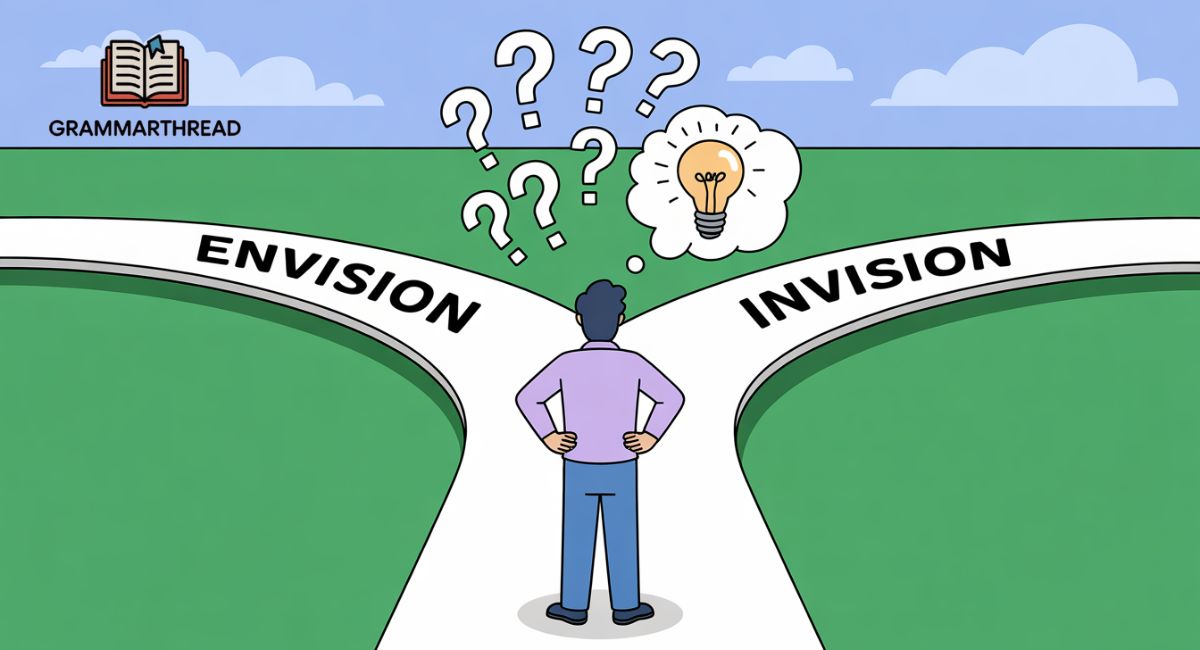
If you have ever paused mid sentence wondering whether to write Invision or Envision, you are not alone. This confusion shows up all the time in emails, essays, and even professional reports. Envision is the correct verb used when you mean to imagine, picture, or mentally plan something. Invision, however, is not a standard English word and mostly appears because of the well known software brand with that name.
This small spelling choice matters more than people realize. It affects clarity, credibility, and how polished your writing feels. I have seen students, bloggers, and professionals second guess themselves simply because the two words look so similar. Once you understand where envision comes from and how it is used in everyday language, the choice becomes simple and confident every time.
The Correct Word: Envision
Envision (/ɛnˈvɪʒən/) is the word you want when talking about picturing something clearly in your mind. It works perfectly in casual chats and professional settings alike, making it a versatile term for describing mental imagery.
Examples in everyday speech:
- “I envision opening my own café someday.”
- “He envisions traveling the world after retirement.”
Academically or professionally:
- “Leaders must envision the long-term impact of their decisions on organizational culture.”
- “Architects envision spatial flow and user interaction before drafting blueprints.”
The Wrong Word: Invision
Invision doesn’t exist as a recognized word in standard English dictionaries. You’ll typically encounter it as an accidental misspelling of envision, particularly in informal online writing or quick messages.
However, there’s one important exception: InVision (with a capital “I”) is an actual brand name. It refers to a well-known software tool used for designing digital products and prototypes. That’s a proper noun, not the verb you’d write in formal communication.
So remember:
- Choose Envision when you need the verb form.
- Reserve InVision strictly for mentioning the software brand (e.g., “The design team shared their mockups through InVision for client review.”).
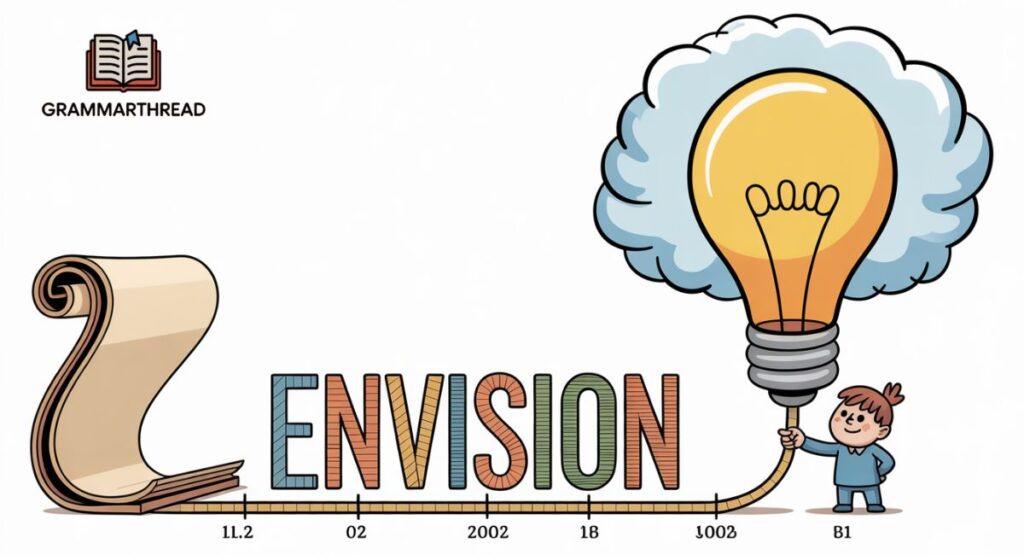
Etymology and Historical Development of “Envision”
| Period | Development |
| Latin & Old French | Derives from Latin “in” (within) + “visionem” (sight), influenced by French “envisager” |
| English Adoption | Made its way into English during the early 1600s, originally meaning “to picture in one’s mind” |
| Modern Evolution | Established itself as standard usage across both American and British English |
Language shifts and transforms as generations use it. Envision found its permanent place in English vocabulary because it captured something specific: the act of forming mental pictures before something exists. This precision made it stick which explains why its spelling has remained stable throughout centuries of use.
American English vs. British English Usage
Envision shows up in both American and British English, although American writers tend to use it more frequently.
Style Guide Notes:
- APA and Chicago Manual of Style: Both recognize envision as the correct form neither acknowledges invision as valid.
- British usage: Though less prevalent, envision regularly appears in professional and scholarly contexts. You won’t find invision in reputable British writing.
In short: Envision is universally recognized. Invision isn’t standard anywhere.
Why Invision Persists as a Misspelling
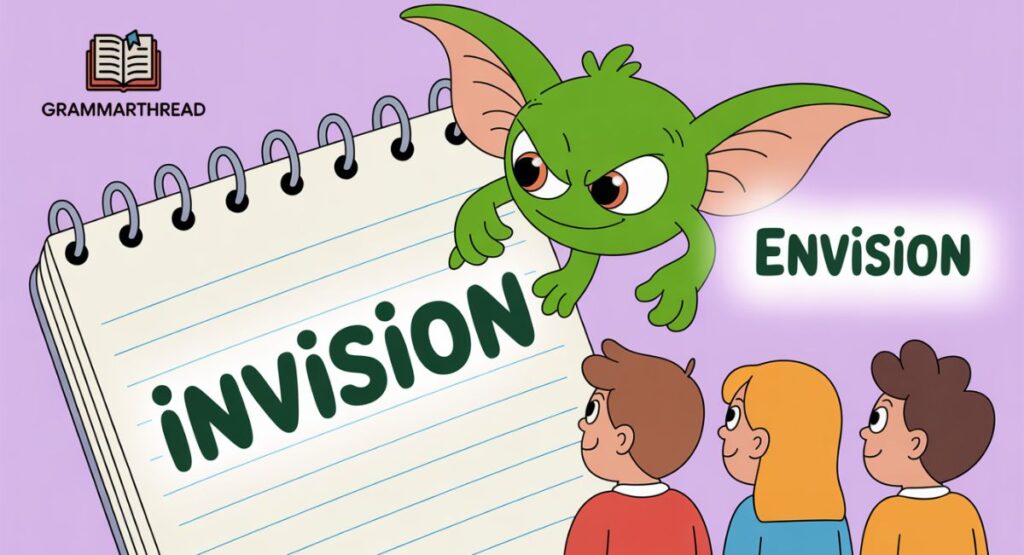
Multiple reasons explain why invision continues showing up despite being incorrect in standard usage:
- Phonetic similarity: When said aloud quickly, it sounds identical to envision.
- Brand influence: The InVision software makes people assume “invision” is a legitimate word.
- Spellcheck gaps: Many digital writing tools fail to flag invision, particularly during rapid typing.
- Casual communication patterns: In quick messages or social posts, people rely on how words sound rather than proper spelling.
Pro tip: A quick proofread and awareness of this common mistake can save you from looking careless in formal or workplace writing.
Correct Usage of Envision in Sentences
Here’s how envision works properly in different writing situations:
| Context | Correct Usage Example | Wrong Version (Avoid) |
| Academic | “Researchers must envision the long-term implications of their findings.” | “Researchers must invision…” |
| Professional | “The executive team needs to envision sustainable growth strategies.” | “The executive team needs to invision…” |
| Creative Writing | “He envisions a future where technology serves humanity, not controls it.” | “He invisions a future…” |
These samples demonstrate how envision adapts seamlessly to various writing styles. It’s precise, impactful, and recognized everywhere.
Synonyms and Related Expressions
Here are some close alternatives:
- Imagine
- Visualize
- Picture
- Foresee
- Conceive
Each carries its own slight difference:
- Visualize typically implies forming detailed, concrete mental images.
- Foresee tends toward predicting what’s coming next.
- Conceive carries hints of creative thinking or abstract ideas.
Yet envision distinctly combines imagination with intentional forward-thinking which makes it particularly effective in professional, scholarly, and inspirational writing.
How to Remember the Correct Spelling
Use these simple techniques to lock it in:
- Mnemonic device: Envision begins with EN, just like ENter or ENable.
- Mental picture: Think of “en-“ as meaning “into vision,” helping you form mental images of something.
- Daily repetition: Type “I envision…” in a sentence each day until it feels automatic.
- Flashcard method: • Front side: envision / invision? • Back side: envision (correct means to picture mentally), invision (wrong except as InVision brand name)
Common Mistakes and How to Avoid Them
These mistakes pop up regularly in online discussions, quick texts, and informal correspondence:
- “I invision completing this project by Monday.” (incorrect)
- “InVision allows our team to collaborate on designs seamlessly.” (correct naming the software)
Tips to catch mistakes:
- Say your sentences aloud your hearing often spots errors your eyes skip over.
- Run text through tools like Grammarly but remember they’re helpers, not substitutes for knowledge.
- Train yourself to hesitate when typing “en/in…” so you make a deliberate spelling choice.
Final Takeaways
- Envision is the proper word for scholarly, imaginative, and workplace writing.
- Invision is typically wrong except when referencing the InVision software platform.
- Careful editing, a helpful memory trick, and conscious attention prevent needless mistakes.
- Accurate spelling elevates your credibility few things undermine professionalism faster than avoidable errors.
Case Study: Impact of Spelling in Academic Work
A university student turned in two identical papers: one using envision, the other using invision.
- Professor A commended the version with envision, describing it as “polished and credible.”
- Professor B marked down invision as “careless editing,” suggesting it appeared like an error.
This small spelling choice influenced how the paper was perceived clear evidence that accuracy shapes your reputation.
Digital Influence: How Brand Names and Tech Products Reinforce the “Invision” Error
The widespread use of InVision as design software has created unexpected confusion around the correct spelling of envision.
- Brand recognition: Designers and tech professionals encounter “InVision” daily in their workflows, making the lowercase “invision” feel legitimate.
- Search engine results: Typing “invision” returns millions of results for the software company, unintentionally validating the misspelling.
- Social media mentions: When people discuss the tool casually, they often drop capitalization, writing “invision” in posts and comments.
- Professional circles: In design and tech communities, frequent exposure to the brand name blurs the line between proper noun and common verb.
This digital overlap shows how modern technology can accidentally reshape our perception of language even when the traditional spelling remains unchanged.
Frequently Asked Questions
What is the difference between Invision and Envision?
Envision is the correct verb meaning to imagine or picture something, while Invision is only a software company name.
Can I use Invision instead of Envision?
No, using Invision in regular writing is incorrect; always use envision for imagining or planning.
What does Envision mean in a sentence?
Envision means to mentally picture or plan something, like “She envisions her future career clearly.”
Is Invision a real English word?
No, Invision is not recognized in standard English and is mainly the name of a design software company.
How do I remember the difference between Invision and Envision?
Think of envision as “visualizing” ideas and Invision as a brand name only.
Why do people confuse Invision and Envision?
The words look similar, so many mistakenly write Invision when they mean envision.
Is Envision used in both British and American English?
Yes, envision is accepted in both varieties as the standard verb for imagining or planning.
Conclusion
In summary, envision is the correct verb to use whenever you are imagining, picturing, or planning something in your mind. Invision, on the other hand, is not part of standard English and should only be recognized as the name of a software company.
Knowing this distinction not only clears up confusion but also boosts your confidence in writing and speaking. By remembering the meaning, origin, and proper usage of envision, you can make your English more precise and professional. Start applying this today and notice how much smoother your communication becomes.
Read Next: Propose vs. Purpose – What’s the Real Difference? Meaning, Usage,

Welcome to GrammarThread. I am Julian Mercer, an AI-powered SEO and content writer with 4 years of experience. I help websites rank higher, grow traffic, and look amazing. My goal is to make SEO and website design simple and effective for everyone. Let’s achieve more together!