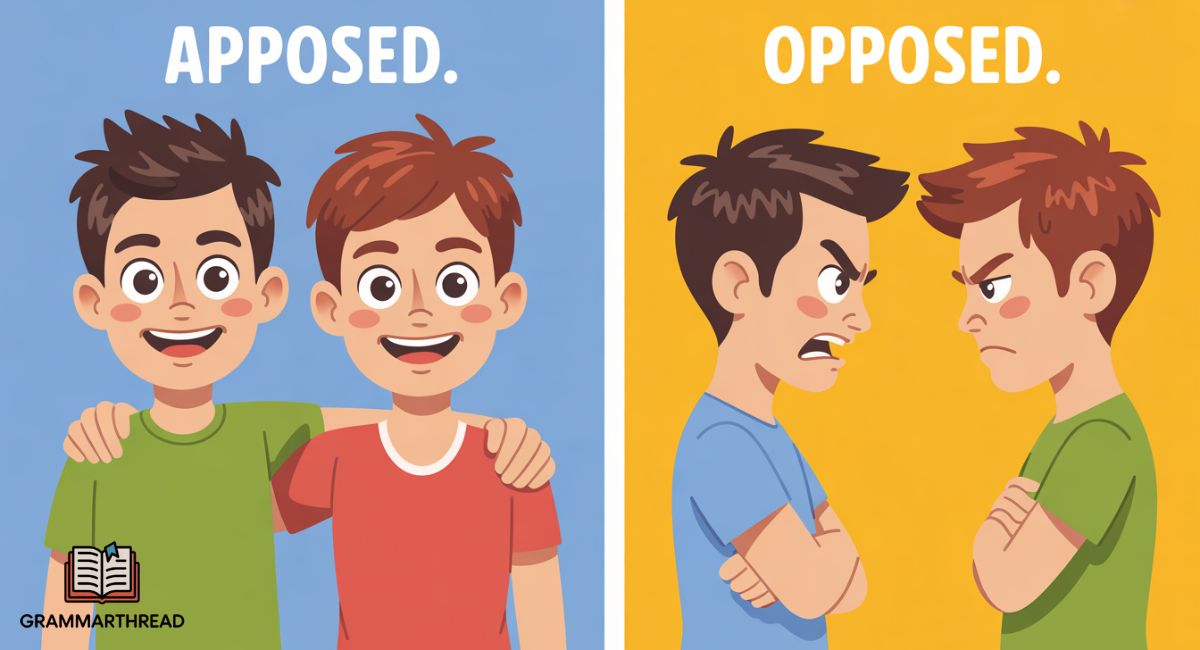
As an editor, I regularly see writers pause over Apposed vs. Opposed because the words look close but behave very differently. One describes things placed next to each other, while the other signals disagreement or resistance. Mixing them up can quietly change the meaning of a sentence, especially in academic work, professional emails, or clear everyday writing.
Think of describing cells in biology, ideas in an essay, or opinions in a meeting. The correct choice matters more than it seems. Understanding how these words work in real contexts helps you write with confidence and precision. Once the difference clicks, your sentences become sharper, smoother, and far less confusing.
Quick Comparison Table: Apposed vs. Opposed
Let’s start with a straightforward comparison to help you spot the differences between apposed and opposed at a glance:
| Feature | Apposed | Opposed |
| Meaning | Positioned next to or adjacent | Resisting or standing against |
| Origin | Latin appōnere (to place near) | Latin opponere (to counter or resist) |
| Part of Speech | Verb (past tense of appose) | Verb / Adjective |
| Usage Context | Medical or technical fields (anatomy, surgery) | Everyday English (opinions, resistance, contrasts) |
| Example | The dentist apposed the two bone fragments carefully. | He opposed the budget cuts at the meeting. |
| Frequency in English | Uncommon, specialist terminology | Widely used, everyday language |
The key takeaway? “Apposed” belongs to technical settings, while “opposed” is part of daily conversation.
Understanding the Word “Opposed”
Definition and Etymology
The term “opposed” traces back to the Latin word opponere, which translates to “set against” or “position in resistance to.” In modern English, opposed functions as both a verb (“to resist or counter something”) and an adjective (“in a state of resistance or contrast”).
It’s pronounced /əˈpoʊzd/, and the word inherently suggests disagreement, confrontation, or standing against something.
Common Meanings of “Opposed”
The interpretation of opposed shifts based on how it’s used. Here are the primary ways it appears:
- To show disagreement or pushback
- I’m opposed to mandatory overtime policies. You’ll encounter this usage frequently in discussions about values, governance, and personal beliefs.
- To indicate physical or spatial contrast
- The two mountains stand on opposed ends of the valley. This version highlights something positioned across from or facing another object.
- As an adjective reflecting resistance
- They represent opposed viewpoints on climate action.
In every instance, “opposed” signals an active tension where one element resists or contrasts with another.
Real-Life Usage Examples
Here’s how opposed appears in everyday situations:
- Politics: “The mayor opposed the zoning changes.”
- Education: “Parents opposed the elimination of art classes.”
- Business: “Management opposed the union’s demands.”
- Sports: “The rival teams stood opposed at midfield.”
Each example involves some form of resistance, disagreement, or conflicting stance whether regarding concepts, decisions, or physical positioning.
Understanding the Word “Apposed”
“Apposed” originates from the Latin term appōnere, which means “to position beside, adjacent to, or in proximity.” It serves as both the past tense and past participle form of the verb appose.
While opposed enjoys widespread use across contexts, apposed remains largely confined to technical and scientific literature. It’s not a term you’ll hear in casual conversation, but it’s entirely appropriate and correct within specialized fields.
When and Where “Appose” Is Actually Used
In contemporary English, appose most commonly shows up in medical, anatomical, or materials research settings. The word describes bringing two objects or structures into close alignment or direct contact with one another.
Examples:
- Biology: “The cellular layers were apposed to enable molecular transfer.”
- Medicine: “Surgeons apposed the incision margins to enhance recovery.”
- Engineering: “Apposed composite sheets created a reinforced junction.”
Within these disciplines, appose has nothing to do with opposition—it refers to positioning elements closely together or side by side.
Real Examples from Academic Sources
- “The epithelial surfaces remained closely apposed during observation.”
- “Surgical clips were applied to appose the vascular walls.”
Put simply, when two structures are apposed, they’re brought into contact or aligned next to each other, rather than set against one another.
Apposed vs. Opposed: Core Differences Simplified
Here’s a straightforward look at how apposed vs. opposed differ in both meaning and application:
| Aspect | Apposed | Opposed |
| Core Meaning | Positioned next to | Set in resistance to |
| Emotion or Intent | Neutral, factual | Confrontational or resistant |
| Field of Use | Specialized (medical, anatomical) | Everyday language |
| Verb Example | The bone fragments were apposed carefully. | She opposed the funding cuts. |
| Adjective Form | Uncommon | Frequent (opposed views) |
An easy way to remember:
“Apposed” = alongside; “Opposed” = against.
Visual Analogy
Think of two puzzle pieces:
- When they fit together snugly, they’re apposed.
- When they push away from each other, they’re opposed.
Makes sense, doesn’t it?
Common Mistakes and How to Avoid Them
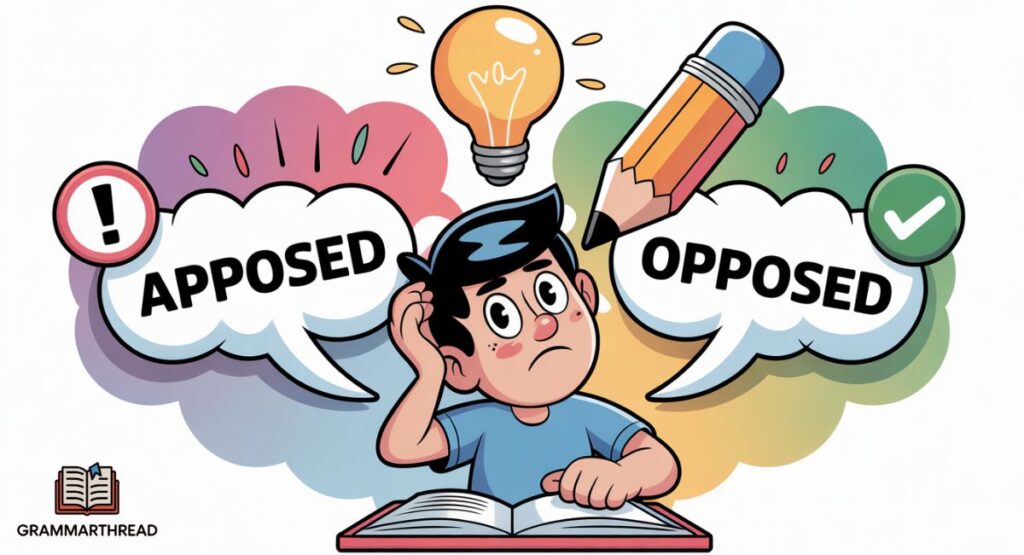
Even skilled writers occasionally mix up these two terms. Here’s what causes the confusion:
- Spelling similarity: Only a single letter separates them.
- Autocorrect interference: Word processors often flag apposed and switch it to opposed automatically.
- Phonetic overlap: When spoken rapidly, both words sound nearly identical.
How to Avoid the Mistake
- Examine your context.
- Discussing concepts, resistance, or disagreement → use opposed.
- Describing proximity, alignment, or physical positioning → use apposed.
- Say the sentence out loud. Ask yourself whether “in resistance to” or “next to” fits better. That’ll guide your choice.
- Double-check automatic corrections. Spell checkers frequently miss apposed since it’s less common, but the word is entirely legitimate in scientific and medical contexts.
Grammar and Syntax in Action
Using “Opposed” Correctly
As a verb:
- He opposed the restrictive regulations.
- Citizens opposed the construction project loudly.
As an adjective:
- The candidates represent opposed positions on healthcare.
Using “Apposed” Correctly
In technical or scientific contexts:
- The apposed bone surfaces integrated successfully.
- Imaging showed closely apposed cellular structures.
Sentence Practice
Test your understanding by choosing the right word:
| Sentence | Correct Word | Explanation |
| The board ______ the budget increase. | Opposed | Shows resistance or disagreement |
| The physician ______ the incision margins. | Apposed | Refers to bringing edges together |
| The parties remained ______ on trade policy. | Opposed | Indicates conflicting stances |
| The materials were ______ under heat to create adhesion. | Apposed | Means positioned in contact |
Contextual Understanding Through Real-World Scenarios
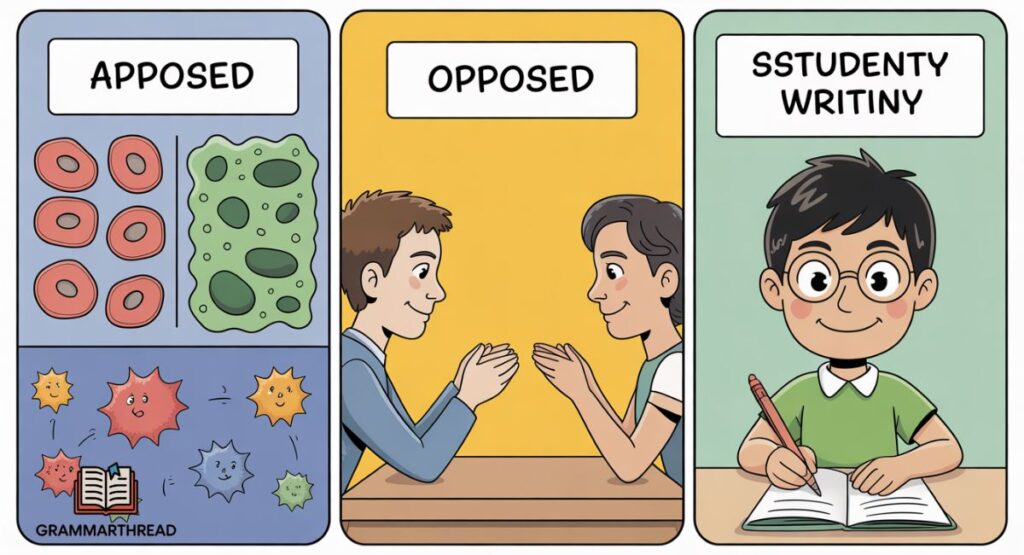
Let’s put this into practice.
Scenario 1: Everyday English (Opposed)
A teacher remarks,“I’m opposed to reducing recess time.” Here,“opposed” conveys disagreement or pushback against a decision.
Scenario 2: Scientific Writing (Apposed)
A researcher notes, “The tissue layers were apposed during the procedure.” This indicates the layers were positioned next to each other or in contact, not in opposition.
Scenario 3: Professional Communication
- In a business context: “Stakeholders were opposed to the restructuring plan.”
- In a clinical context: “Apposed wound margins promoted faster healing.”
Both terms are accurate, but their application hinges completely on the subject matter and context.
How to Remember the Difference (Memory Aids)
Here are some simple and effective tricks to keep apposed vs. opposed straight:
- Associate the prefix “op-“ with “opposition” → Opposed.
- Link the prefix “ap-” with “approach” or “adjacent” → Apposed.
- Mnemonic: “Apposed items sit close and aligned; Opposed items clash and decline.”
Another trick:
“Appose” sounds like “apply” both involve bringing elements together. “Oppose” sounds like “impose” both suggest resistance or confrontation.
Usage Frequency and Data Insights
Language data from real-world sources highlights the contrast between these terms clearly.
| Word | Frequency (Google Books Corpus) | Common Context |
| Opposed | Very high (hundreds of thousands of instances) | Everyday communication, debate, journalism |
| Apposed | Minimal (predominantly scholarly) | Medical and technical literature |
According to linguistic analysis from the Corpus of Contemporary American English (COCA), opposed occurs approximately 2,000 times more frequently than apposed.
Put simply, unless you’re drafting scientific documentation or clinical reports, you’re unlikely to encounter apposed in regular writing.
Practical Tips for Students, Teachers, and Professionals
For Students
- Stick with opposed in argumentative papers, class discussions, and opinion pieces.
- Reserve apposed for specialized subjects like biology, medicine, or engineering contexts.
For Teachers
- Emphasize contextual awareness over simple definition drills.
- Incorporate practical examples and comparative exercises during lessons.
For Professionals
- Choose opposed when expressing resistance, conflict, or contrasting perspectives in communications, presentations, and business documents.
- Apply apposed exclusively in technical papers, research findings, or specialized industry reports.
Summary: The Takeaway
Both terms are valid but they serve entirely different purposes.
| Word | When to Use | Example |
| Apposed | When referring to objects positioned adjacent or in contact (specialized/medical use). | Apposed tissue layers during surgery. |
| Opposed | When indicating disagreement, resistance, or conflicting positions (everyday use). | Opposed viewpoints in a debate. |
Remember:
Apposed = next to each other. Opposed = in resistance to each other.
When the Difference Actually Matters in Professional Writing
Using the wrong term might seem minor, but in certain fields, precision carries real weight.
In Medical and Scientific Documents
Confusing these words in clinical or research writing can alter meaning entirely. If a surgeon writes “the wound edges were opposed” instead of “apposed,” it suggests the edges were positioned against each other rather than brought together for healing. That’s not just incorrect it’s potentially misleading to other medical professionals reviewing the case.
In Academic and Technical Contexts
Peer reviewers and editors in scientific journals expect exact terminology. Using apposed correctly demonstrates subject matter expertise, while misusing it can undermine your credibility. Academic readers notice these distinctions.
In General Business and Communication
For everyday professional writing emails, reports, presentations opposed is almost always the right choice. You’ll express disagreement, contrast, or resistance without sounding overly technical. Mistakenly using apposed here would confuse readers and seem out of place.
The Bottom Line
Context determines everything. In specialized fields like medicine, biology, or materials science, apposed has a specific technical function. Everywhere else, opposed handles the job perfectly. Knowing when each term applies shows attention to detail and strengthens your professional communication.
Frequently Asked Questions
What is the difference between apposed and opposed?
Apposed means placed next to or alongside something, while opposed means being against or in disagreement.
When should I use apposed in a sentence?
Use apposed when describing things positioned side by side, such as structures in biology or descriptive phrases in grammar.
When is opposed the correct word to choose?
Opposed is correct when you are talking about resistance, conflict, or holding a different opinion.
Are apposed and opposed interchangeable?
No, they are not interchangeable. Using the wrong one can completely change the meaning of a sentence.
Is apposed commonly used in everyday English?
Apposed is less common and appears more in technical, academic, or grammatical contexts.
Does opposed always refer to people disagreeing?
Not always. Opposed can also describe ideas, forces, or actions that work against each other.
Conclusion
Choosing correctly between Apposed vs. Opposed may feel minor, but it shows how well you handle meaning, context, and intent. Apposed describes closeness or placement side by side, rooted in structure and description. Opposed comes from the idea of standing against something, often tied to disagreement or resistance.
Knowing when to use each keeps your writing accurate and credible. Before you hit send or submit, pause and ask what relationship you really want to show. Try using both words in a few sentences today. That simple practice builds confidence and keeps your message clear every time.
Read Next: Invision or Envision – Which Is Correct?

Welcome to GrammarThread. I am Julian Mercer, an AI-powered SEO and content writer with 4 years of experience. I help websites rank higher, grow traffic, and look amazing. My goal is to make SEO and website design simple and effective for everyone. Let’s achieve more together!