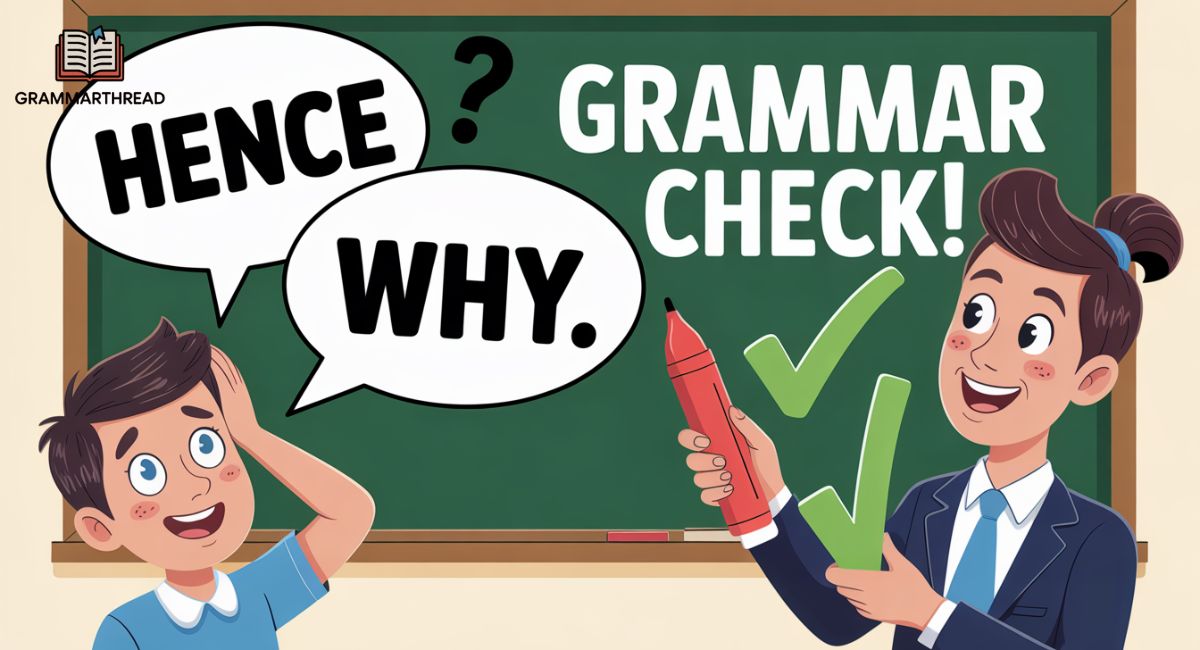
If you have ever paused while writing and wondered, Is “Hence Why” Grammatically Correct, you are not alone. The phrase shows up everywhere in emails, essays, and even polished reports, yet many people are unsure whether it actually works. It sounds natural in conversation, which is why it slips into writing so easily.
The problem is that what feels right is not always grammatically sound. Understanding how “hence” and “why” function helps you spot the issue quickly. This topic matters because small wording choices affect clarity, credibility, and tone. Once you see why this phrase is questioned, you will start noticing better alternatives in everyday writing.
What Does “Hence Why” Actually Mean?
On the surface, “hence why” looks perfectly fine. People use it all the time when explaining causes or outcomes. Take this example:
“She forgot her laptop, hence why the presentation got postponed.”
In this sentence, “hence why” seems to work as a way of saying “that’s the reason behind it.” But there’s a catch: both words in this phrase already express the concept of causation. Using them together creates redundancy similar to saying “the reason why” or even “the reason for the reason.”
Here’s how it breaks down:
- Hence = therefore, for this reason, or as a consequence
- Why = for what reason or cause
Combined: “Hence why” = therefore the reason, which doubles up on the same idea unnecessarily.
When you stack these two words together, you’re essentially repeating yourself. It’s like saying “ATM machine” or “PIN number” the meaning is already built into one of the words, so adding the second creates an awkward overlap that careful writers typically avoid.
Is “Hence Why” Grammatically Incorrect?
From a technical standpoint, yes. The phrase “hence why” is redundant and generally avoided in formal or academic writing contexts.
Garner’s Modern English Usage points out that “hence” already carries the meaning of causality on its own. Tacking on “why” creates what’s called a tautology a phrase that repeats the same concept twice and weakens your writing style.
What Language Authorities Say:
| Source | Comment on “Hence Why” |
| Garner’s Usage Guide | “Redundant construction. Should be avoided in professional or academic writing.” |
| Chicago Manual of Style | “Use clear, non-repetitive phrasing instead.” |
| Merriam-Webster | “Hence = ‘for this reason.’ The addition of ‘why’ serves no purpose.” |
| Oxford English Dictionary | Does not recognize “hence why” as a standard expression. |
While you might hear this phrase frequently in casual conversation or everyday speech, it’s not appropriate for formal documents like research papers, business reports, cover letters, or academic essays. Stick to cleaner alternatives when writing professionally.
What “Hence” Really Means in American English
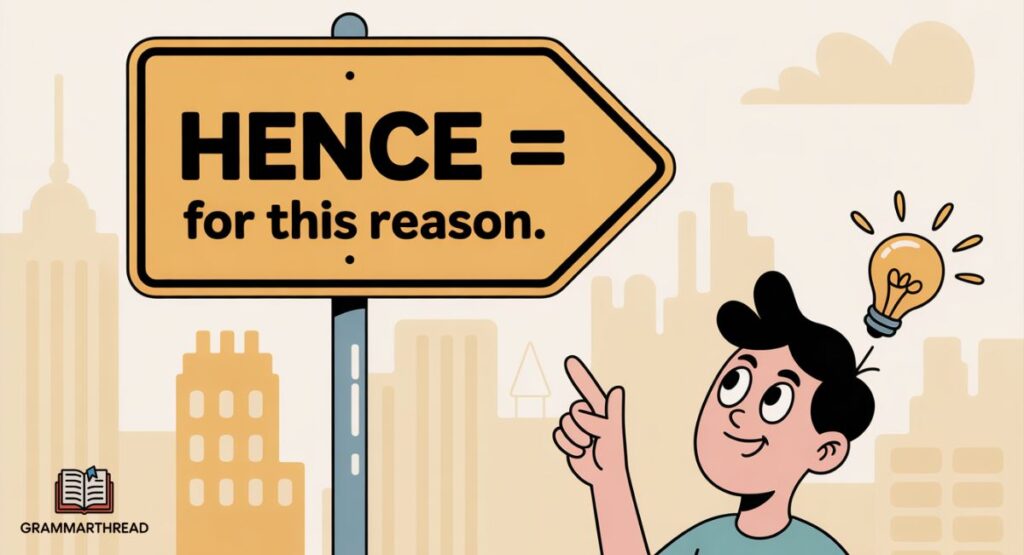
To grasp how “hence” works, you need to understand its grammatical role. It functions as an adverb, not as a conjunction or preposition. Here’s what it conveys:
- For this reason
- From this point forward or location
- Consequently
Examples of Proper Usage:
- “Traffic was terrible; hence the late arrival.”
- “She lacked the required certifications, hence she didn’t get the position.”
- “This building dates back to 1885; hence its protected status.”
You’ll find “hence” most often in formal writing contexts. It appears regularly in legal documents, academic papers, and scientific publications where precision matters.
Interesting note: “Hence” traces back to Middle English, where it originally meant “from this place.” As the language evolved over hundreds of years, it gradually acquired the causal meaning we use today showing how a word can shift from expressing location to expressing logical consequence.
“Hence Why” vs. “That’s Why”: Understanding the Difference
This is where a lot of writers stumble. “That’s why” is both grammatically sound and natural in contemporary English. It establishes a clear cause-and-effect relationship without any unnecessary repetition.
Comparison Chart:
| Phrase | Correct? | Formality | Usage |
| Hence Why | ❌ No | Formal settings – skip it | Comes across as wordy and redundant |
| That’s Why | ✅ Yes | Neutral/casual | Conversational, easy to understand |
| Hence | ✅ Yes | Formal | Standard in academic and professional documents |
Choose “that’s why” when you’re writing or speaking casually. Opt for “hence” when crafting formal content like research papers or business communications. As for “hence why” it’s best to leave it out of your writing entirely, regardless of context.
Examples of Proper “Hence” Usage
Let’s look at practical examples. Here are sentences that work properly and ones that don’t:
✔ Correct:
- “The shipment arrived late; hence, the production delay.”
- “She missed the training session, hence the mistakes in her work.”
- “He studied abroad for three years, hence his proficiency in Spanish.”
✘ Incorrect:
- “He was exhausted, hence why he left the party early.”
- “Sales dropped significantly, hence why management made cuts.”
Rather than using those clunky phrases, revise them this way:
“He was exhausted, hence he left the party early.” “Sales dropped significantly; that’s why management made cuts.”
Notice how removing “why” immediately tightens the sentence and eliminates the redundancy. The meaning stays identical, but the writing becomes sharper and more professional.
What to Say Instead of “Hence Why”
When you’re unsure, swap out “hence why” with any of these more effective options:
Stronger Alternatives:
- “Hence”
- “That’s why”
- “Therefore”
- “Thus”
- “As a result”
- “For this reason”
Selecting the Right Option:
| Phrase | Best For | Example |
| Hence | Formal documents | “The data was incomplete, hence the decision to postpone publication.” |
| That’s why | Casual speech | “She missed the bus. That’s why she arrived late.” |
| Therefore | Academic contexts | “The evidence contradicts the theory; therefore, it must be revised.” |
| Thus | Scientific papers | “The equipment malfunctioned. Thus, the experiment was repeated.” |
| As a result | Business and narrative writing | “Revenue declined sharply. As a result, layoffs were announced.” |
Each alternative serves a specific purpose depending on your audience and the formality level required. Match your word choice to the context, and your writing will sound both natural and polished.
“Hence,” “Therefore,” or “Thus”? Clarifying the Confusion
People frequently treat these words as identical, but they’re not always interchangeable in every situation. Here’s what sets them apart:
| Word | Tone | Best Used In | Example |
| Hence | Formal, logical | Essays, scholarly papers | “She violated protocol, hence the suspension.” |
| Therefore | Logical, formal | Legal documents, academic writing | “The conditions were met; therefore, the process continued.” |
| Thus | Neutral-formal | Reports, technical documentation | “Results were inconsistent. Thus, we adjusted our approach.” |
Quick tip: “Hence” carries a slightly more traditional or classical tone. “Therefore” tends to sound more contemporary in modern academic writing.
Grammar Evolution and Why Some “Wrong” Phrases Stick
Language constantly changes. What counted as incorrect a century ago might be standard today and the reverse is also true. So why does “hence why” continue to appear?
Here’s the explanation:
- Redundant expressions gain acceptance through repeated use in media and everyday speech
- People copy language patterns from influential speakers, writers, and online content creators
- Our minds focus more on understanding meaning than grammatical accuracy in conversation
However, just because something sounds natural doesn’t automatically make it correct.
“We often write the way we talk. But written language demands more precision than spoken words.” Steven Pinker
The gap between casual speech and formal writing remains important. While spoken English allows for looser constructions, professional and academic writing still requires adherence to grammatical standards that eliminate unnecessary redundancy.
Common Redundant Phrases Like “Hence Why” to Avoid
“Hence why” isn’t alone in this category. Here are other redundant expressions worth eliminating:
| Redundant Phrase | Better Version |
| “Close proximity” | “Proximity” |
| “Past history” | “History” |
| “Final outcome” | “Outcome” |
| “Advance warning” | “Warning” |
| “End result” | “Result” |
These unnecessary words create bloat without adding meaning or clarity.
Each phrase already contains the concept that the extra word tries to reinforce. Proximity means closeness by definition, history refers to the past automatically, and outcomes are inherently final. Cutting the redundant modifier strengthens your writing by making it more direct and easier to read.
Real-World Impact: Why Grammar Precision Matters
In Academic Settings:
Instructors look for polished, professional writing. Using constructions like “hence why” probably won’t result in a failing grade, but it can undermine your academic credibility.
In Professional Environments:
Picture sending a business proposal packed with unnecessary wordiness. Your audience might start doubting your thoroughness and your expertise.
In Daily Communication:
Weak grammar obscures your intended message. Sharp grammar enhances both clarity and persuasive power.
Precise writing reflects precise thinking. And precise thinking earns respect and confidence from your readers, whether they’re colleagues, clients, or professors evaluating your work.
Mini-Quiz: Can You Spot the Error?
Put your grammar knowledge to the test. Which sentence contains an error?
- The server crashed, hence the downtime.
- Traffic was backed up; that’s why we arrived late.
- He didn’t meet the requirements, hence why his loan was denied.
- The data was corrupted. Therefore, we ran the analysis again.
Answer: Sentence 3 is incorrect. It should be revised to:
“He didn’t meet the requirements, hence his loan was denied.” or “He didn’t meet the requirements. That’s why his loan was denied.”
The redundancy in sentence 3 makes it grammatically flawed. By removing either “hence” or “why,” you create a cleaner, more professional statement that conveys the exact same meaning without the unnecessary repetition.
Conclusion: So, Should You Ever Use “Hence Why”?
If you’re crafting a research paper, business email, or formal document, avoid “hence why.” It’s repetitive, adds no value, and can damage your professional credibility.
What to do instead:
- Use “hence” for formal documents and academic writing
- Use “that’s why” in casual speech and informal contexts
- Use “therefore” and “thus” when clarity and precision matter most
Keep your writing tight. Cut unnecessary words. Your audience and your reputation will benefit from the extra care you put into choosing the right words for each situation.
Additional Resources
Looking to strengthen your grammar skills and writing precision even further? These trusted resources can help:
- Chicago Manual of Style
- Purdue OWL Grammar Guide
- Merriam-Webster Dictionary
- APA Style Guide
Each of these references offers detailed guidance on proper usage, grammar rules, and writing conventions that will help you communicate more effectively in both academic and professional settings.
Why Native Speakers Still Say “Hence Why” Without Noticing
Even fluent English speakers use “hence why” regularly, often without realizing it’s grammatically flawed. This happens for several interconnected reasons rooted in how we learn and process language.
First, spoken language prioritizes speed and flow over grammatical precision. When we’re speaking quickly, our brains grab familiar phrase patterns without stopping to analyze their internal logic. “Hence why” sounds smooth and emphatic, so it slips out naturally in conversation.
Second, we learn through imitation. If you hear colleagues, podcasters, or news commentators using “hence why,” your brain files it away as acceptable usage. Over time, repeated exposure normalizes the phrase, making it feel correct even when it technically isn’t.
Third, the redundancy isn’t always obvious in real-time communication. Unlike glaring errors such as “I seen it” or “between you and I,” the problem with “hence why” is subtle. Both words point to causation, but they don’t clash in a way that immediately disrupts understanding. Your listener grasps your meaning perfectly, so the grammatical issue flies under the radar.
Finally, hypercorrection plays a role. Some speakers assume that adding more formal-sounding words makes their speech more sophisticated. They might think “hence why” sounds more educated than plain “that’s why,” not realizing they’ve actually created a redundancy that weakens their statement.
The result? Native speakers continue using the phrase in emails, presentations, and casual conversations completely unaware they’re doubling up on the same concept. Awareness is the first step toward eliminating these subtle errors from your writing and speech.
Frequently Asked Questions
Is “hence why” grammatically correct in English
No, it is considered grammatically incorrect in standard English because both words explain a reason and repeat the same meaning.
Why do people say “hence why” so often
It sounds natural in speech, so many speakers use it without realizing it is redundant in formal writing.
Is “hence why” acceptable in casual conversation
In casual speech, people may use it freely, but it is still avoided in polished or professional writing.
What is the correct alternative to “hence why”
You can simply use “hence,” “that’s why,” or “therefore,” depending on the sentence.
Do grammar experts consider “hence why” wrong
Yes, most editors, teachers, and style guides recommend avoiding it due to redundancy.
Can “hence why” ever be correct in writing
In standard grammar rules, it is not considered correct, even though it appears in informal usage.
What does “hence” actually mean on its own
“Hence” already means “for this reason,” which makes adding “why” unnecessary.
Conclusion
To sum it up, is “Hence Why” grammatically correct is a question with a clear answer in standard English. The phrase feels familiar because it is common in speech, but in writing it repeats the same idea twice.
“Hence” already points to a reason, so adding “why” adds no value. Choosing one clear word makes your sentence sharper and more professional. These small adjustments matter in emails, essays, and formal content where clarity builds trust. As you write, pause and look for phrases you can simplify. Try revising a recent sentence today and see how much cleaner it sounds.
Read Next: Apposed vs. Opposed – What’s the Difference

Welcome to GrammarThread. I am Julian Mercer, an AI-powered SEO and content writer with 4 years of experience. I help websites rank higher, grow traffic, and look amazing. My goal is to make SEO and website design simple and effective for everyone. Let’s achieve more together!