When I began paying closer attention to how native speakers talk, I noticed how often a tiny detail creates confusion. The choice between Any Problem or Any Problems is one of those moments. Ask “Any problem?” and people may pause, wondering if you mean one specific issue. Ask “Any problems?” and the door opens for honest feedback, whether it is a minor concern or a serious obstacle.
This small grammar choice matters in meetings, emails, and daily conversations. Singular sounds focused and urgent. Plural feels open and inviting. Understanding when to use each form helps you sound natural, confident, and clear. Once you spot the pattern, you start hearing it everywhere and using it with purpose.
Understanding the Word ‘Any’
The secret to cracking this puzzle comes down to grasping what “any” actually means.
- Part of speech: Functions as a determiner, pronoun, or adverb based on how it’s used.
- Core meaning: Points to one, several, or every instance of something without pinning down an exact number.
- Flexibility: Pairs naturally with singular countable nouns, plural countable nouns, and uncountable nouns alike.
Example:
| Type of Noun | Example Phrase | Meaning |
| Singular | any question | One potential question, identity unknown. |
| Plural | any questions | Several potential questions. |
| Uncountable | any advice | Some amount of guidance that can’t be counted. |
Important point: “Any” typically signals possibility or existence rather than a precise quantity.
The Function of ‘Any’ with Nouns
What comes after “any” is determined by the type of noun you’re using:
- Singular noun: Applied when pointing to one general or unspecified item.
- Plural noun: Applied when indicating more than one item.
- Uncountable noun: Applied for materials or ideas that don’t have a plural version.
Examples:
- Singular: “If you need any help, just ask.”
- Plural: “If you need any suggestions, I’m here.”
- Uncountable: “If you have any feedback, I’d love to hear it.”
Why it matters:
In English, matching singular and plural forms correctly allows your audience to immediately grasp whether you mean one item or multiple items.
‘Any Problem’ – Meaning and Usage
“Any problem” is usually singular and broad in scope.
When to use it:
- Formal or professional correspondence
- Broad reference to one potential issue
- When you’re not emphasizing how many problems might exist
Examples:
- “Have you encountered any problem with the software?”
- “Let me know if there’s any problem with the delivery.”
- “Reach out immediately if you spot any problem during installation.”
Tone and impression:
- Comes across as more formal and refined.
- Fits naturally in customer support messages, scholarly writing, and corporate documents.
Case Study – Email Communication:
A consulting agency reaching out to clients regularly uses “any problem” to keep things professional: “Don’t hesitate to contact us if there’s any problem with the proposal we submitted.”
‘Any Problems’ – Meaning and Usage
“Any problems” is plural and implies there could be multiple issues at play.
When to use it:
- Informal or everyday conversation
- Contexts where several issues might come up
- Collaborative or team environments
Examples:
- “Any problems with the project?” (Casual status check)
- “Flag any problems to your supervisor right away.”
- “If you run into any problems with the website, clear your cache.”
Tone and impression:
- Sounds warm and conversational.
- Widely used in everyday speech, particularly in American English.
Case Study – Workplace IT Support:
In corporate settings, tech support teams commonly ask: “Are you experiencing any problems with the network?” This phrasing handles everything from minor bugs to serious technical failures without feeling stiff or overly corporate.
Flexibility and Overlap in Real Usage
There are moments when both “any problem” and “any problems” work perfectly fine, with just a subtle shift in meaning.
Example:
- “Reach out if you notice any problem.” (Neutral, polished)
- “Reach out if you notice any problems.” (Neutral, relaxed or open to multiple issues)
Context matters:
- Message to a business client: typically “any problem”
- Text to a coworker: typically “any problems”
American vs. British English:
- American English tends to favor “any problems” in everyday conversation.
- British English may lean toward “any problem” in professional communication.
Grammatical Guidelines for Choosing Correctly
Here’s a handy reference table:
| Context | Recommended Form | Example |
| Formal writing | any problem | “Should you discover any problem in the document, please inform us.” |
| Professional emails | any problem | “Get in touch if there’s any problem with your shipment.” |
| Informal conversation | any problems | “Any problems with the assignment yet?” |
| Customer service scripts | any problem | “Feel free to call if you experience any problem.” |
| Group/team communication | any problems | “Let us know if you’re dealing with any problems.” |
Pro tip:
When you’re unsure, consider whether you’re anticipating a single potential issue or several.
Frequency in Modern English
Google Ngram Viewer offers a fascinating look at how usage has evolved over time.
Findings:
- “Any problems” has grown more common since the late 20th century.
- “Any problem” has held consistent, particularly in formal contexts.
| Phrase | Usage Trend (2000–2024) | Common Domains |
| Any problem | Consistent | Academic, legal, technical |
| Any problems | Increasing | Conversation, blogs, workplace chats |
Why the shift?
Informal digital communication (emails, messaging apps, online discussions) has made “any problems” the default choice in numerous everyday situations.
Examples and Mini-Exercises
Complete the sentences:
- “Should there be ____ problem, reach out right away.” (Answer: any)
- “Are you experiencing ____ problems with the new software?” (Answer: any)
- “The report looks solid — I don’t see ____ problem at all.” (Answer: any)
Conversation snippets:
- Manager: “Any problems with the client presentation?”
- Employee: “Nope, went smoothly.”
- Support agent: “Send us a message if you encounter any problem during installation.”
Common Mistakes and How to Avoid Them
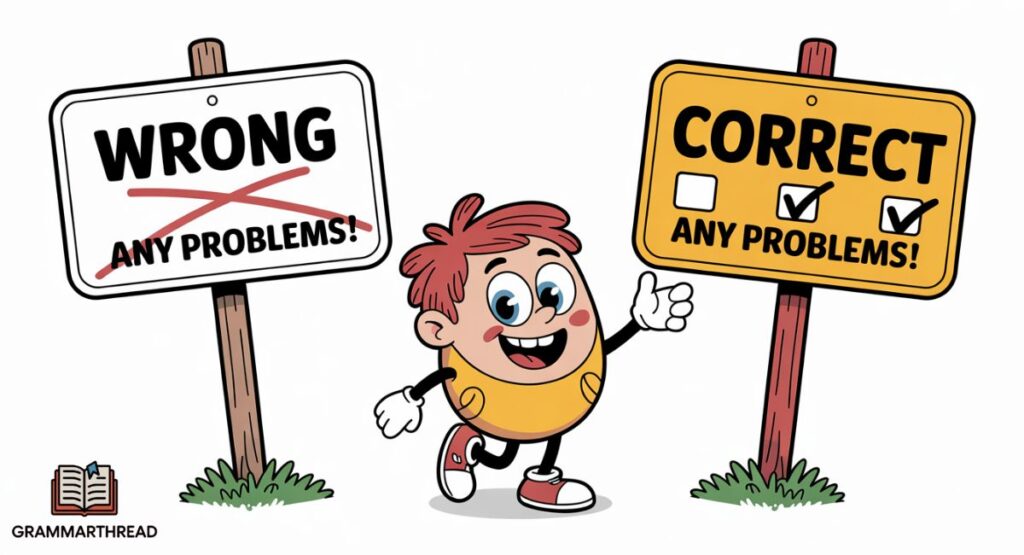
- Using “any problem” when multiple issues are likely: “Any problem with the five reports I sent?” (when referring to multiple items) → “Any problems with the five reports I sent?”
- Overusing “any problems” in professional documents: “Should you encounter any problems with the contract…” (in official correspondence) → “Should you encounter any problem with the contract…”
- Switching between singular/plural inconsistently: Avoid alternating forms during the same exchange unless you have a specific reason.
Time as a Concept: When Duration Becomes Meaning
Time isn’t just about clocks and calendars it’s also about how long something lasts and what that duration signifies.
Key aspects:
- Duration: How long an event or action continues.
- Perception: The way we experience time subjectively, not just objectively.
- Meaning: What a specific length of time communicates in context.
Examples:
- Brief duration: “I’ll be there in a minute” suggests a quick arrival, not literally 60 seconds.
- Extended duration: “We’ve been working on this for years” emphasizes commitment and effort.
- Contextual meaning: A 5-minute wait at a coffee shop feels different than a 5-minute emergency response time.
Why it matters:
When duration carries meaning, it shapes how we interpret situations, measure value, and communicate urgency. A “long time” in one context might be seconds; in another, it could be decades.
Real-world application:
In project management, saying “This will take some time” versus “This will take three weeks” changes expectations completely. The first is vague and open-ended; the second sets a clear boundary and accountability measure.
Final Takeaways
- “Any problem” = singular emphasis, typically more polished.
- “Any problems” = plural form, relaxed tone, or open to several issues.
- Your audience and setting should determine which one fits best.
Quick tip:
If you’re addressing a team in an informal environment, choose “any problems.” If you’re drafting a professional email or official document, stick with “any problem.”
Frequently Asked Questions
Is it correct to say any problem?
Yes, it is correct. You use “any problem” when referring to one specific issue or when the situation feels urgent or focused.
When should I use any problems?
Use “any problems” when inviting someone to share multiple concerns or possible issues in a general, open way.
Which sounds more polite, any problem or any problems?
“Any problems” usually sounds more polite and friendly because it encourages open discussion.
Do native speakers prefer any problems?
In casual conversation, native speakers often prefer “any problems” because it feels natural and less direct.
Is any problem grammatically wrong?
No, it is grammatically correct. It simply has a more specific and direct tone.
Can I use any problems in formal meetings?
Yes, it works well in meetings when you want feedback or want to hear all concerns.
Why does any problem sound urgent?
Because it points to a single issue, it can sound sharper or time sensitive depending on tone.
Conclusion
Choosing between any problem or any problems comes down to intent and situation. Both are grammatically correct, but they guide the conversation in different ways. The singular highlights one clear issue and often sounds direct or time sensitive.
The plural invites people to share concerns openly, whether they are small or still forming. Once you understand this difference, your questions sound more natural and your meaning becomes sharper.
The best tip is to listen to context and match your tone to the moment. Try using both forms in real conversations and notice how people respond.
Read Next: Whole Day or All Day – Which Is Correct? (With Examples)

Welcome to GrammarThread. I am Julian Mercer, an AI-powered SEO and content writer with 4 years of experience. I help websites rank higher, grow traffic, and look amazing. My goal is to make SEO and website design simple and effective for everyone. Let’s achieve more together!