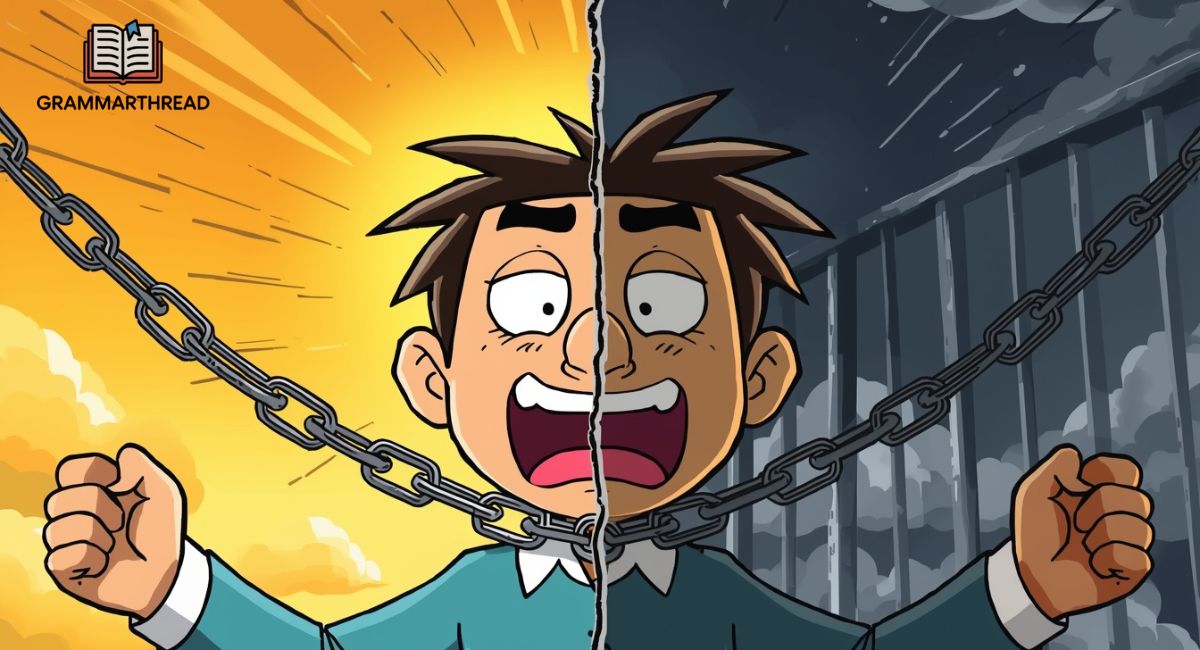
The Opposite of Freedom describes situations where choice, movement, or self expression is limited by force, rules, or circumstances beyond one’s control. Words such as oppression, confinement, bondage, and restriction help explain what life looks like when liberty is taken away. This topic matters because we see it everywhere, from laws that control societies to personal moments where someone feels trapped emotionally or socially.
Understanding the opposite of freedom helps us talk clearly about human rights, power, and responsibility. It also sharpens everyday language, whether you are describing history, current events, or personal experiences where autonomy is denied.
Definition of Freedom and Its Antonyms
Freedom represents the ability to make choices, express yourself, and live without unnecessary restrictions. It covers personal independence, civil liberties, and the opportunity to pursue your own path in life. This fundamental concept shapes how we think about human rights, self-governance, and the space people need to make meaningful decisions about their lives.
Words that mean the opposite of freedom describe situations where people lose control over their own lives. These terms capture everything from being physically locked up to more subtle ways someone’s choices get taken away whether through social pressure, financial dependence, or political control. Each opposing word tells us something specific about how freedom disappears in different situations.
When we look at antonyms for freedom, they fall into distinct groups based on what type of restriction they describe. Some words point to physical confinement, like being held in captivity or incarceration. Others describe forced servitude, such as bondage or enslavement. Political terms like tyranny and authoritarianism capture government oppression. Economic antonyms reflect financial constraints and dependency that limit someone’s ability to act independently. Understanding these categories helps us recognize the many forms that loss of freedom can take in real life.
Structural Breakdown
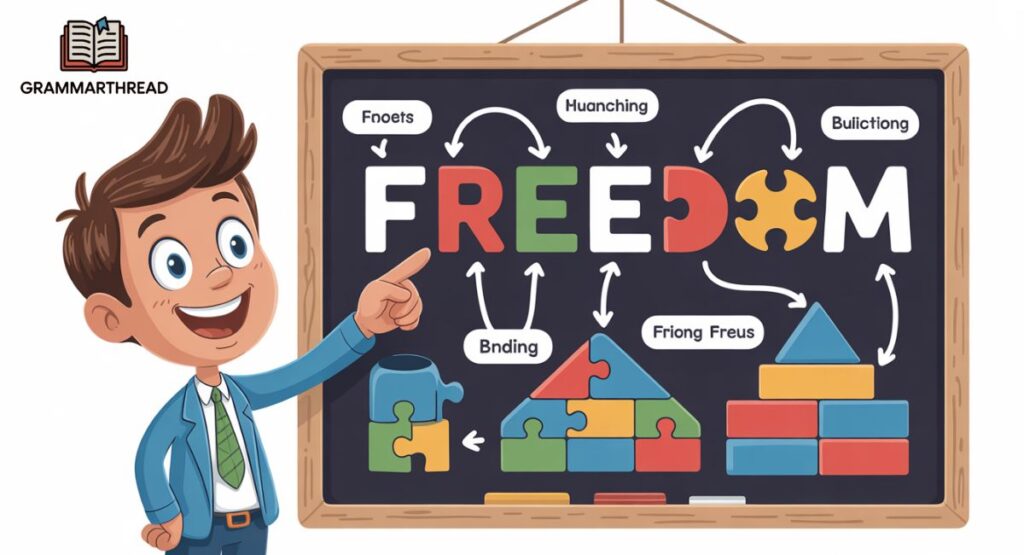
Looking at how antonyms for freedom work requires us to see how these words contradict or reverse what freedom means. From a grammatical standpoint, these opposing terms show up as nouns (like bondage), adjectives (like restricted), or verbs (like constrain). Which antonym fits best depends on what dimension of freedom you’re talking about.
Take political freedom as an example. Words like authoritarianism or totalitarianism work better here. When you’re describing personal liberty, terms like detention or restraint make more sense. The way these words are built often uses prefixes or suffixes that flip the meaning of a base word (think independent versus dependent).
Look at how “free” transforms into its opposites. You can attach prefixes like ‘un’, ‘in’, or ‘non’ to build antonyms: “unfree,” “incarcerated,” or “nonautonomous.”
The same pattern works with suffixes. Adding endings like ‘ment’ or ‘dom’ to related root words creates antonymous nouns: “confinement” (from “confine”) or “thralldom” (connected to “thrall”).
Opposite of Freedom
Captivity and Imprisonment
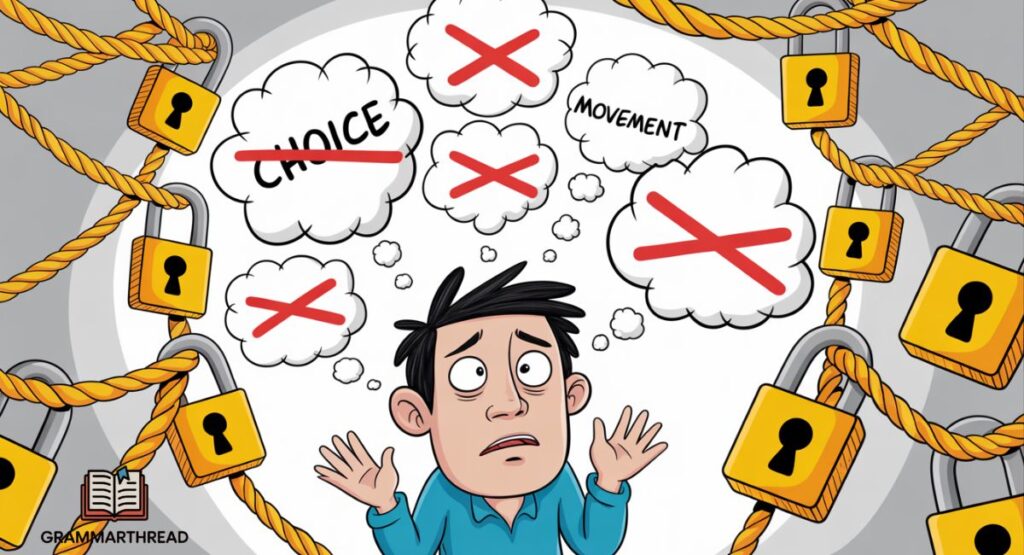
Captivity and imprisonment describe being held somewhere against your wishes, usually within a restricted area. These antonyms for freedom focus on physical confinement and the inability to move freely. Captivity tends to mean a broader state of being trapped, while imprisonment typically refers to official or lawful detention.
Think about wild animals kept in captivity at a wildlife facility versus someone serving time in prison after a criminal conviction. Both situations represent a clear removal of physical liberty and movement.
Servitude and Slavery
Servitude and slavery describe situations where people are forced to work without control over their own lives or labor. Slavery represents the most severe form, where one human being actually owns another. Servitude also covers contract labor or other types of obligatory service that strip away personal agency.
These words capture the loss of both economic independence and personal autonomy. Someone enslaved has zero rights and gets treated like an object. Someone in servitude might retain minimal rights but still answers to someone else’s authority.
Oppression and Tyranny
Oppression and tyranny describe the unfair or brutal use of authority, usually by governments or those in power. These terms point to the crushing of liberties through intimidation or violence. Tyranny takes oppression further, involving total and unrestricted power wielded without accountability.
These opposing concepts connect directly to political and civil freedom. People living under tyrannical rule have zero voice in governance and must bend to the dictator’s desires. Those facing oppression encounter systematic bias and the withholding of fundamental human rights.
Restraint and Restriction
Restraint and restriction mean limits or controls imposed on what you can do, say, or choose. These words cover both tangible and intangible barriers. Restraint usually suggests an intentional act of holding back, while restriction encompasses a wider variety of boundaries.
These antonyms touch different dimensions of liberty. Someone released on probation might face restrictions on where they can go. A journalist might show restraint in their reporting to protect sources or avoid legal issues.
Dependence and Reliance
Dependence and reliance describe needing other people or things for help, resources, or basic survival. While these aren’t always harmful, too much dependence can reduce your independence and ability to make free choices. These concepts emphasize the absence of self-reliance and the risk of being controlled by others.
These opposing terms often connect to financial or psychological freedom. An adult who depends financially on family members may struggle to make autonomous life choices. A country that relies too heavily on imported goods may become susceptible to diplomatic manipulation.
Examples of Antonyms in Sentences
To demonstrate how these antonyms for freedom work in real contexts, let’s look at practical examples. These examples are organized by antonym type, showing how each term applies across different situations.
The following table presents examples of Captivity and Imprisonment in sentences:
| Antonym | Example Sentence |
| Captivity | The sanctuary works to rehabilitate animals removed from captivity. |
| Captivity | Following decades in captivity, the elephants needed time to readjust to open spaces. |
| Captivity | The film exposed the harsh reality of holding dolphins in captivity. |
| Imprisonment | His imprisonment stemmed from participation in fraudulent business schemes. |
| Imprisonment | The court issued a ten-year imprisonment sentence for the offense. |
| Imprisonment | Activists campaigned for better conditions during imprisonment. |
| Confinement | The isolation of solitary confinement left lasting psychological scars. |
| Confinement | Being restricted to confinement in the remote town made her crave city life. |
| Confinement | Watching the parrot’s confinement in that tiny cage was heartbreaking. |
| Detention | Authorities placed him in detention while conducting their investigation. |
| Detention | The teacher assigned detention after the classroom disruption. |
| Detention | Advocacy groups have challenged the practices at immigration detention facilities. |
| Incarceration | Rising incarceration numbers signal deeper societal challenges. |
| Incarceration | The period of incarceration transformed his entire perspective. |
| Incarceration | Overcrowding has become a critical issue affecting incarceration facilities statewide. |
| Internment | Wartime policies led to the internment of thousands of civilians. |
| Internment | Historical records document the suffering within internment facilities. |
| Internment | The legacy of internment remains a painful national memory. |
| Custody | Officers took the accused into custody at the scene. |
| Custody | Social services placed the minor in protective custody. |
| Custody | He stayed in custody pending his court appearance. |
| House arrest | White-collar offenders often receive house arrest instead of jail time. |
| House arrest | The terms of house arrest prohibited leaving the residence. |
| House arrest | Her sentence included six months under house arrest with monitoring. |
This table demonstrates how terms like captivity, imprisonment, and confinement express being held without consent, underscoring the removal of physical liberty. The sentences span various scenarios, from wildlife conservation to judicial outcomes.
The following table presents examples of Servitude and Slavery in sentences:
| Antonym | Example Sentence |
| Servitude | Contract servitude played a significant role in early American labor. |
| Servitude | After breaking free from servitude, he built an independent future. |
| Servitude | Legal agreements trapped him in several years of servitude without compensation. |
| Slavery | Ending slavery marked a pivotal moment in the fight for human dignity. |
| Slavery | Countless lives were destroyed by the inhumane institution of slavery. |
| Slavery | The legacy of slavery shapes contemporary social dynamics. |
| Enslavement | Mass enslavement represents one of history’s gravest injustices. |
| Enslavement | Advocates worked tirelessly to eliminate the enslavement of laborers. |
| Enslavement | The exhibition documented the brutal realities of enslavement. |
| Bondage | Financial bondage kept families trapped in cycles of poverty. |
| Bondage | Psychological bondage can restrict people just as effectively as physical restraints. |
| Bondage | The narrative examined concepts of bondage and emancipation. |
| Subjugation | Colonial subjugation brought tremendous hardship to indigenous communities. |
| Subjugation | Communities defended their heritage against cultural subjugation. |
| Subjugation | Foreign subjugation dominated the region for generations. |
| Forced labor | International regulations prohibit the practice of forced labor. |
| Forced labor | Investigations revealed forced labor throughout the production network. |
| Forced labor | The nonprofit fights against forced labor and trafficking worldwide. |
| Oppression | Institutional oppression blocked access to education and employment. |
| Oppression | Revolutionary movements challenged the oppression of authoritarian leaders. |
| Oppression | Learning about historical oppression helps us protect freedoms today. |
This table showcases words like servitude, slavery, enslavement, and subjugation through sentence examples. These terms capture situations of compulsory work and lost autonomy, emphasizing the stripping away of economic and personal independence.
The following table presents examples of Oppression and Tyranny in sentences:
| Antonym | Example Sentence |
| Oppression | Decades of political oppression left deep wounds in society. |
| Oppression | Citizens organized resistance movements against oppression. |
| Oppression | Legislative reforms sought to dismantle systemic oppression. |
| Tyranny | Mass protests erupted against the tyranny of the ruling leader. |
| Tyranny | Liberation from tyranny came after years of struggle. |
| Tyranny | Thinkers throughout history have cautioned about tyranny left unchecked. |
| Despotism | The monarchy suffered under the despotism of an unjust ruler. |
| Despotism | Citizens desperately wanted escape from governmental despotism. |
| Despotism | Ancient texts chronicle the despotism and decay of fallen empires. |
| Authoritarianism | Growing authoritarianism posed serious risks to civil liberties. |
| Authoritarianism | New regulations signaled a dangerous move toward authoritarianism. |
| Authoritarianism | The nation worked to shed decades of authoritarianism. |
| Dictatorship | A military dictatorship seized control of the government. |
| Dictatorship | Under dictatorship, any opposition faced immediate punishment. |
| Dictatorship | Popular uprisings toppled the dictatorship and created democratic institutions. |
| Totalitarianism | Totalitarianism attempts to regulate all dimensions of public and private life. |
| Totalitarianism | State-imposed totalitarianism dominated every facet of society. |
| Totalitarianism | Classic literature warns readers about the perils of totalitarianism. |
| Autocracy | Absolute power rested with the king in this autocracy. |
| Autocracy | No dissenting voices survived under the autocracy. |
| Autocracy | Moving from autocracy toward democracy proved lengthy and complex. |
This table provides sentence examples for words like oppression, tyranny, despotism, and dictatorship. These terms describe harsh misuse of authority, highlighting how liberties get crushed through violence or intimidation.
The following table presents examples of Restraint and Restriction in sentences:
| Antonym | Example Sentence |
| Restraint | Despite the insult, she demonstrated remarkable restraint. |
| Restraint | New policies placed restraints on public demonstrations. |
| Restraint | The designer used restraint with decorative elements, achieving elegant simplicity. |
| Restriction | Library policy includes restrictions on food and beverages. |
| Restriction | Immigration restriction became stricter under recent legislation. |
| Restriction | Trade sanctions imposed restrictions on what the business could sell abroad. |
| Limitation | Acknowledging her skill limitations, she enrolled in advanced training. |
| Limitation | Financial limitations delayed the construction timeline. |
| Limitation | Health limitations forced him to reconsider his career path. |
| Control | Authorities attempted to gain control over news outlets. |
| Control | Icy conditions caused him to lose control of the vehicle. |
| Control | Management exercised tight control over daily operations. |
| Curb | Environmental rules were designed to curb industrial emissions. |
| Curb | She made efforts to curb unnecessary purchases. |
| Curb | Law enforcement strategies focused on efforts to curb gang activity. |
| Check | New oversight measures put a check on monopolistic practices. |
| Check | Independent reviews served as a check on financial reporting. |
| Check | Media scrutiny provided a check against political overreach. |
This table includes sentence examples for words like restraint, restriction, limitation, and control. These terms represent boundaries or regulations imposed on behavior, decisions, or self-expression.
The following table presents examples of Dependence and Reliance in sentences:
| Antonym | Example Sentence |
| Dependence | Economic dependence on tourism left the island exposed to seasonal downturns. |
| Dependence | Substance dependence created severe medical complications. |
| Dependence | The teenager’s dependence on family support lessened with maturity. |
| Reliance | Heavy reliance on one vendor created significant business risk. |
| Reliance | The grower’s reliance on consistent weather patterns proved problematic. |
| Reliance | Strong reliance on collaboration drove the initiative forward. |
| Subordination | Gender-based subordination has persisted across many cultures. |
| Subordination | Workplace subordination to supervisors came with the job responsibilities. |
| Subordination | The philosophy stressed subordination of personal goals to collective welfare. |
| Vulnerability | Financial vulnerability exposed the economy to international crises. |
| Vulnerability | His vulnerability attracted negative attention from classmates. |
| Vulnerability | Security vulnerability to digital breaches raised serious alarms. |
| Subservience | His excessive subservience toward leadership seemed troubling. |
| Subservience | Traditional structures encouraged subservience to established hierarchies. |
| Subservience | Fear drove her patterns of subservience and compliance. |
This table offers sentence examples for words like dependence, reliance, subordination, and vulnerability. These terms describe situations requiring external support or resources, illustrating diminished self-reliance and susceptibility to outside influence.
Usage Rules and Considerations
When selecting antonyms for freedom, context matters significantly, along with the precise shade of meaning you want to communicate. Here are essential guidelines and factors to keep in mind:
- Specificity: Select the most precise antonym that accurately captures the particular form of restriction you’re describing. For instance, use incarceration when discussing legal detention and tyranny when referring to governmental suppression of liberties.
- Connotation: Pay attention to the emotional weight each antonym carries. Enslavement conveys far more severity than dependence, reflecting how extreme the loss of autonomy is in each case.
- Formality: Think about the appropriate tone for your readers and writing purpose. Certain antonyms (like authoritarianism) sound more academic than others (like limitation).
- Figurative Language: These opposing terms work effectively as metaphors to express non-literal forms of constraint. For instance, “She felt trapped in a cage of expectations” applies captivity symbolically to describe social pressure rather than actual physical confinement.
Common Mistakes
Typical errors when working with antonyms for freedom include:
- Overgeneralization: Choosing a vague term instead of a more precise alternative that better captures the situation.
- Incorrect: The nation lacked freedom.
- Correct: The nation experienced authoritarian rule.
- Misusing connotations: Selecting a word that carries unintended emotional associations or implications.
- Incorrect: He celebrated his bondage to the organization.
- Correct: He valued his commitment to the organization.
- Incorrect Part of Speech: Applying the wrong grammatical form (such as using a verb when you need a noun).
- Incorrect: The confine of prisoners was controversial.
- Correct: The confinement of prisoners was controversial.
Practice Exercises
Check your grasp of antonyms for freedom through these practice activities. Select the most appropriate opposite term for “freedom” in each context.
Exercise 1: Fill in the Blanks
| Question | Answer |
| 1. The wildlife suffered in ____ within the cramped enclosures. | captivity |
| 2. The authoritarian leader governed through ____, crushing any opposition. | tyranny |
| 3. His financial ____ on family members restricted his personal decisions. | dependence |
| 4. New regulations placed ____ on public assembly rights. | restrictions |
| 5. The ____ of laborers represents one of humanity’s darkest chapters. | enslavement |
| 6. Police held the individual in ____ during the investigation. | custody |
| 7. Citizens endured the ____ of oppressive monarchs for generations. | despotism |
| 8. The court ordered ____ as punishment for embezzlement. | imprisonment |
| 9. The business’s heavy ____ on imports created economic vulnerability. | reliance |
| 10. Authorities maintained tight ____ over news broadcasting. | control |
Exercise 2: Multiple Choice
| Question | Options | Answer |
| 1. Which term represents an antonym for freedom involving physical restriction? | a) Reliance, b) Captivity, c) Oppression, d) Restraint | b) Captivity |
| 2. Which word characterizes cruel misuse of authority? | a) Dependence, b) Servitude, c) Tyranny, d) Restriction | c) Tyranny |
| 3. Which option indicates compulsory work? | a) Restraint, b) Slavery, c) Reliance, d) Confinement | b) Slavery |
| 4. What word describes boundaries placed on behavior or decisions? | a) Oppression, b) Dependence, c) Restriction, d) Captivity | c) Restriction |
| 5. Which term implies inability to function independently? | a) Tyranny, b) Dependence, c) Imprisonment, d) Subjugation | b) Dependence |
| 6. Which option represents unchecked authoritarian governance? | a) Subservience, b) Despotism, c) Confinement, d) Limitation | b) Despotism |
| 7. Which word refers to formal holding by authorities? | a) Subjugation, b) House arrest, c) Detention, d) Control | c) Detention |
| 8. What describes existing under another’s power or direction? | a) Reliance, b) Subordination, c) Incarceration, d) Restraint | b) Subordination |
| 9. Which term suggests susceptibility to harm or external pressure? | a) Vulnerability, b) Enslavement, c) Autocracy, d) Servitude | a) Vulnerability |
| 10. Which word means forcibly bringing someone under control? | a) Dependence, b) Subjugation, c) Restraint, d) Captivity | b) Subjugation |
Advanced Topics
For those seeking deeper knowledge, exploring the philosophical and political aspects of antonyms for freedom offers valuable insights. Dive into the writings of philosophers such as John Stuart Mill, Thomas Hobbes, and Isaiah Berlin, who extensively examined liberty and the forces that limit it.
Study the historical circumstances that gave rise to various forms of oppression, including enslavement systems, imperial domination, and authoritarian regimes. Additionally, consider how these themes appear in literary works, visual arts, and cinema to understand their cultural impact and representation.
Freedom vs Control: How Meaning Changes With Context
The relationship between freedom and control shifts dramatically depending on the situation you’re examining. What counts as restriction in one context might seem reasonable or even necessary in another. Understanding these nuances helps you choose the right antonym and communicate more precisely.
In personal relationships, control can range from healthy boundaries to toxic manipulation. A parent setting rules for a child represents responsible guidance, while an abusive partner isolating their victim exemplifies oppressive control. The same word carries vastly different weight based on circumstances.
Political contexts add another layer of complexity. Government regulation of public safety might feel like sensible oversight to some citizens but oppressive interference to others. The perception often depends on whose freedom gets prioritized and what values people hold about collective versus individual liberty.
Economic freedom versus control presents similar tensions. Employment relationships involve some level of subordination, but the line between fair work expectations and exploitative labor depends on factors like compensation, working conditions, and the ability to leave. Financial dependence on an employer differs significantly from historical servitude, even though both limit autonomy.
Cultural and social contexts also reshape these meanings. What one society views as appropriate social restraint, another might see as oppression. Traditional hierarchies that emphasize subordination can coexist with modern values of independence, creating ongoing debates about where freedom ends and necessary structure begins.
The key is recognizing that antonyms for freedom exist on a spectrum rather than as absolute categories. Context determines whether limitation serves a legitimate purpose or represents genuine loss of liberty. When choosing your words, consider not just the dictionary definition but the specific situation and the perspective of those affected.
Frequently Asked Questions
What is the opposite of freedom?
The opposite of freedom refers to a state where choice, movement, or independence is limited or controlled, such as oppression or confinement.
Which word best represents the opposite of freedom?
Oppression is often seen as the strongest opposite of freedom because it involves forceful control over people or rights.
Is captivity the opposite of freedom?
Yes, captivity directly contrasts freedom as it means being physically or legally confined.
Can restriction be considered the opposite of freedom?
Restriction is a common opposite of freedom because it limits actions, choices, or expression.
What is the opposite of freedom in a political sense?
In politics, the opposite of freedom often refers to tyranny, dictatorship, or authoritarian control.
What is the opposite of freedom in daily life?
In everyday situations, the opposite of freedom can mean dependence, lack of choice, or strict rules.
Are bondage and freedom opposites?
Yes, bondage implies being bound or controlled, making it a clear opposite of freedom.
What is the emotional opposite of freedom?
Emotionally, the opposite of freedom can be feeling trapped, pressured, or powerless.
Conclusion
Understanding the Opposite of Freedom gives real depth to how we view liberty itself. Words such as captivity, oppression, restraint, and dependence highlight the many ways freedom can be reduced or taken away, depending on context and intent.
Knowing how these antonyms work, where they come from, and how to use them correctly helps sharpen both writing and critical thinking. It also prevents common misuse that can change meaning or tone. Now is a good time to try using these terms in your own sentences, reflect on real world examples, and strengthen how you express ideas about rights, control, and personal choice.
Read Next: Dialogue Between Teacher And Student About Importance Of English

Welcome to GrammarThread. I am Julian Mercer, an AI-powered SEO and content writer with 4 years of experience. I help websites rank higher, grow traffic, and look amazing. My goal is to make SEO and website design simple and effective for everyone. Let’s achieve more together!