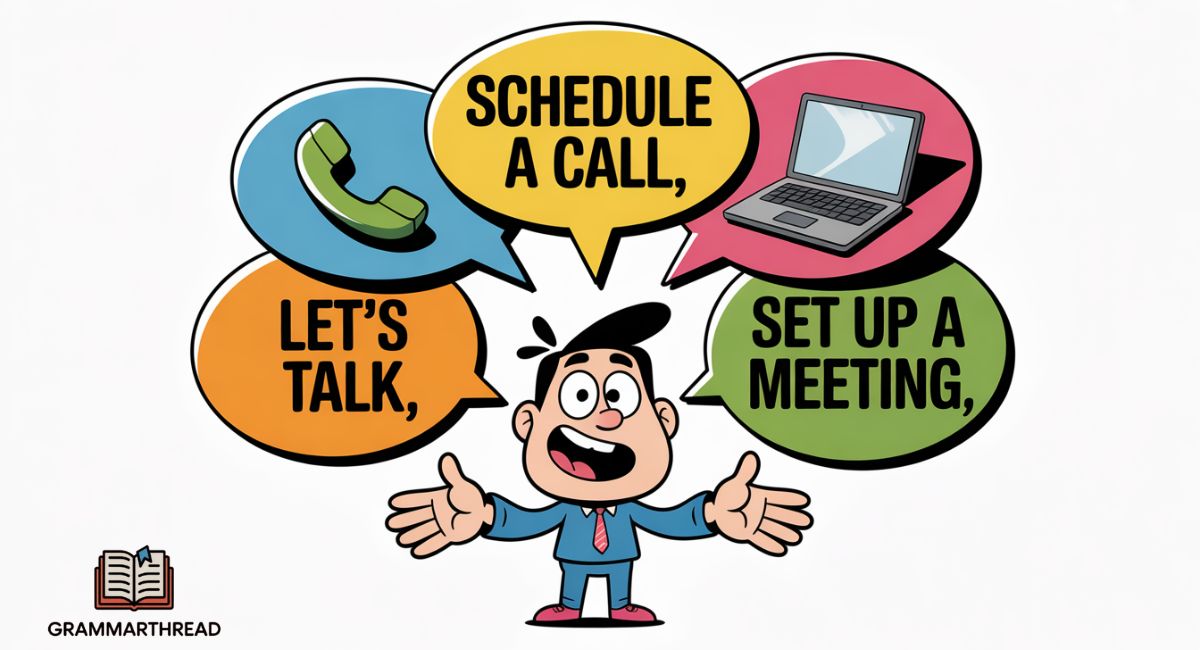
“Hop on a call” is a relaxed, modern phrase people use to suggest a quick phone or video conversation. While it works well in casual chats or team messages, it can feel too informal in professional or business settings. In those moments, clearer alternatives such as “schedule a call,” “set up a time to talk,” or “arrange a meeting” often sound more polished and appropriate.
From coordinating with coworkers to following up with a client or connecting with a potential partner, the words you choose can shape the tone of the entire conversation. This guide explores practical, professional ways to replace “hop on a call,” helping you communicate clearly while matching the right level of formality for every audience and situation.
Definition: “Hop on a Call” and Its Alternatives
“Hop on a call” is a casual expression that refers to joining a phone or video conversation quickly and informally. The phrase implies a short, sometimes impromptu chat rather than a lengthy, structured meeting. It’s considered an idiomatic phrase because you can’t understand its meaning just by looking at each word separately. People use it to suggest having a real-time conversation, usually when they want to discuss something faster than email allows. The setting is often workplace environments or casual interactions where being direct and efficient matters. Choosing varied expressions helps you communicate more clearly and adapt your language to match different professional situations.
You’ll find alternatives to “hop on a call” spanning the entire formality spectrum, and your choice depends on who you’re speaking with, what you need to discuss, and how you want to come across. Professional alternatives work best in corporate communications, particularly when reaching out to managers, executives, or external clients.
Casual alternatives fit conversations with friends, family members, and coworkers you know well. Purpose-driven alternatives help whe
Structural Breakdown of Alternative Phrases
Most alternatives to “hop on a call” rely on recognizable grammatical patterns. Getting familiar with these patterns helps you craft your own variations and apply them appropriately in different contexts.
- Modal Verbs + Verb Phrase: This pattern typically combines modal verbs such as can, could, should, or would with a verb phrase that references calling or connecting. Examples: “Could we arrange a conversation?”, “We should connect by phone.”
- Imperative Sentences: These sentence types deliver a direct request or instruction to the recipient. Examples: “Give me a ring when you’re available.”, “Let’s set up a video call.”
- Question Forms: Posing a question offers a courteous approach to proposing a call. Examples: “Do you have time for a quick discussion?”, “Would you be interested in a short phone chat?”
- Statements + Invitation: This approach combines expressing the reason for a call with an invitation for the other person to join. Examples: “I’d like to go over this in detail; do you have time for a call?”, “It might be easier to discuss this verbally; can we talk soon?”
Grasping these grammatical structures gives you the flexibility to modify and generate your own phrases, which makes your professional communication more adaptable and polished. Having a solid understanding of sentence construction in English improves clarity in everyday interactions.
Types and Categories of Alternatives
You can group alternatives to “hop on a call” according to their formality level and how specific they are about the conversation details. Understanding these categories makes it easier to select the right phrase that matches your situation and audience.
Formal Alternatives
Formal alternatives work well in professional settings, particularly when communicating with managers, clients, or people you haven’t built a relationship with yet. These expressions demonstrate professionalism and courtesy.
- “Would it be possible to schedule a conversation?”
- “I’d appreciate the opportunity to arrange a conference call.”
- “Might I propose a phone discussion?”
- “I suggest we address this matter by telephone.”
- “Are you available for a call whenever suits you best?”
Informal Alternatives
Informal alternatives fit naturally when you’re reaching out to friends, family members, or colleagues you’re comfortable with. These phrases sound relaxed and approachable.
- “Let’s have a phone chat.”
- “Feel like talking on the phone?”
- “Ring me up when you get a chance.”
- “Let’s touch base soon.”
- “Up for a quick call?”
Specific Alternatives
Specific alternatives come in handy when you need to highlight certain details about the call, like why you’re calling, how urgent it is, or what communication tool you’ll use (such as a video conference).
- “Let’s have a brief conversation to go over this.” (Purpose)
- “Can we get on a quick call to sort this out?” (Urgency)
- “Let’s schedule a video meeting so I can walk you through it.” (Medium)
- “Let’s set up a call through Zoom/Skype/Teams.” (Platform)
- “I’d like to book a follow-up conversation.” (Follow-up)
Examples of Alternative Phrases
The tables below offer comprehensive examples of alternative phrases organized by various scenarios. Each table presents multiple options to match different contexts and communication approaches.
Scheduling a Call
This table offers alternatives to “hop on a call” when you need to schedule a conversation for a future time. These expressions work well for coordinating availability and planning ahead.
| Phrase | Context |
| “Would it be possible to schedule a conversation for next week?” | Formal, professional setting |
| “Let’s arrange a time to connect by phone.” | Semi-formal, with colleagues |
| “Do you have availability for a call tomorrow?” | General, polite request |
| “What time would work well for you to connect?” | Open-ended, flexible scheduling |
| “I’d appreciate arranging a conversation to explore this further.” | Formal, business communication |
| “Can we mark down a time to have a chat?” | Informal, friendly scheduling |
| “Let’s identify a time in our schedules to talk.” | Collaborative, team setting |
| “How about we arrange a brief call on Monday?” | Suggesting a specific time |
| “I’m free for a conversation in the afternoon; would that suit you?” | Providing availability |
| “Let’s reserve a time to speak.” | Professional, direct scheduling |
| “Should we organize a phone discussion?” | Formal, polite inquiry |
| “Might you be free for a call later this week?” | Checking availability |
| “Let’s align our schedules for a conversation.” | Professional, coordinating schedules |
| “Can we block off time to address this by phone?” | Professional, emphasizing the need for dedicated time |
| “I’d like to arrange a short conversation to clarify some details.” | Professional, specifying the purpose and duration |
| “Would you be interested in scheduling a phone meeting?” | Formal, suggesting a structured discussion |
| “Let’s find a suitable time to connect by phone.” | Professional, prioritizing convenience |
| “Could we organize a call when it’s most convenient for you?” | Formal, emphasizing urgency and flexibility |
| “I’d like to reserve a time slot for a phone discussion.” | Formal, suggesting a formal scheduling process |
| “Let’s compare our calendars to identify a good time for a call.” | Professional, suggesting a detailed scheduling approach |
| “What would be an ideal time for us to speak by phone next week?” | Formal, professional setting |
| “Let’s plan a time to connect on the phone; which day is best for you?” | Semi-formal, with colleagues |
| “Do you have time for a conversation tomorrow afternoon?” | General, polite request |
| “What would be a suitable time to touch base next week?” | Open-ended, flexible scheduling |
| “I’d appreciate setting up a call to go over these specifics.” | Formal, business communication |
| “Can we block out a time to speak next week?” | Informal, friendly scheduling |
Requesting a Call
This table presents phrases for directly asking someone to contact you by phone. These expressions range in formality and directness.
| Phrase | Context |
| “Please contact me by phone when convenient.” | Formal, urgent request |
| “Would you be able to call me when you’re available?” | Polite, professional request |
| “Ring me back when you have time.” | Semi-formal, expecting a return call |
| “Drop me a line later.” | Informal, friendly request |
| “Could you return my call? I need to go over something.” | Direct, indicating urgency |
| “A call from you would be wonderful.” | Polite, indirect request |
| “Please phone me whenever you’re free.” | Formal, indicating flexibility |
| “I’d be grateful for a return call at your convenience.” | Formal, showing appreciation |
| “Would you mind calling me when you get a chance?” | Polite, indirect request |
| “Please get in touch with me by phone.” | Formal, direct request |
| “I’d appreciate if you could call me when possible.” | Polite, indicating preference |
| “Could you phone me back about this situation?” | Professional, specific request |
| “Please reach me by phone at your convenience.” | Formal, polite request |
| “I’m requesting that you contact me as soon as you can.” | Formal, urgent request |
| “Would you have time to call me back today?” | Polite, checking availability |
| “A phone call from you would be much appreciated.” | Formal, expressing gratitude |
| “I’ll be waiting for your call.” | Direct, indicating anticipation |
| “Please think about calling me to go over this.” | Formal, suggesting a call |
| “I’m here for your call.” | Providing availability |
| “I’m eager to hear from you.” | Expressing anticipation |
| “Please contact me by phone when convenient. I’m available throughout the day.” | Formal, urgent request |
| “Would you be able to call me when you have time to review the document?” | Polite, professional request |
| “Ring me back when you can; it’s regarding the assignment.” | Semi-formal, expecting a return call |
| “Drop me a line later; I’ve got updates to share.” | Informal, friendly request |
| “Could you return my call? I need to go over something time-sensitive.” | Direct, indicating urgency |
| “A call from you would be wonderful; I need to confirm some details.” | Polite, indirect request |
Suggesting a Quick Call
This table presents alternatives when you want to propose a short and focused call to handle a particular matter or question.
| Phrase | Context |
| “Let’s have a brief conversation to go over this.” | General, suggesting brevity |
| “Can we get on a short call to handle this matter?” | Urgent, problem-solving focus |
| “I’d like to suggest a quick conversation to clear up the specifics.” | Formal, professional suggestion |
| “Let’s check in quickly by phone.” | Informal, efficient communication |
| “Should we have a brief call to review this?” | Polite, collaborative |
| “I recommend a short call to coordinate our approach.” | Professional, strategic discussion |
| “Let’s touch base briefly by phone to sync our work.” | Collaborative, coordinating tasks |
| “A brief call would help us settle this more quickly.” | Emphasizing efficiency |
| “Can we arrange a short phone discussion to handle this situation?” | Formal, addressing a specific issue |
| “Let’s have a quick and efficient call.” | Informal, friendly suggestion |
| “I suggest a short call for a progress check.” | Professional, updating progress |
| “Let’s have a brief 10-minute discussion to address this.” | General, suggesting brevity |
| “Can we get on a short call to handle this matter before the cutoff?” | Urgent, problem-solving focus |
| “I’d like to suggest a quick conversation to clear up the agreement terms.” | Formal, professional suggestion |
| “Let’s check in quickly by phone regarding the slides.” | Informal, efficient communication |
| “Should we have a brief call to review this document together?” | Polite, collaborative |
| “I recommend a short call to coordinate our approach for next month.” | Professional, strategic discussion |
| “Let’s touch base briefly by phone to sync our work on the promotion.” | Collaborative, coordinating tasks |
| “A brief call would help us settle this more quickly and maintain momentum.” | Emphasizing efficiency |
| “Can we arrange a short phone discussion to handle this situation with the vendor?” | Formal, addressing a specific issue |
| “Let’s have a quick and efficient call to wrap up the loose ends.” | Informal, friendly suggestion |
| “I suggest a short call for a progress check on the finances.” | Professional, updating progress |
| “Let’s have a brief discussion to address this; I’m free right now.” | General, suggesting brevity |
| “Can we get on a short call to handle this matter immediately?” | Urgent, problem-solving focus |
| “I’d like to suggest a quick conversation to clear up the specifics; if you’re available.” | Formal, professional suggestion |
| “Let’s check in quickly by phone; I’ve got 10 minutes free.” | Informal, efficient communication |
Specifically Suggesting a Video Call
This table presents alternatives when you want to specifically propose a video conversation, typically to share visual content or create a more personal interaction.
| Phrase | Context |
| “Let’s arrange a video conversation so I can demonstrate.” | Suggesting visual aid |
| “Can we meet via Zoom/Skype/Teams?” | Specifying platform |
| “I’d like to suggest a video conference to address this topic.” | Formal, professional setting |
| “Let’s have a video discussion to add a personal touch.” | Emphasizing personal connection |
| “Should we connect through webcam to review the information?” | Polite, detailed discussion |
| “I recommend a video conversation so we can view screens together.” | Professional, screen sharing |
| “Let’s schedule a video meeting to work together more productively.” | Collaborative, improving efficiency |
| “A video conversation would improve our mutual understanding.” | Emphasizing understanding |
| “Can we organize a video meeting to tackle this matter?” | Formal, addressing a specific issue |
| “Let’s have a virtual face-to-face conversation.” | Informal, friendly suggestion |
| “I suggest a video call for a more dynamic conversation.” | Professional, engaging discussion |
| “Let’s arrange a video conversation so I can walk you through the model.” | Suggesting visual aid |
| “Can we meet via Zoom/Skype/Teams for a quick walkthrough?” | Specifying platform |
| “I’d like to suggest a video conference to address this topic with everyone.” | Formal, professional setting |
| “Let’s have a video discussion to add a personal touch and strengthen our connection.” | Emphasizing personal connection |
| “Should we connect through webcam to review the information about the layout?” | Polite, detailed discussion |
| “I recommend a video conversation so we can view screens together and examine the numbers.” | Professional, screen sharing |
| “Let’s schedule a video meeting to work together more productively on the initiative.” | Collaborative, improving efficiency |
| “A video conversation would improve our mutual understanding and prevent confusion.” | Emphasizing understanding |
| “Can we organize a video meeting to tackle this matter with the partners?” | Formal, addressing a specific issue |
| “Let’s have a virtual face-to-face conversation; it’s been too long!” | Informal, friendly suggestion |
| “I suggest a video call for a more dynamic conversation about the plan.” | Professional, engaging discussion |
| “Let’s arrange a video conversation so I can walk you through the mockups.” | Suggesting visual aid |
| “Can we meet via Zoom/Skype/Teams to exchange the documents?” | Specifying platform |
| “I’d like to suggest a video conference to address this topic for the pitch.” | Formal, professional setting |
Phrases for International Calls
This table presents alternatives when you’re organizing or proposing a call with someone in another country, taking into account time zones and cultural considerations.
| Phrase | Context |
| “Could we arrange a call while being mindful of the time difference?” | Acknowledging time zones |
| “Which time is most suitable for you in your location?” | Prioritizing convenience |
| “Let’s identify a time that accommodates both of us internationally.” | Collaborative, international context |
| “Should we organize a call even with the geographical distance?” | Polite, acknowledging distance |
| “I’m adaptable; please share what time is best for you.” | Offering flexibility |
| “Let’s coordinate a call that fits both our calendars.” | Collaborative, schedule coordination |
| “Could we set up a call that accounts for the time zone gap?” | Formal, professional consideration |
| “What would be your ideal time for a cross-border call?” | Direct, seeking preference |
| “I’m willing to modify my schedule to fit your time zone.” | Offering accommodation |
| “Let’s make sure our call happens at a suitable hour for each of us.” | Emphasizing consideration |
| “Could we arrange a call while being mindful of the time difference between Paris and Chicago?” | Acknowledging time zones |
| “Which time is most suitable for you in your location in Singapore?” | Prioritizing convenience |
| “Let’s identify a time that accommodates both of us internationally for a discussion.” | Collaborative, international context |
| “Should we organize a call even with the geographical distance; I’m fine with an early start?” | Polite, acknowledging distance |
| “I’m adaptable; please share what time is best for you to connect.” | Offering flexibility |
| “Let’s coordinate a call that fits both our calendars; I’m available after 7pm.” | Collaborative, schedule coordination |
| “Could we set up a call that accounts for the time zone gap; I’m currently in PST.” | Formal, professional consideration |
| “What would be your ideal time for a cross-border call; I’m open to options.” | Direct, seeking preference |
| “I’m willing to modify my schedule to fit your time zone; just let me know.” | Offering accommodation |
| “Let’s make sure our call happens at a suitable hour for each of us; let’s settle on a time.” | Emphasizing consideration |
| “Could we arrange a call while being mindful of the time difference between our cities?” | Acknowledging time zones |
| “Which time is most suitable for you in your location; simply inform me.” | Prioritizing convenience |
| “Let’s identify a time that accommodates both of us internationally for the session.” | Collaborative, international context |
| “Should we organize a call even with the geographical distance; what’s your availability?” | Polite, acknowledging distance |
Usage Rules and Considerations

When selecting an alternative to “hop on a call,” keep the following guidelines and factors in mind:
- Formality: Align your language formality with your relationship to the recipient. Choose professional expressions when communicating with managers and clients, and use casual language when reaching out to friends and familiar coworkers.
- Context: Think about the reason behind the call. When something is time-sensitive, opt for straightforward language. For routine conversations, use more flexible phrasing.
- Specificity: Make the call format clear when suggesting a conversation. If you’re proposing a video meeting, state it explicitly. If screen sharing is needed, include that detail.
- Cultural Sensitivity: Stay aware of cultural nuances, particularly in cross-border communications. Certain cultures value more formal expressions, while others appreciate directness.
- Time Zones: When coordinating international calls, always account for time zone variations and demonstrate flexibility in scheduling.
Following these guidelines helps ensure your communication remains effective, courteous, and suitable for each unique situation. Being thoughtful about these considerations strengthens professional relationships and prevents misunderstandings.
Common Mistakes to Avoid
Here are frequent errors to steer clear of when using alternatives to “hop on a call”:
| Incorrect | Correct | Explanation |
| “Let’s ring, okay?” | “Let’s have a phone conversation.” | Stay away from casual slang or fragmented sentences in business contexts. |
| “Ring me right now!” | “Please contact me when you have a moment.” | Don’t use excessively urgent phrasing unless the situation genuinely demands it. |
| “Video call immediately!” | “Would you have time for a video call?” | Steer clear of commanding language. Keep your tone polite and considerate. |
| “I want call with you.” | “I’d like to arrange a call with you.” | Make sure your grammar and sentence construction are accurate. |
| “We talk phone soon.” | “Let’s connect by phone soon.” | Write in complete sentences to ensure clarity. |
| “Let’s ring, okay.” | “Let’s have a phone conversation later.” | Avoid casual slang or incomplete phrasing in professional communication. |
| “Contact me immediately!” | “Please reach out to me at your earliest chance.” | Don’t resort to overly urgent wording unless truly required. |
| “Get on video now!” | “Do you have availability for a video call when convenient?” | Avoid commanding tones; keep your approach respectful and courteous. |
| “I want speak you quick.” | “I’d like to speak with you as soon as you’re available.” | Ensure your phrasing follows proper grammatical rules and structure. |
| “We call soon; really important.” | “Let’s arrange a phone call soon; it’s important that we discuss this.” | Use full sentences for better comprehension and provide necessary context. |
Paying attention to these common pitfalls helps maintain professionalism and ensures your message comes across clearly and respectfully in any business setting.
Practice Exercises
Challenge your knowledge with these practice scenarios. Select the most suitable alternative to “hop on a call” for each situation.
1. Scenario: You need to go over a project with your supervisor.
- a. Let’s hop on a call.
- b. Would it be possible to arrange a call about the project?
- c. Ring me up later.
Answer: b
2. Scenario: You want to quickly address an issue with a coworker.
- a. Let’s have a phone chat.
- b. Can we get on a brief call to handle this?
- c. Contact me whenever.
Answer: b
3. Scenario: You need to conduct a thorough discussion with a client.
- a. Let’s video chat.
- b. I’d like to suggest a video conference to address this topic.
- c. Give me a ring.
Answer: b
4. Scenario: You want to propose a call with a friend.
- a. Let’s touch base soon.
- b. I would appreciate scheduling a conversation.
- c. We ought to plan a formal call.
Answer: a
5. Scenario: You need to arrange a call with someone in another time zone.
- a. Contact me whenever you can.
- b. Which time is most convenient for you in your location?
- c. Let’s have a conversation.
Answer: b
6. Scenario: You need to address an urgent situation with your manager.
- a. Let’s have a chat.
- b. Can we arrange a conversation at some point?
- c. Please contact me when you have your first available moment.
Answer: c
7. Scenario: You want to casually propose a call to a familiar colleague.
- a. Let’s catch up later to talk it over.
- b. I’d like to suggest a formal discussion about the matter.
- c. We should organize an official call in the near future.
Answer: a
8. Scenario: You need to demonstrate something visually to a client.
- a. Let’s speak later on.
- b. Let’s arrange a video call so I can walk you through it.
- c. Ring me when you’re available.
Answer: b
9. Scenario: You’re working to schedule a meeting across multiple countries.
- a. Contact me whenever, wherever.
- b. What time would suit you best, taking your time zone into account?
- c. Let’s just connect at some point.
Answer: b
10. Scenario: You want to suggest a brief, casual call to a friend.
- a. Could we organize a professional call?
- b. Let’s check in quickly by phone.
- c. I’m requesting an official meeting.
Answer: b
Advanced Topics: Nuances and Subtleties
For those looking to refine their communication abilities, recognizing the nuances and subtle distinctions in alternatives to “hop on a call” can significantly improve your professional interactions:
- Implied Urgency: Certain expressions carry an underlying sense of time sensitivity even when urgency isn’t directly mentioned. For instance, “Can we get on a brief call to sort this out?” signals that the issue requires prompt attention and shouldn’t be delayed.
- Level of Engagement: Video conversations typically indicate a deeper level of focus and involvement than standard phone calls. Opting to propose a video meeting can communicate that the topic holds substantial importance and warrants full attention.
- Cultural Expectations: Various cultures maintain distinct norms surrounding telephone communication etiquette. Taking time to learn and respect these cultural differences can help you avoid potential miscommunications and build rapport across borders.
- Tone of Voice: The way you deliver your request for a call plays a crucial role in how your message is received. Using a warm and welcoming tone can increase the likelihood that the recipient will respond positively to your suggestion.
Developing proficiency in these subtleties enables you to communicate with greater precision and cultivate more meaningful professional connections. These skills become particularly valuable in cross-cultural business environments and senior-level communications.
Polite Ways to Suggest a Call Without Sounding Pushy
Proposing a phone conversation without coming across as demanding requires careful word choice and thoughtful phrasing. The key is balancing your need for communication with respect for the other person’s time and schedule. When you frame your request tactfully, you increase the chances of a positive response while maintaining professional courtesy.
Use Question Formats
Questions naturally soften requests and give the recipient control over the decision. Instead of telling someone to call you, ask if they’d be open to it. Phrases like “Would you be available for a brief conversation?” or “Do you have time to connect by phone?” put the choice in their hands and show consideration for their schedule.
Offer Flexibility
Demonstrating flexibility signals that you value the other person’s time constraints. Include phrases that acknowledge their availability, such as “whenever it’s convenient for you” or “at a time that works best with your schedule.” This approach removes pressure and creates space for them to participate on their own terms.
Acknowledge Their Busy Schedule
Recognizing that someone might have competing priorities shows empathy and awareness. Try expressions like “I know you’re juggling many things right now” or “I understand if your schedule is tight.” This acknowledgment validates their workload before making your request, which helps establish mutual respect.
Provide Context
Explaining why you want to connect helps the other person understand the value of the conversation. Brief context like “I’d appreciate discussing the proposal details with you” or “It would be helpful to walk through these questions together” gives them a clear reason to prioritize your request without feeling blindsided.
Use Softening Language
Words like “perhaps,” “possibly,” or “if you’re willing” reduce the forcefulness of your suggestion. These terms create a collaborative tone rather than a directive one. For example, “Perhaps we could arrange a time to speak?” feels considerably gentler than “We need to schedule a call.”
Express Appreciation
Thanking someone in advance for their time demonstrates gratitude and politeness. Phrases such as “I’d really appreciate your input” or “Thank you for considering this” show that you don’t take their availability for granted and recognize the favor you’re asking.
Give Them an Out
Allowing the person to decline gracefully without awkwardness is essential. Include options like “If now isn’t a good time, we can definitely find another way to address this” or “No pressure if your schedule doesn’t allow for it.” This removes any obligation and keeps the interaction comfortable for both parties.
By incorporating these techniques into your communication, you can suggest phone conversations that feel inviting rather than intrusive, ultimately leading to more successful and respectful professional exchanges.
Frequently Asked Questions
What does “hop on a call” mean?
It means to have a quick phone or video conversation, usually in a casual or informal setting.
Is “hop on a call” professional to use?
It works in relaxed workplaces, but in formal or client-facing situations, more polished phrases are better.
When should I use “hop on a call”?
Use it with coworkers, friends, or teams where the tone is friendly and informal.
What are formal alternatives to “hop on a call”?
Common options include “schedule a call,” “set up a meeting,” or “arrange a time to talk.”
Is “hop on a call” suitable for emails?
It fits casual emails, but formal emails usually require a more professional expression.
Can I say “hop on a call” in business meetings?
It depends on company culture; startups may accept it, while traditional firms may not.
Does “hop on a call” sound rude?
No, it sounds friendly, but it can feel too casual if the context is serious.
Is “hop on a call” used in American English?
Yes, it’s commonly used in American English, especially in modern workplace communication.
Conclusion
To wrap up, knowing when and how to replace “hop on a call” can make your communication clearer and more professional. By paying attention to context, formality, and cultural expectations, you can select phrases that fit the situation and leave the right impression.
From setting up a client call to asking a teammate for a quick chat or planning an international meeting, the right wording matters. Start using these alternatives in emails, messages, and conversations to build confidence and fluency. Try a few today and notice how small language choices can strengthen relationships and open new opportunities.
Read Next: 18 Opposite of Freedom: Must-Know Antonyms Listed

Welcome to GrammarThread. I am Julian Mercer, an AI-powered SEO and content writer with 4 years of experience. I help websites rank higher, grow traffic, and look amazing. My goal is to make SEO and website design simple and effective for everyone. Let’s achieve more together!