Choosing between Combating or Combatting often trips people up, especially when writing about real issues like fighting illness, reducing crime, or stopping false information. At first glance, both spellings look reasonable, which is exactly why this question keeps coming up in classrooms, offices, and online content.
In everyday writing, combating is the form most readers expect to see, particularly in American English. The reason comes down to how English spelling rules work and where the stress falls in the word combat. Understanding this small detail can save you from second guessing and awkward corrections later.
If you care about clarity, credibility, and sounding confident in your writing, this distinction matters. Using the right spelling helps your message feel polished, professional, and easy to trust, whether you are writing an essay, an email, or a blog post.
Understanding “Combat” Where This Powerful Word Comes From
The term “combat” has its origins in Latin and old French. Historically, people used this word to describe warfare and physical confrontations. In modern usage, it refers not only to actual fighting but also to determined efforts against challenges such as disease, corruption, or misinformation.
English speakers use “combat” in two main ways. When used as a noun, it describes a battle or conflict. When used as a verb, it means to actively oppose or fight something. This foundational word gives rise to related forms like “combating,” which appears frequently in contemporary writing and speech.
American vs. British Spelling: How Each Region Writes “Combating”
| Spelling Variation | Where It’s Used | Preference Level |
| Combating | United States | Primary spelling |
| Combatting | United Kingdom & Commonwealth | Accepted alternative |
- American English favors combating as the standard form. You’ll find this spelling across textbooks, major publications, and official documents throughout the U.S.
- British English writers occasionally choose combatting with double “t,” although combating remains widely accepted and frequently appears in professional writing across the UK.
- When writing for international audiences, combating works best since it’s recognized universally and avoids regional confusion.
The Consonant Doubling Rule: Why “Combating” Gets One “T”
- When a single-syllable word ends with a vowel followed by a consonant, you double that final consonant before adding -ing (stop → stopping).
- For words with multiple syllables, the final consonant doubles only if the emphasis lands on that last syllable (refer → referring).
- Since “combat” places stress on the first syllable rather than the last, the “t” stays single when forming combating. This follows the standard pattern for similarly stressed words.
Grammar Essentials: Present Participles and Gerunds Explained

Understanding These Forms:
A present participle is a verb ending in “-ing” that describes ongoing action, such as “She is writing.” This form pairs with auxiliary verbs to convey actions in progress or continuous states.
A gerund shares the same“-ing” ending but functions as a noun in sentences. It labels an activity, as in “Writing helps me think.” Though they appear identical, these forms serve distinct grammatical purposes. Recognizing the difference improves clarity in both casual and formal communication.
- A present participle carries the “-ing” suffix and describes action in progress, like They are cooking.
- A gerund uses the same “-ing” ending but operates as a noun, such as Cooking relaxes me.
- While these forms appear identical, their grammatical functions differ completely within sentence structure.
Writing for Your Readers: Why Audience Matters
Audience awareness involves considering who will read your content before you write. Different readers follow different English conventions some prefer American standards, others British norms. Writers select spelling and language patterns that align with their audience so the message lands naturally and accurately.
Strong audience awareness makes your writing appear polished and considerate. An academic essay, a business memo, or a blog article might each require distinct spelling conventions. Understanding your readers allows you to maintain clarity, simplicity, and consistency throughout your text.
- Audience awareness means recognizing your readers’ expectations and adapting your language choices accordingly.
- Readers in America typically expect combating, whereas some British audiences might recognize combatting in certain contexts.
- Maintaining consistency with one spelling style throughout your document helps readers follow along easily and builds trust in your credibility.
How “Combating” Appears in Everyday Writing

- American news outlets regularly use combating when covering topics like public health or crime prevention.
- UK medical publications occasionally feature combatting, though combating remains equally common across official reports.
- Educators across the United States teach combating as the standard spelling in classroom instruction.
- International news websites addressing global challenges typically opt for combating to reach diverse audiences.
- Major dictionaries and editorial style manuals list combating as the primary form, with combatting noted as a less frequent variant.
What Leading Dictionaries and Style Guides Recommend
| Reference Source | Preferred Spelling | Additional Details |
| Merriam-Webster | Combating | Doesn’t recognize “combatting” |
| Oxford English Dictionary | Both accepted | Lists “combating” as standard form |
| Cambridge Dictionary | Both accepted | Single “t” more prevalent, double “t” allowed |
| AP Stylebook (U.S.) | Combating | Single consonant standard |
| Chicago Manual of Style | Combating | Single consonant standard |
Spelling Myths and Errors to Avoid
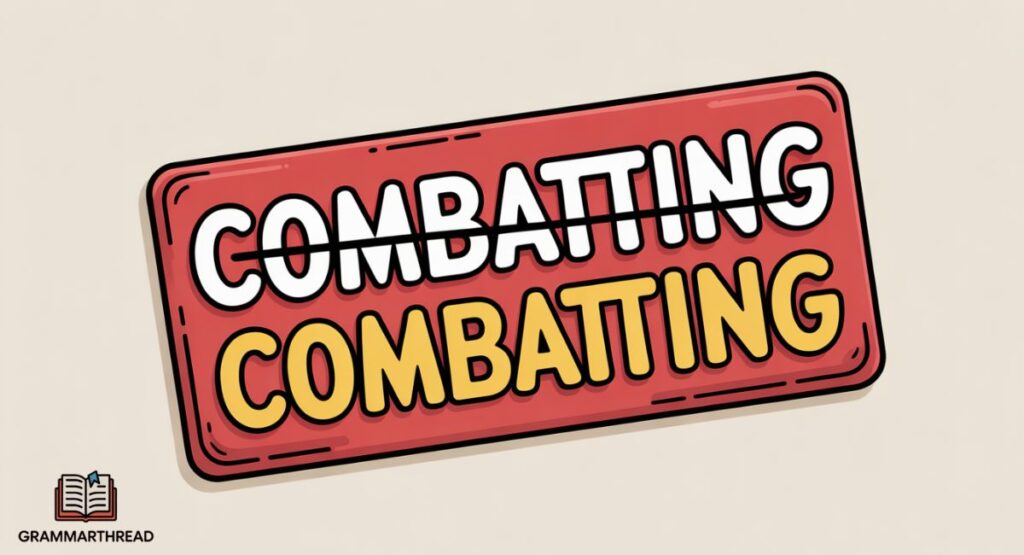
- A common assumption is that combatting is incorrect everywhere, but it actually shows up in certain British English publications.
- Some assume the two spellings carry different meanings, though both versions express exactly the same concept.
- Spell-checking software might accept combatting when set to British English configurations without flagging errors.
- Switching between both spellings within a single document creates an inconsistent appearance that undermines credibility.
- Selecting one correct form at the start and maintaining it throughout ensures your writing stays polished and trustworthy.
Why SEO, Clarity, and Consistency Matter in Your Writing
Effective SEO increases your content’s visibility to online audiences. Accurate spelling paired with straightforward language creates accessible reading experiences. Search algorithms favor well-structured text, meaning proper choices boost rankings while strengthening reader confidence in your material.
Maintaining clarity and uniform style elevates your writing’s professionalism. Sticking with one spelling choice throughout eliminates reader confusion. Audiences feel reassured when content appears polished, logically arranged, and uniform. This approach enhances everything from academic assignments to digital publications.
- Strong SEO practices position your writing where searchers can easily discover it online.
- Precise spelling creates smooth readability that welcomes all audience levels.
- Maintaining identical spelling throughout demonstrates attention to detail and competence.
- Uniform presentation cultivates credibility as readers recognize your careful, dependable approach.
- Establishing spelling standards upfront prevents errors and streamlines your editing process later.
Other Words with Similar Spelling Differences
- American writers use canceling with one “l,” whereas British writers prefer cancelling with two.
- In the United States, traveling is standard, but UK publications feature travelling instead.
- Americans spell it quarreling, while their British counterparts write quarrelling.
- Many words follow this pattern where American English keeps a single consonant and British English doubles it.
- Recognizing these spelling tendencies enables writers to select appropriate forms based on their target audience.
The Bottom Line: Which Spelling Should You Choose?
- American English consistently requires combating as the proper spelling.
- British English occasionally uses combatting, though combating remains widely accepted and frequently seen.
- The meaning stays identical between both versions only the spelling varies.
- Avoid alternating between the two spellings within a single piece of writing.
- When addressing international audiences, combating serves as the more universally recognized and dependable option.
For Grammar Lovers: The Linguistic Details Behind “Combating”
Why “Combat” Breaks the Doubling Pattern
- The word combat places emphasis on its opening syllable rather than the final one.
- English consonant-doubling conventions typically apply when stress falls on the word’s ending.
- Due to this stress placement, the concluding “t” remains single.
- Similar words like profit follow this identical pattern (profit → profiting).
- This principle clarifies why combating appears with one “t” instead of two.
When British English Adds an Extra “t”
- British spelling traditions occasionally double final consonants in verbs with two syllables.
- Words such as benefit demonstrate this tendency (benefit → benefitting in UK texts).
- This same reasoning produces combatting in certain British publications.
- The doubling represents a stylistic preference rather than a grammatical requirement.
- Contemporary British writers still largely favor combating for clearer communication.
Historical Origins
- The term combat derives from Latin combattere and French combattre.
- Early English texts occasionally featured both combating and combatting as acceptable variants.
- Notable writers including Charles Dickens employed the double-t version in historical works.
- Spelling conventions gradually simplified over centuries, promoting the single-t approach.
- Modern usage establishes combating as the norm, with combatting surviving mainly in regional contexts.
Real Example: How One Global Organization Standardized Its Spelling
- A nonprofit organization originally used combatting throughout its internal documentation.
- American funding partners requested the organization switch to combating for consistency.
- The editorial team revised all materials to adopt this uniform spelling approach.
- This standardization enhanced online discoverability and eliminated spelling inconsistencies.
- Adopting combating streamlined the review process and simplified document distribution across teams.
What Spellcheckers and Writing Tools Say About These Spellings
- Microsoft Word typically accepts combating by default but may flag combatting depending on your language settings.
- Grammarly recognizes combating as standard and suggests it for most users, while treating combatting as acceptable in British English modes.
- Google Docs underlines combatting in American English settings but permits it when switched to UK English preferences.
- Professional editing software like ProWritingAid recommends combating for broader audience reach and consistency.
- Adjusting your spellchecker’s regional settings ensures it aligns with your chosen spelling convention, preventing unnecessary corrections that could slow your writing process.
Practical Writing Tips to Remember
- Select either American or British spelling conventions upfront and maintain that choice throughout all your documents.
- Create a simple style reference guide to document your preferences for future projects.
- Leverage editing tools like Grammarly or built-in spellcheckers to maintain uniformity across your work.
- Share the correct spelling guidelines with colleagues or classmates to ensure everyone follows the same standards.
- Developing consistent spelling practices improves efficiency and elevates your writing’s professional appearance.
Quick Recap
- Combating serves as the primary spelling throughout American English usage.
- Combatting occasionally surfaces in British English contexts but remains the minority choice.
- Both variations convey identical meaning only the spelling format differs between them.
- Writers benefit from selecting one version initially and applying it uniformly.
- When targeting global audiences, combating offers the most widely understood and reliable option.
Frequently Asked Questions
Is “combating” or “combatting” the correct spelling?
Combating is the correct and widely accepted spelling, especially in American English and most style guides.
Why do people get confused between combating or combatting?
The confusion comes from adding ing to combat, but English stress rules mean the final t is not doubled.
Is combatting ever considered correct?
Combatting appears occasionally in British writing, but it is rare and not standard in modern usage.
Which spelling should I use in academic writing?
You should use combating, as it is preferred by teachers, editors, and academic style guides.
Does American English allow combatting?
No, American English consistently uses combating and avoids the double t spelling.
What do dictionaries say about combating or combatting?
Most dictionaries list combating as the main entry and treat combatting as uncommon or secondary.
How do I remember the correct spelling of combating?
Remember that the stress in combat is on the first syllable, so you do not double the final t.
Conclusion
To wrap it up, combating is the spelling most style guides recognize and recommend, while the double-t version appears only rarely. This choice comes from basic spelling rules and long-standing usage, not personal preference. When you understand where the word comes from and how it is formed, the decision becomes simple.
Clear writing depends on consistency and informed choices. Picking the correct form keeps your message clean, confident, and easy to read. The next time you face Combating or Combatting in your writing, trust the standard rule and move forward without hesitation. Try using it in your next sentence and notice how much smoother your writing feels.
Read Next: Leafs vs Leaves Explained: Plural Rules in English

Welcome to GrammarThread. I am Julian Mercer, an AI-powered SEO and content writer with 4 years of experience. I help websites rank higher, grow traffic, and look amazing. My goal is to make SEO and website design simple and effective for everyone. Let’s achieve more together!