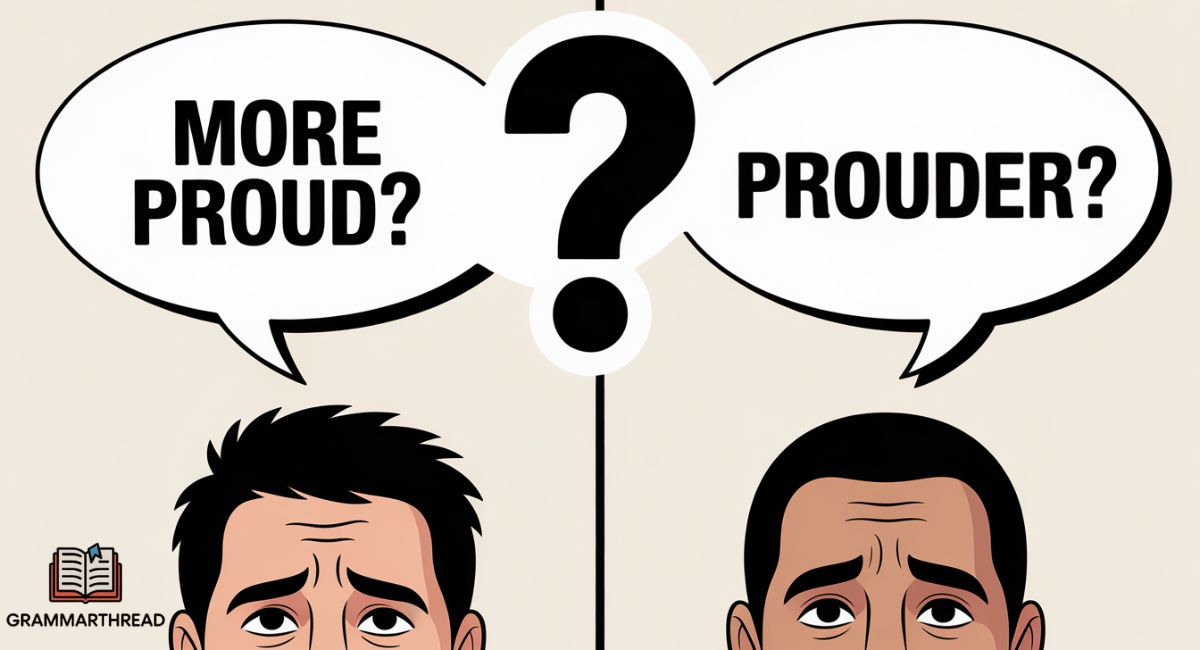
Learning English often feels simple until one small comparison stops you mid sentence. The question “More Proud” or “Prouder” is a perfect example. Both sound natural, both appear in real conversations, yet many learners are unsure which one actually fits. You might hear a parent say “I am more proud of you” or a teacher say “I could not be prouder,” and wonder why English allows both.
This topic matters because pride is an emotion we express often in daily life, from personal achievements to praising others. Choosing between more proud and prouder is not just about grammar rules. It is about tone, rhythm, and clarity. Once you understand how these forms work, your sentences feel smoother and more confident. That is when English starts to feel less confusing and more expressive.
Introduction: Why “More Proud” vs. “Prouder” Confuses So Many
You’ve probably caught yourself saying “I’ve never been more proud of you” or “I’m prouder than I’ve ever been.” Both versions feel okay when you say them out loud. But here’s the thing: is there actually a correct choice between the two? English has its grammar guidelines (plus plenty of quirks), and when you’re making comparisons, picking the right form makes your speech clearer and sounds more polished. In this guide, you’ll discover how comparative adjectives actually function, why “prouder” usually wins out, situations where “more proud” fits perfectly, and the common mistakes that slip through in everyday conversation. Once you’re done reading, you’ll know exactly which phrase to use without second-guessing yourself.
What Are Comparative Adjectives in English Grammar?
When you use comparative adjectives, you’re essentially putting two people, objects, or places side by side to see which one has more (or less) of a particular quality. The British Council explains that a comparative adjective helps us “compare two things or show how something has changed.”
Here’s how to understand it through straightforward guidelines and practical examples:
Basic Guidelines to Follow
- Single-syllable adjectives → usually add -er (for instance, fast → faster)
- Adjectives with two or more syllables → typically pair with “more” or “less” (for instance, intelligent → more intelligent)
- Watch out for exceptions and irregular forms (for instance, far → farther, little → less)
Quick Reference Chart
| Adjective Type | Example Base Form | Comparative Form | Important Notes |
| One syllable | short | shorter | standard pattern |
| One syllable with consonant-vowel-consonant | hot | hotter | double the final consonant |
| Two syllables (ending in -y) | easy | easier | swap -y for -i then add -er |
| Three or more syllables | difficult | more difficult | pair with “more” |
| Irregular | bad | worse | memorize these special cases |
Why Getting This Right Matters
When you pick the wrong comparative structure, your sentences can feel awkward or unnatural. Your audience might hesitate for a moment, trying to decode what you actually meant. Learning comparatives properly makes your communication smoother and gives you that extra confidence when speaking or writing.
Defining “Prouder”: The Correct Comparative Form of “Proud”
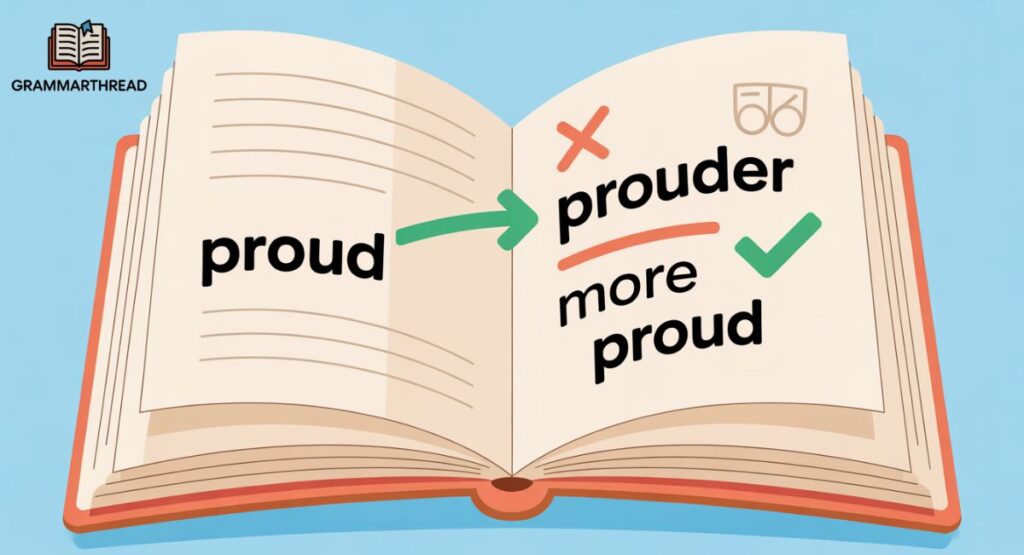
Now let’s focus specifically on the word we’re discussing:“proud.”
- “Proud” contains just one syllable.
- Following the single-syllable pattern, you simply attach -er → “prouder.”
- Standard grammar resources show the progression as proud → prouder → proudest.
Sample Sentences
- My parents are prouder of my achievements now than they were before.
- Tom feels prouder each time his students improve.
- We became prouder as the project came together.
In professional writing and everyday conversation, “prouder” is your go-to, reliable option. It follows the established grammar rule, flows naturally off the tongue, and keeps your sentences clean without extra filler words.
Is “More Proud” Ever Correct? Context and Acceptability
Absolutely – “more proud” has its place, though it shows up less frequently and often serves a specific stylistic purpose. Let’s look at where and why you’ll encounter it.
Scenarios Where “more proud” Shows Up
- For emphasis or natural rhythm: “I couldn’t be more proud of what you’ve accomplished.”
- In relaxed, everyday conversations where natural flow takes priority over technical rules.
- Across different dialects or regional speech patterns, particularly in informal settings.
The Important Distinction
Though “more proud” functions fine in casual contexts, grammatically speaking, “prouder” is what you should default to. Feel free to use “more proud” when you need a specific rhythm or want to emphasize something – just remember that “prouder” stays the standard, most reliable option for formal writing.
Common Mistake: Never Say “More Prouder”
Here’s where people often stumble. When trying to add extra emphasis, some speakers mistakenly say “more prouder”. That creates a double comparative, which breaks grammar rules.
What Makes It Incorrect
- “Prouder” is already in comparative form.
- Adding “more” in front creates redundancy – the grammar rules for comparison state you cannot use “more” alongside adjectives that already have the -er ending.
Wrong vs. Right
- ❌ He became more prouder after winning the award.
- ✓ He became prouder after winning the award.
- ✓ He became more proud after winning the award. (acceptable but informal)
The bottom line: pick one comparative method and stick with it, never both at once.
The Emotional Nuance: Why “I Couldn’t Be Prouder” Feels So Powerful
Grammar isn’t purely mechanical. Emotions matter too. Expressions like “I couldn’t be prouder” communicate more than correct syntax – they communicate genuine sentiment.
What This Expression Conveys
- Completeness: Pride has reached its absolute maximum.
- Power: The speaker expresses the strongest possible feeling.
- Idiomatic authenticity: Native English speakers naturally gravitate toward this wording.
Side-by-Side Comparison:
- “I couldn’t be more proud.” – perfectly acceptable, widely used.
- “I couldn’t be prouder.” – feels slightly more natural, packs more punch.
Real-World Example
During a 2023 awards ceremony, a coach told her team: “I couldn’t be prouder of what you’ve accomplished together.” The response? The audience connected with that raw sincerity. The brief statement conveyed profound emotion. You can’t measure feelings in spreadsheets, but the connection speaks for itself.
When you opt for “prouder” in moments like these, you satisfy both grammatical standards and emotional authenticity. That combination makes all the difference in effective communication.
Grammar Rules Refresher: When to Use “More” vs. “-er”
Here’s your handy reference guide for whenever you need to form comparative adjectives.
Follow these core principles:
- Single-syllable adjective → attach -er (for instance, cold → colder)
- Adjective with two or more syllables → pair with “more” (for instance, beautiful → more beautiful)
- Two-syllable words ending in -y → swap to -ier (for instance, funny → funnier)
- Keep irregular forms in mind (for instance, far → farther, little → less).
Easy Comparison Chart
| Situation | Example Adjective | Comparative Form |
| One syllable | proud | prouder |
| One syllable with C-V-C pattern | sad | sadder |
| Two syllables ending in -y | busy | busier |
| Two or more syllables (standard) | creative | more creative |
| Irregular adjective | bad | worse |
Key Grammar Reminders
- Never combine both methods: avoid constructions like “more prettier”.
- Include “than” when drawing comparisons: He feels prouder than his brother does.
- A few two-syllable words accept either form (for instance, narrow → narrower / more narrow) but “proud” strictly follows the -er pattern.
Real-World Usage: Examples in Everyday Sentences
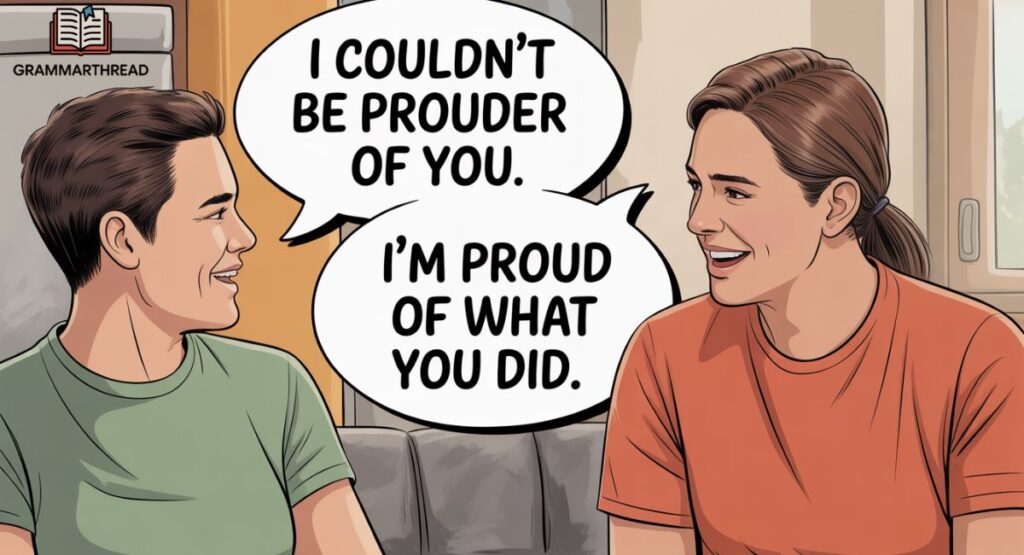
Below are hands-on examples you can reference or modify for your own use. I’ve included both “prouder” (the grammatically standard choice) and “more proud” (fine for informal situations) so you can see the difference.
Standard Grammatical Form (“prouder”)
- My coach became prouder of our team after we won the championship.
- She feels prouder now than she did at the start of her career.
- Our town couldn’t be prouder of the volunteers who stepped up during the crisis.
- Each milestone made him prouder of his decision to start over.
- Parents grow prouder watching their kids navigate life’s obstacles.
Informal Conversational Form (“more proud”)
- We’re more proud of this accomplishment than anything else we’ve done.
- He looks more proud than nervous standing on that stage.
- I couldn’t be more proud of how you handled that difficult situation.
- The team felt more proud once they saw the final results.
- You deserve to be more proud of what you’ve built here.
Why This Distinction Is Important
For formal contexts (like professional emails, research papers, or polished articles), stick with “prouder”. When you’re in casual settings (texting a friend, writing a personal journal entry, or chatting online), “more proud” works fine – just understand you’re operating in relaxed, conversational territory.
Dialectical and Cultural Differences
English changes from place to place, and how people use comparative forms often reflects those differences.
American vs. British English
- Across casual American conversations, “more proud” appears regularly because it fits natural speech patterns and adds emphasis.
- British English generally favors “prouder” in written and formal communication.
Prescriptive vs. Descriptive Grammar Approaches
- Prescriptive grammar insists: “Follow the standard rule and use ‘prouder’.”
- Descriptive grammar tracks real-world language habits – when large numbers of English speakers say “more proud,” linguists recognize that usage as legitimate.
- For practical communication: let your context, audience, and level of formality guide your choice.
Cultural Example
During a BBC interview with an athlete celebrating her team’s victory, she stated “I couldn’t be prouder of what we’ve achieved together.” That wording matched the professional setting. Choosing “more proud” might have felt too relaxed or informal for that particular moment.
Quick Grammar Tip Section: How to Master Comparatives Easily
Here are some helpful mental shortcuts, practical advice, and a quick quiz to cement these rules in your mind.
Simple Memory Shortcuts
- “Brief adjective → -er.” Clear winner.
- “Lengthy adjective → more.” You’ll be more successful.
- Test by removing either “more” or the “-er” ending – one should leave you with the original adjective.
- Quick check: Is it a single-syllable word? If yes → attach -er.
Quick Practice Quiz (choose the correct version)
- We became (more proud / prouder) of our neighborhood after the cleanup.
- My grandmother grows (more proud / prouder) every time I visit.
- The coach couldn’t be (more proud / prouder) of the team’s performance.
- She’s getting (more proud / prouder) of her cultural roots.
- Never say “I feel more prouder”, instead say (prouder / more proud).
Answer Key
- prouder
- prouder (standard) / more proud (informal)
- prouder
- prouder
- prouder
Practice these exercises until choosing the right form becomes second nature and automatic.
Common Comparative Adjective Errors (and How to Avoid Them)
Even skilled writers stumble sometimes. Here are typical errors you’ll want to watch for, complete with examples and fixes.
1. Double Comparatives
- ❌ My project is more better than before.
- ✓ My project is better than before.
Reason: “Better” already functions as the comparative form.
2. Pairing “More” with Single-Syllable Words
- ❌ The lake is more deep than the pond.
- ✓ The lake is deeper than the pond.
Follow the single-syllable guideline.
3. Leaving Out “Than” in Comparisons
- ❌ He feels prouder his colleagues.
- ✓ He feels prouder than his colleagues.
“Than” establishes the comparison relationship.
4. Using Comparative When Superlative Is Needed (Three or More)
- ❌ She’s prouder all the other students in the program.
- ✓ She’s the proudest of all the students in the program.
Switch to superlative form when comparing three or more items.
5. Mixing Up Irregular Patterns
- ❌ Today’s weather is more worse than yesterday.
- ✓ Today’s weather is worse than yesterday.
Memorize irregular forms: good/better/best, far/farther/farthest.
What Editors and Style Guides Say About “More Proud”
Major style guides and professional editors generally agree on one thing: “prouder” takes priority. Let’s see how different authorities handle this comparison.
Leading Style Guide Positions
- The Chicago Manual of Style supports standard comparative rules – single-syllable adjectives take the -er suffix, making “prouder” the preferred form.
- The Associated Press (AP) Stylebook follows traditional grammar conventions, recommending “prouder” for formal journalism and professional writing.
- Oxford English Dictionary lists “prouder” as the standard comparative, though it acknowledges “more proud” appears in informal speech.
What Professional Editors Look For
When editing manuscripts, articles, or business documents, most editors will flag “more proud” and suggest replacing it with “prouder” – unless the informal tone serves a specific stylistic purpose. The reasoning? Consistency with established grammar patterns keeps writing crisp and credible.
Academic Writing Standards
University writing centers and academic style guides (like MLA and APA) treat “prouder” as the grammatically correct choice. Students using “more proud” in formal essays might see corrections from instructors who enforce traditional comparative rules.
The Flexibility Factor
That said, modern style approaches recognize language evolves. Some contemporary editing philosophies accept “more proud” in conversational pieces, creative writing, or dialogue where natural speech matters more than rigid rules. The key is knowing your audience and matching your choice to the context.
Bottom Line: Choosing Between “Prouder” and “More Proud”
To sum it up: “prouder” is your default comparative form for “proud.” It follows the single-syllable pattern and sounds natural in nearly every situation. “More proud” works when you’re speaking casually, aiming for a specific cadence, or adding emphasis – just understand it’s the less formal option. Stay away from “more prouder” or any doubled-up comparative, since those mistakes are immediately noticeable.
Getting this small distinction right makes your writing look polished and professional – and that matters whether you’re chatting online, publishing blog content, handling work correspondence, or anything in between. The more you work with comparatives, the more instinctive your word choices become and the smoother your communication flows.
Frequently Asked Questions
Is it correct to say more proud or prouder
Both are correct. Prouder is the standard comparative form, while more proud is acceptable in casual or emotional speech.
Which one is grammatically better prouder or more proud
Prouder is grammatically preferred because proud is a one syllable adjective that follows the er rule.
Can I say I am more proud of you
Yes, it is commonly used in everyday conversation and sounds natural in informal contexts.
Why do people say I could not be prouder
Because prouder sounds fluent, natural, and expressive, especially in emotional or confident statements.
Is more prouder ever correct
No, more prouder is incorrect because it combines two comparative forms.
Should I use prouder in formal writing
Yes, prouder is the better choice for essays, reports, and professional communication.
Does more proud sound wrong to native speakers
No, native speakers use more proud often in speech, especially when emphasizing feelings.
What is the rule behind prouder
One syllable adjectives usually form comparatives by adding er, so proud becomes prouder.
Conclusion
Choosing between prouder and more proud is not just a grammar check. It is about clarity, tone, and how your words land with the reader. Prouder is the standard comparative form, clean and confident, and it fits naturally in both formal and everyday writing. More proud is also acceptable, especially in speech or emotional moments where emphasis matters more than structure.
The key is awareness. Think about your audience and the feeling you want to express. Now try it yourself. Write one sentence using prouder and another using more proud, and notice how the tone shifts. That small habit builds real confidence in English.
Read Next: Passerbyers or Passersby or Passerby? Which One Is Correct?

Welcome to GrammarThread. I am Julian Mercer, an AI-powered SEO and content writer with 4 years of experience. I help websites rank higher, grow traffic, and look amazing. My goal is to make SEO and website design simple and effective for everyone. Let’s achieve more together!