Perspective is the lens through which we understand people, ideas, and situations. When that lens is missing or distorted, the Opposite of Perspective comes into play. It shows up when someone ignores context, clings to one idea, or refuses to see beyond their own experience. We notice it in daily life during arguments, workplace decisions, or online debates where listening breaks down.
The opposite of perspective includes concepts like ignorance, bias, narrow thinking, and misunderstanding. These terms help explain why communication fails and why judgment becomes flawed. In this guide, you will learn what these words really mean, how they are used in real situations, and how recognizing them can improve clarity, fairness, and better decision making.
Definition of “Perspective”
At its core, perspective describes the particular lens through which we view something essentially, it’s our point of view or stance on a situation or experience. The term “perspective” captures how we make sense of the world, shaped by everything from our personal history and core beliefs to our cultural background and individual values. Your perspective might be deeply personal, colored by unique experiences and individual judgment, or it can be shared among a community, reflecting common understandings within a group or society.
Grasping the concept of perspective matters tremendously in everyday communication. It reminds us that two people can witness the exact same event yet walk away with completely different interpretations. When we acknowledge these varying viewpoints, we open the door to more compassionate, meaningful conversations and stronger connections with others.
Grammatically , “perspective” works as a noun when we talk about someone’s viewpoint or general outlook. You’ll also see it used in specialized contexts, like “perspective drawing” in visual arts, where it describes a method for creating depth and dimension on a flat surface.
When we discuss moral questions, societal challenges, or interpersonal dynamics, appreciating different perspectives becomes vital. It builds mutual respect, encourages open-mindedness, and helps us navigate disagreements with greater understanding and less friction.
Structural Breakdown of “Perspective”
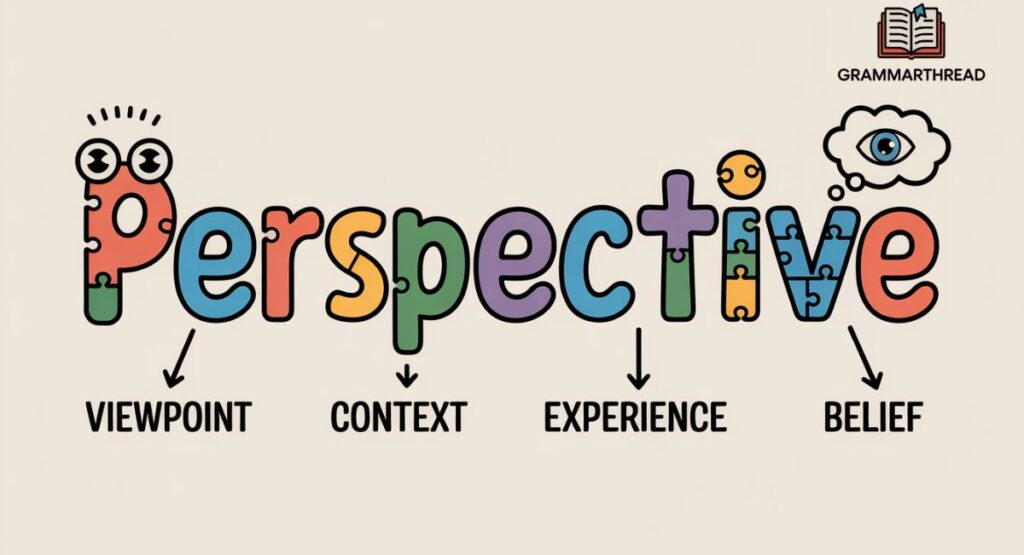
The term “perspective” traces back to the Latin perspicere, which translates to “to see through” or “to perceive clearly.” This linguistic origin points directly to what the word fundamentally represents: the capacity to view and comprehend something from a specific standpoint or angle.
From a grammatical standpoint, “perspective” functions as a noun, and its full significance often depends on how it’s used in conversation or writing. Take “a cultural perspective,” for example this phrase means interpreting ideas or behaviors through the lens of a particular culture. Meanwhile, “a professional perspective” indicates how someone views an issue based on their career expertise and experience.
Adjectives frequently pair with “perspective” to sharpen or expand its meaning. Consider “a limited perspective,” which points to a constrained or one-sided viewpoint that misses the bigger picture. On the flip side, “an international perspective” conveys a wide-ranging, cross-border understanding that embraces multiple cultures and contexts
Types of Perspective
Perspective shows up in many different forms, each one shaping how we see and engage with our surroundings. Below are some of the main types:
Personal Perspective
This represents someone’s individual viewpoint, molded by their own life experiences, personal convictions, and core values. It’s inherently subjective, meaning what feels true or important to one person might look completely different to another.
Historical Perspective
This approach means viewing past events through the lens of their own era, taking into account the social conditions, political climate, and cultural norms that shaped them. It calls for empathy and an openness to understand history from the standpoint of those who actually lived through it.
Cultural Perspective
This encompasses the collective beliefs, traditions, and practices of a specific community or society. It plays a major role in how group members make sense of their experiences and engage with people from different backgrounds.
Ethical Perspective
This centers on evaluating the moral dimensions of choices and behaviors. Various ethical theories, like consequentialism or virtue ethics, can produce distinctly different ethical perspectives on the same dilemma.
Economic Perspective
This angle examines the monetary and resource-related elements of a scenario, weighing factors like expenditures, gains, and market dynamics. You’ll commonly see this perspective applied in corporate strategy and public policy discussions.
Political Perspective
This concerns the belief systems and governance structures that shape communities and nations. Differing political perspectives often result in opposing viewpoints on topics like public spending, individual rights, and foreign policy decisions.
Opposite of Perspective
While “perspective” centers on a specific viewpoint or angle, its opposites typically point to either the lack of a clear standpoint, an effort to remove personal influence, or a restricted capacity for understanding. Here’s a closer look at some important antonyms:
- Objectivity: Pursuing neutrality by prioritizing verifiable facts over emotions or subjective judgments.
- Subjectivity: Depending heavily on individual emotions, preferences, and personal viewpoints rather than external evidence.
- Bias: A preconceived tendency to favor or oppose something, someone, or a particular group in a manner that’s typically viewed as unjust or unbalanced.
- Impartiality: Treating all perspectives and evidence equally, maintaining fairness without allowing personal preferences to interfere.
- Tunnel Vision: A restricted outlook that results from focusing too narrowly on one aspect while ignoring the broader context, similar to viewing the world through a confined opening.
- Broad-Mindedness: Demonstrating openness and acceptance toward differing viewpoints and ideas, even when they challenge your own beliefs.
Objectivity
Objectivity describes the characteristic of being objective. It prioritizes neutrality, balanced judgment, and reliance on evidence rather than subjective emotions or individual beliefs. Unlike perspective, which recognizes how personal viewpoints shape our understanding, objectivity aims for a dispassionate and neutral evaluation free from personal influence.
Across fields like news reporting, scientific research, and legal proceedings, objectivity is highly valued as a professional standard. Reporters strive to present information without inserting personal commentary, researchers work to design studies and interpret findings without letting preconceptions interfere, and legal professionals are tasked with rendering judgments rooted in statutes and precedent rather than personal sentiments.
Though achieving perfect objectivity remains more of an aspirational goal than a realistic expectation, working toward it helps reduce prejudice and promotes equitable treatment. That said, we should remember that everyone operates from some perspective, and even our most earnest efforts at neutrality can be subtly shaped by hidden assumptions we don’t fully recognize.
Subjectivity
Subjectivity refers to the characteristic of being shaped by individual emotions, preferences, or personal judgments. It exists in direct opposition to objectivity, which prioritizes neutral assessment and evidence-based conclusions. While perspective recognizes how individual viewpoints color our understanding, subjectivity emphasizes the central role that personal experiences and interpretations play in how we see things.
Within creative fields like visual arts, storytelling, and interpersonal connections, subjectivity holds considerable value. Painters and sculptors channel their internal emotions and lived experiences onto canvas or into form, authors craft stories and characters that embody their unique worldview, and people build meaningful relationships rooted in emotional resonance and aligned principles.
Yet in situations demanding impartiality and precision, such as news reporting, academic research, and judicial proceedings, subjectivity becomes a liability. Allowing personal sentiments or individual opinions to drive decisions can introduce distortion, compromise accuracy, and undermine fair treatment for all parties involved.
Bias
Bias describes a tendency or inclination toward or against something, someone, or a particular group when compared to others, typically in ways deemed unjust or unbalanced. While perspective simply refers to a viewpoint, bias represents a distorted perspective that blocks fair and balanced evaluation.
Bias appears in multiple forms, such as confirmation bias (actively searching for evidence that supports what we already believe), unconscious bias (hidden prejudices we’re not aware of), and in-group bias (preferring members of our own community over outsiders). Identifying and confronting bias is essential for cultivating fairness, equity, and mutual respect across different contexts.
Within academic studies, bias can compromise findings and produce misleading interpretations. Across news outlets and media platforms, bias has the power to sway collective attitudes and shape societal conversations.
Among friends, family, and colleagues, bias can create friction, breed miscommunication, and damage trust between individuals.
Impartiality
Impartiality embodies the practice of treating all perspectives and evidence equally, free from personal favoritism or inclination. It serves as a fundamental principle underlying justice, equitable treatment, and sound moral judgment. Unlike perspective, which acknowledges the role of individual viewpoints, impartiality seeks a balanced and unbiased evaluation that doesn’t favor any particular side.
Legal professionals, sports officials, and conflict resolution specialists are required to maintain impartiality in their rulings and decisions. They need to weigh every angle of a situation fairly and ground their conclusions in facts and logical reasoning, setting aside personal emotions or preconceived notions.
Reaching true impartiality proves challenging in practice, since we all carry our own viewpoints and unconscious preferences. Still, making a genuine effort toward impartiality helps reduce unfair influence and promotes just outcomes.
This process requires recognizing your own predispositions, deliberately exposing yourself to contrasting viewpoints, and remaining open to revising your position when presented with compelling new information.
Tunnel Vision
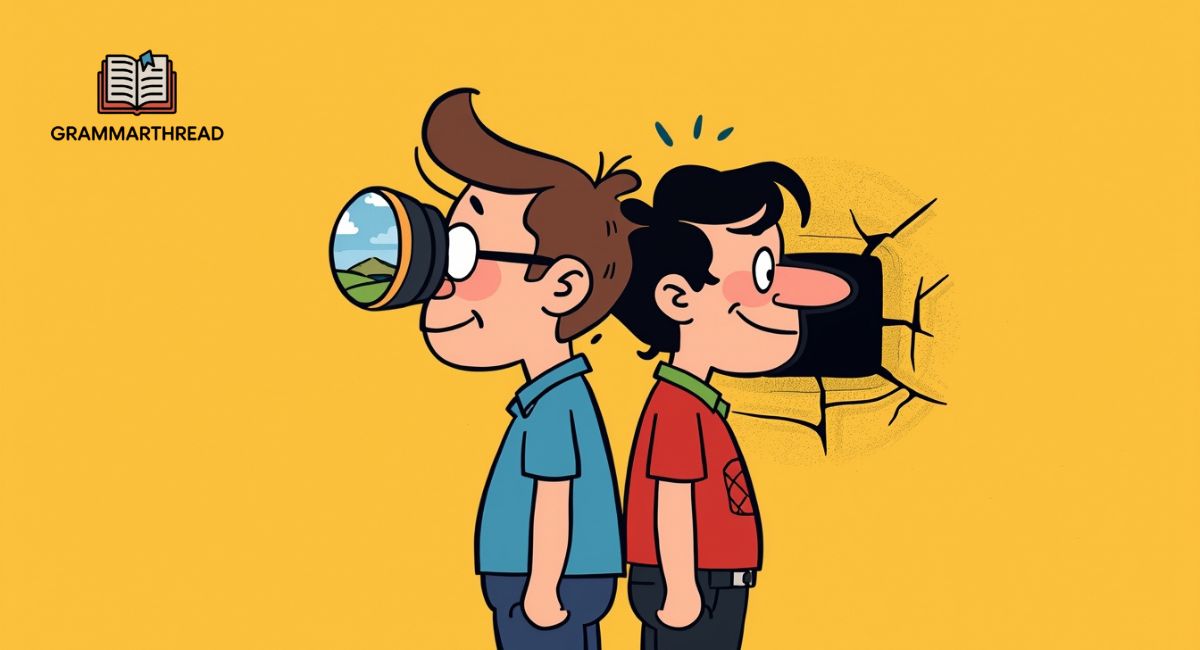
Tunnel vision describes a restricted viewpoint that emerges when someone concentrates so intensely on a single element that their field of vision narrows, much like peering through a confined passageway. It characterizes situations where individuals become so fixated on one dimension of an issue that they overlook the complete picture or dismiss other valid perspectives. This represents the complete opposite of maintaining a comprehensive perspective.
Tunnel vision often stems from high stress levels, intense pressure, or insufficient access to relevant information. It can result in flawed judgments, overlooked possibilities, and difficulty responding effectively when situations evolve or shift unexpectedly.
Preventing tunnel vision requires consciously zooming out to examine the wider situation and surrounding factors. This means actively gathering input from varied sources, questioning your initial assumptions, and staying receptive to fresh insights that might challenge your current understanding.
Broad-Mindedness
Broad-mindedness reflects the capacity to accept and respect differing viewpoints, even when they conflict with your own beliefs. It means staying receptive to unfamiliar concepts and alternative perspectives, regardless of how much they diverge from your established thinking. This stands in sharp contrast to a limited perspective, which remains rigid and closed off to other possibilities.
Broad-mindedness plays a crucial role in productive dialogue, teamwork, and creative problem-solving. It enables people to grasp how others think, value cultural differences, and identify shared interests that bridge divides.
Developing broad-mindedness means purposefully engaging with viewpoints that differ from yours, examining your own preconceptions critically, and maintaining flexibility to adjust your stance when new information warrants it. It also demands empathy, kindness, and a sincere curiosity about what drives and shapes other people’s experiences.
Examples of Antonyms in Sentences
The tables below offer practical examples showing how these antonyms of “perspective” function in actual sentences, illustrating their contrasting meanings and applications.
Objectivity vs. Perspective
This table shows how “objectivity” and “perspective” work in context, emphasizing the difference between pursuing impartial facts and recognizing individual viewpoints.
| Sentence with Objectivity | Sentence with Perspective |
| The reporter strived for objectivity in her coverage, sticking to verified facts. | In her perspective, the policy change felt unjust. |
| Maintaining objectivity is fundamental to credible scientific inquiry. | The scholar provided a distinctive perspective on the wartime events. |
| The magistrate earned respect for maintaining objectivity during proceedings. | Every character in the story brings their own perspective to the main struggle. |
| Objectivity becomes critical when weighing evidence in legal cases. | Grasping the cultural perspective helps bridge communication gaps. |
| The financial analyst worked hard to preserve objectivity in his evaluation. | From an economic perspective, the initiative appeared financially unviable. |
| The researcher conducted her study with unwavering objectivity. | Her perspective grew from the personal experiences that shaped her life. |
| Objectivity in news media protects against slanted reporting. | The painter’s perspective shines through in his distinctive visual approach. |
| The critic worked to deliver an objective analysis of the production. | From a philosophical perspective, debates about determinism grow complicated. |
| Objectivity remains essential when reviewing scholarly work. | His perspective stemmed from deeply held political convictions. |
| The accountant upheld objectivity throughout the audit process. | Recognizing the patient’s perspective enhances the quality of healthcare. |
| The document aimed for objectivity by excluding personal interpretations. | From a legal perspective, the agreement held up under scrutiny. |
| The umpire’s objectivity came under fire following disputed decisions. | Her perspective diverged sharply from others in the discussion. |
| Objectivity serves as a foundational element of rigorous research methods. | The writer wove together multiple perspectives on a single incident. |
| The statistics underwent analysis with rigorous objectivity. | From a historical perspective, that moment marked a pivotal shift. |
| The review system prioritized objectivity at every stage. | Seeing things from the child’s perspective matters deeply in raising kids. |
| The presentation sought to convey findings with maximum objectivity. | The movie brought a novel perspective to the familiar narrative. |
| The examination proceeded with careful objectivity and thorough scrutiny. | From a business perspective, consolidating operations seemed logical. |
| The magistrate exhibited extraordinary objectivity across all hearings. | His perspective evolved through decades working in that profession. |
| The researcher’s objectivity remained beyond reproach. | The program examined the topic through several distinct perspectives. |
| The panel placed objectivity at the top of their priorities. | From the creator’s perspective, reality itself became raw material. |
| Objectivity forms the backbone of equitable judgment. | The biography presented a fresh perspective on the famous leader. |
| The oversight committee insisted on absolute objectivity. | From a personal perspective, that experience changed everything. |
| The results appeared with pure scientific objectivity. | The forum revealed contrasting perspectives on the proposed legislation. |
| Objectivity stands as a pillar of responsible reporting. | Her perspective bore the marks of her ethnic heritage. |
| The evaluation demanded strict objectivity throughout. | The initiative sought to honor the perspective of neighborhood residents. |
Subjectivity vs. Perspective
This table illustrates how “subjectivity” and “perspective” appear in sentences, contrasting personal feelings with broader viewpoints.
| Sentence with Subjectivity | Sentence with Perspective |
| The reviewer’s commentary overflowed with subjectivity, mirroring personal preferences. | From my perspective, the film qualified as extraordinary. |
| The scoring method faced complaints over excessive subjectivity. | The academic presented an alternative perspective on what sparked the conflict. |
| Subjectivity often complicates efforts to find common ground. | Every team participant offered a distinct perspective worth considering. |
| The appraisal leaned more toward subjectivity than measurable standards. | Comprehending another’s perspective unlocks the path to settling disputes. |
| Her claims were rejected as mere subjectivity. | From a leadership perspective, that choice became unavoidable. |
| Artistic worth frequently hinges on subjectivity. | His perspective took form during his childhood in countryside surroundings. |
| The verdict reflected personal emotions and subjectivity. | The publication delivered a novel perspective on past occurrences. |
| The rating lacked concrete measures and depended on subjectivity. | From a scientific perspective, the findings remained ambiguous. |
| The analysis drew fire for its subjectivity and thin supporting data. | Her perspective stood apart from everyone else present. |
| Subjectivity holds considerable weight in creative endeavors. | The production examined the topic through varied perspectives. |
| The discussion intensified due to individual viewpoints and subjectivity. | From a worldwide perspective, the challenge grows more critical. |
| His reasoning suffered from subjectivity and emotional interference. | Appreciating the client’s perspective proves vital for commercial achievement. |
| The rating system depended too much on subjectivity. | From a parent’s perspective, protecting their kids matters above everything. |
| Subjectivity can create inconsistent evaluation outcomes. | The piece showcased the subject through different perspectives for fair coverage. |
| Food preferences largely come down to subjectivity. | From a medical perspective, the therapy delivered positive outcomes. |
| The choice rested on individual taste and subjectivity. | The feature film presented an unconventional perspective on the social trend. |
| Her opinions were brushed aside as pure subjectivity. | From an ecological perspective, the development proved damaging. |
| Subjectivity fits within artistic realms but has no place in empirical studies. | His perspective drew from his occupational expertise and training. |
| The writer’s subjectivity permeated the entire critique. | The talks demanded recognizing the perspective of each side. |
| The measurement process suffered from excessive subjectivity. | From a tactical perspective, the action represented sound reasoning. |
| Subjectivity occasionally undermines equitable assessment. | The text investigated the event through numerous perspectives. |
| His statements often got dismissed because of apparent subjectivity. | From a future-oriented perspective, the financial commitment proved sensible. |
| The scoring lost credibility due to overwhelming subjectivity. | The program worked to represent the perspective of residents authentically. |
| Though subjectivity belongs somewhere, it shouldn’t dominate choices. | Her perspective felt invigorating and introduced alternative angles on the challenge. |
| The exchange exposed how challenging separating reality from subjectivity can be. | From the creator’s perspective, each element held meaning and purpose. |
Bias vs. Perspective
This table showcases the usage of “bias” and “perspective” in sentences, distinguishing between distorted viewpoints and general viewpoints.
| Sentence with Bias | Sentence with Perspective |
| The broadcast displayed obvious bias toward a specific party. | From my perspective, the regulation benefits the nation. |
| The research drew criticism for bias leaning toward predetermined conclusions. | The scholar offered an original perspective on those historical moments. |
| Bias can result in unjust treatment of people. | Each team contributor brought a separate perspective to the work. |
| The official faced accusations of demonstrating bias through decisions. | Grasping the other party’s perspective aids in settling disagreements. |
| Her bias against newcomers showed clearly in her statements. | From a commercial perspective, the acquisition represented strategic thinking. |
| The polling data got distorted through selection bias. | His perspective formed through experiences with economic hardship. |
| The commercial held subtle bias favoring one particular product. | The volume provided an engaging perspective on the familiar tale. |
| The assessment system aimed to reduce bias wherever possible. | From a scientific perspective, the test produced successful results. |
| His reasoning fell flat due to transparent bias. | Her perspective contrasted with others throughout the assembly. |
| Bias blocks people from recognizing reality. | The documentary addressed the subject through various perspectives for thorough coverage. |
| Hidden bias shapes our choices without conscious awareness. | From an international perspective, the situation demands immediate attention. |
| The publication received backlash for bias and missing neutrality. | Recognizing the consumer’s perspective matters for building sound marketing approaches. |
| Her bias toward conventional approaches blocked progress. | From a parent’s perspective, nothing outweighs their child’s happiness and safety. |
| The probe suffered from political bias affecting outcomes. | The essay examined the topic through different perspectives for balanced insight. |
| The organization encountered accusations of discriminatory bias in recruitment. | From a healthcare perspective, the innovative therapy displayed encouraging outcomes. |
| The analysis contained bias and missed factual grounding. | The program captured an uncommon perspective on the artistic evolution. |
| His bias against modern tools showed in his resistance to change. | From an ecological perspective, the venture caused environmental damage. |
| The correspondent received criticism for letting bias color the coverage. | His perspective emerged from extensive industry involvement. |
| The group worked to remove bias from their deliberations. | The bargaining process needed acknowledging the perspective of every participant. |
| The outcomes faced scrutiny over possible interviewer bias. | From a planning perspective, the move involved calculated uncertainty. |
| The regulation appeared unfair because of built-in bias. | The manuscript studied the occurrence through multiple perspectives for depth. |
| The scoring seemed unjust since it relied on bias instead of standards. | From a forward-looking perspective, the venture represented thoughtful planning. |
| The investigation accounted for interfering factors to limit bias. | The effort centered on amplifying the perspective of community members. |
| The presenter’s bias emerged immediately during opening remarks. | Her perspective brought freshness and introduced innovative thinking on the matter. |
| The evaluation got turned down for obvious bias and weak evidence. | From the artist’s perspective, each mark on canvas advanced the story. |
Usage Rules for Antonyms of Perspective
Grasping the subtle distinctions among these antonyms of “perspective” helps you apply them accurately in different contexts. Here are some practical guidelines:
- Objectivity works best when you want to stress neutrality and evidence-based reasoning. For instance, “The investigator examined the evidence with complete objectivity.”
- Subjectivity fits well when you’re pointing out individual emotions, preferences, or personal judgments. For example, “The food blogger’s recommendations were heavily influenced by subjectivity.”
- Bias should be employed when referring to a prejudiced inclination that compromises fair evaluation. For instance, “The study faced scrutiny for its bias favoring corporate interests.”
- Impartiality suits situations where you’re describing balanced and equitable consideration of all perspectives. For example, “The arbitrator maintained impartiality during the entire dispute resolution.”
- Tunnel Vision describes a restricted focus that overlooks the complete picture or surrounding context. For example, “The executive’s tunnel vision prevented her from recognizing emerging market trends.”
- Broad-mindedness best characterizes someone who demonstrates openness and acceptance toward differing viewpoints. For example, “The effective educator showed broad-mindedness by encouraging students to challenge conventional thinking.”
Common Mistakes When Using Antonyms of Perspective
Here are some frequent errors to watch out for when working with antonyms of “perspective”:
| Incorrect | Correct | Explanation |
| “She demonstrated strong perspective in her biased analysis.” | “She demonstrated strong bias in her analysis.” | “Perspective” and “bias” shouldn’t be mixed this way. “Bias” better captures a skewed or prejudiced viewpoint. |
| “The neutral referee displayed bias during the match.” | “The referee displayed bias during the match.” | “Neutral” and “bias” contradict each other. Someone cannot maintain neutrality while showing bias. |
| “The fair assessment revealed a strong perspective supporting one candidate.” | “The assessment revealed a strong perspective supporting one candidate.” | “Fair” and “perspective” can get confused here. Fairness suggests balanced treatment without favoritism. |
| “His tunnel vision approach helped him grasp every detail.” | “His tunnel vision approach prevented him from grasping the full situation.” | “Tunnel vision” signals a restricted focus that reduces understanding, not expands it. |
| “She was close-minded yet demonstrated remarkable broad-mindedness.” | “She was broad-minded and demonstrated remarkable openness.” | “Broad-mindedness” means embracing diverse viewpoints. “Close-minded” represents the exact opposite trait. |
Practice Exercises
Put your knowledge of the antonyms of “perspective” to the test with these practice activities.
Exercise 1: Fill in the Blanks
Select the most appropriate word from the options (Objectivity, Subjectivity, Bias, Impartiality, Tunnel Vision, Broad-Mindedness) to complete each sentence.
| Question | Answer |
| 1. The researcher worked hard to preserve __________ throughout her study, keeping personal views separate. | Objectivity |
| 2. The film reviewer’s commentary was dominated by __________, mirroring his individual tastes and opinions. | Subjectivity |
| 3. The analysis faced backlash for its __________ favoring a specific business interest. | Bias |
| 4. The arbitrator earned recognition for her __________ during proceedings, ensuring equal treatment for everyone. | Impartiality |
| 5. His __________ kept him from recognizing the broader advantages of the proposed approach. | Tunnel Vision |
| 6. Her __________ enabled her to appreciate diverse perspectives and identify shared values. | Broad-Mindedness |
| 7. The reporter worked to uphold __________ when presenting information, avoiding personal interpretations. | Objectivity |
| 8. The assessment suffered from __________, relying on individual preferences instead of measurable standards. | Subjectivity |
| 9. The inquiry was undermined by __________ stemming from the examiner’s prior relationships. | Bias |
| 10. The facilitator maintained __________ by providing both parties with equivalent opportunities to express their positions. | Impartiality |
Exercise 2: Multiple Choice
Select the best antonym for “perspective” in each sentence.
| Question | Options | Answer |
| 1. The researcher conducted the study with ______. | a) bias b) objectivity c) perspective d) subjectivity | b) objectivity |
| 2. The food critic’s evaluation was marked by ______. | a) impartiality b) objectivity c) subjectivity d) broad mindedness | c) subjectivity |
| 3. The article drew criticism for its ______ leaning toward one viewpoint. | a) impartiality b) bias c) objectivity d) perspective | b) bias |
| 4. The magistrate received acclaim for her ______ when presiding over the trial. | a) subjectivity b) bias c) impartiality d) tunnel vision | c) impartiality |
| 5. His ______ stopped him from grasping the complete situation. | a) broad mindedness b) objectivity c) tunnel vision d) perspective | c) tunnel vision |
| 6. Her ______ helped her embrace different traditions and viewpoints. | a) subjectivity b) bias c) tunnel vision d) broad mindedness | d) broad mindedness |
| 7. The correspondent sought to deliver the information with _______. | a) subjectivity b) bias c) objectivity d) tunnel vision | c) objectivity |
| 8. The appraisal relied more heavily on ______ than measurable benchmarks. | a) objectivity b) impartiality c) bias d) subjectivity | d) subjectivity |
| 9. The probe was damaged by ______ arising from existing relationships. | a) impartiality b) objectivity c) bias d) broad mindedness | c) bias |
| 10. The negotiator guaranteed ______ by granting both parties equal presentation time. | a) subjectivity b) tunnel vision c) impartiality d) bias | c) impartiality |
Advanced Topics: Nuances and Context
The antonyms of “perspective” don’t always function as complete opposites. In many situations, they can intersect or exist side by side.
Take this scenario: someone might aim for objectivity yet remain affected by hidden biases they’re not fully aware of. Likewise, an individual could maintain a comprehensive perspective while simultaneously holding particular subjective convictions.
The interpretation of these antonyms shifts based on the situation you’re in. Within academic research, objectivity carries tremendous weight, whereas in creative pursuits, subjectivity often gets celebrated and encouraged.
Recognizing these subtle distinctions and context-dependent meanings proves essential for applying these terms with precision and impact.
Beyond that, “perspective-taking” stands out as a valuable ability in fostering connection and understanding between people. It means making a genuine effort to grasp how someone else sees things, particularly when their viewpoint contrasts with yours.
This process demands that you temporarily suspend your own biases and personal judgments, and acknowledge that alternative perspectives hold legitimacy and worth.
How Context Shapes and Distorts Perspective
Context plays a powerful role in shaping how we form and interpret perspective, often influencing our viewpoints in ways we don’t immediately recognize. The circumstances surrounding an event, the cultural environment we’re immersed in, and the timing of when something occurs all contribute to how we make sense of what we observe.
Consider how the same action can be viewed completely differently depending on context. A firm decision by a leader might be seen as decisive strength in a crisis situation, yet that identical behavior could come across as authoritarian rigidity during peaceful times. This illustrates how context doesn’t just influence perspective it can fundamentally alter the meaning we assign to events.
Context can also distort perspective by creating blind spots or amplifying certain details while minimizing others. When we’re deeply embedded in a particular situation, we might miss crucial information that someone outside that context would immediately notice. Historical context proves especially tricky, as judging past events through today’s values and norms can lead to misunderstandings about why people acted as they did.
Cultural context adds another layer of complexity. What seems perfectly reasonable behavior in one culture might appear confusing or even offensive in another, not because either perspective is wrong, but because the contextual frameworks differ so dramatically.
Being aware of how context shapes perspective helps us approach situations with greater humility and openness. It reminds us to ask questions about the circumstances behind someone’s viewpoint before rushing to judgment, and to recognize that our own perspective is equally shaped by the context we inhabit.
Frequently Asked Questions
What is the opposite of perspective in simple terms?
The opposite of perspective refers to a lack of viewpoint or understanding, such as bias, ignorance, or narrow thinking that ignores context.
Is ignorance considered an opposite of perspective?
Yes, ignorance fits as an opposite of perspective because it reflects missing knowledge or refusal to see the bigger picture.
Can bias be called the opposite of perspective?
Bias is often an opposite of perspective since it limits fair judgment and blocks objective understanding.
What does tunnel vision mean as an opposite of perspective?
Tunnel vision means focusing on one narrow idea while ignoring other viewpoints or relevant details.
Is objectivity the opposite of perspective?
Objectivity can act as an opposite of perspective when perspective is personal or emotional, as it aims for neutral and balanced judgment.
How is narrow mindedness related to the opposite of perspective?
Narrow mindedness shows resistance to new ideas, making it a common example of the opposite of perspective.
Why is understanding the opposite of perspective important?
It helps improve communication, reduce misunderstandings, and recognize flawed thinking in daily conversations.
Is misunderstanding part of the opposite of perspective?
Yes, misunderstanding happens when context or viewpoint is missing, making it closely linked to the opposite of perspective.
Conclusion
Understanding the Opposite of Perspective helps you spot how thinking can narrow, shift, or lose balance. Concepts like bias, objectivity, subjectivity, tunnel vision, and broad mindedness explain why people interpret the same situation so differently. Knowing when and how to use these terms adds clarity to writing, sharper reasoning to discussions, and fairness to decision making.
Whether you are studying, writing, or navigating everyday conversations, this knowledge helps you express contrasting views with confidence and accuracy. Try noticing these patterns in real situations and practice using the right term at the right time. It is a simple step toward clearer communication and better understanding.
Read Next: Opposite of Salutation: 30 Antonyms Like Farewell Explained

Welcome to GrammarThread. I am Julian Mercer, an AI-powered SEO and content writer with 4 years of experience. I help websites rank higher, grow traffic, and look amazing. My goal is to make SEO and website design simple and effective for everyone. Let’s achieve more together!