The opposite of salutation refers to words or actions that signal distance rather than welcome. Instead of starting a conversation with a polite hello or friendly gesture, these expressions show avoidance, cold behavior, or a clear lack of interest in engaging. You see this often in everyday life, such as when someone ignores a greeting, ends a discussion abruptly, or responds without warmth.
Understanding the opposite of salutation matters because tone shapes communication. A small choice of words can change how a message feels, whether in emails, conversations, or social settings. In this guide, you will learn common antonyms, when they are used, and how they appear in real situations, with simple examples you can relate to instantly.
Definition of Salutation
A salutation is a way of greeting someone or expressing goodwill when you begin an interaction. It’s how you acknowledge another person at the start of a conversation, email, letter, or presentation. Salutations help build rapport, demonstrate courtesy, and establish the mood for what comes next. They can be as casual as “Hey” or “What’s up” or as professional as “Dear Dr. Johnson” or “Good afternoon.”
The way you greet someone matters more than you might think. Choosing the right salutation sets a welcoming, respectful tone that encourages positive communication. On the flip side, skipping a greeting entirely or using one that feels too stiff or too casual for the situation can create awkwardness or even cause offense.
That’s why knowing how to use salutations properly, and understanding what words mean the opposite of greeting, helps you communicate more clearly and confidently in any setting.
Structural Breakdown of Salutations
Most salutations are built from a greeting expression combined with the person’s name or title. How you put these pieces together depends on whether you’re writing something casual or formal.
Here’s how the main components work:
- Greeting Expression: This could be something simple like “Hi,” a time-based greeting such as “Good evening,” or something more traditional like “Dear.”
- Person’s Name or Title: This is who you’re talking to. You might use just a first name, a last name, someone’s full name, or add a title such as “Mrs.,” “Dr.,” or “Professor.”
- Punctuation Mark: You’ll usually add either a comma or a colon after the salutation. Commas work well for casual messages, while colons fit better in formal correspondence.
Take the greeting “Dear Dr. Martinez:” as an example. “Dear” serves as your greeting expression, “Dr. Martinez” shows the recipient’s title and surname, and the colon indicates a formal tone. When you understand how these pieces fit together, you can create salutations that match any situation you encounter.
Opposite of Salutation
Words that mean the opposite of “salutation“ fall into different groups, each representing a unique way of contradicting or reversing the idea of a greeting. These groupings include:
- Farewells: Phrases you use when parting ways or leaving, signaling that an interaction is coming to a close.
- Dismissals: Statements or gestures that cut a conversation short, often showing lack of interest or displeasure.
- Ignoring: Purposely overlooking someone’s presence or their attempt to greet you, which communicates indifference or animosity.
- Formal Closings: Concluding statements in written messages that lack the warmth of an opening greeting.
- Rejections: Direct refusals to interact with or recognize someone, expressing clear disapproval or unwillingness to engage.
These categories capture different facets of what it means to be the opposite of a greeting. They span everything from courteous goodbyes to complete disregard for another person. Recognizing these differences helps you navigate social exchanges more effectively and respond appropriately based on the context.
Examples of Antonyms for Salutation
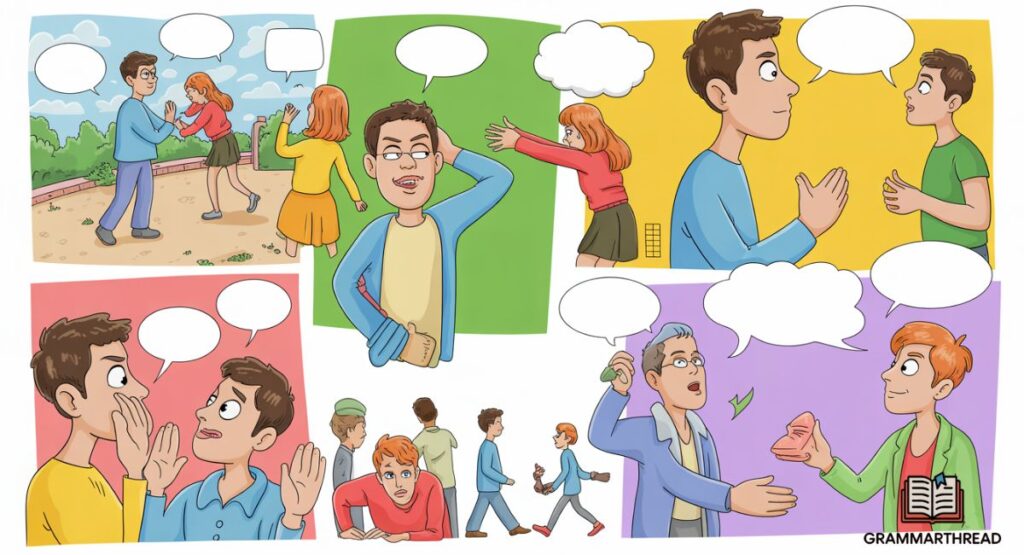
This section offers detailed examples of antonyms for “salutation,” sorted by category. Each grouping includes multiple expressions and situations that show the various ways you can oppose or contrast a greeting.
Farewells
Farewells are courteous expressions you use when saying goodbye. They signal the conclusion of an interaction and typically include well wishes for the other person.
Unlike dismissals, farewells carry a generally positive and considerate tone.
The table below shows examples of farewells that function as antonyms to salutations, organized by formality level and usage.
| Farewell | Context | Additional Notes |
| Goodbye | General | The most widely used and adaptable farewell. |
| Farewell | Formal | A more traditional and less common parting phrase. |
| See you later | Informal | Suggests you’ll meet again. |
| See you soon | Informal | Indicates an upcoming reunion. |
| Take care | General | Shows concern for someone’s welfare. |
| Have a nice day | General | Offers pleasant wishes for the day ahead. |
| Have a great evening | General | Offers pleasant wishes for the evening. |
| Have a wonderful weekend | General | Offers pleasant wishes for the weekend. |
| So long | Informal | An older, less commonly heard parting phrase. |
| Adieu | Formal/Literary | A French parting term, commonly found in literature. |
| Bye | Informal | A shortened form of “goodbye.” |
| Ciao | Informal | An Italian parting term, popular in casual situations. |
| Until next time | General | Acknowledges a future encounter. |
| Peace out | Informal/Slang | A very casual and relaxed farewell. |
| I’m off | Informal | Announces that you’re leaving. |
| I must be going | Formal | A courteous way to announce your departure. |
| It was nice seeing you | General | Conveys enjoyment of the encounter. |
| It was good to see you | General | Similar to “It was nice seeing you.” |
| Catch you later | Informal | Similar to “See you later.” |
| Later | Informal | A shortened form of “See you later.” |
| All the best | General | Offers good wishes to the other person. |
| Best wishes | Formal | A more traditional version of “All the best.” |
| Godspeed | Formal/Archaic | Offers wishes for success and safety. |
| Have a safe trip | Specific | Used when someone is about to travel. |
Dismissals
Dismissals are sharp or discourteous ways of terminating a conversation. They frequently signal disinterest, frustration, or hostility.
Unlike farewells, dismissals carry a generally negative and disrespectful tone.
The table below shows examples of dismissals that function as antonyms to salutations, organized by rudeness level and usage.
| Dismissal | Context | Additional Notes |
| Get lost | Rude | A very discourteous way to tell someone to go away. |
| Leave me alone | Impatient/Angry | Shows a strong need for privacy. |
| Go away | Impatient | A blunt and somewhat rude command to leave. |
| I’m done with this | Frustrated | Shows that you’re finished with the exchange. |
| I have no time for this | Impatient | Shows that you’re too occupied to continue. |
| Buzz off | Rude/Informal | A rude command to leave. |
| Get out | Angry | A forceful demand to depart immediately. |
| That’s enough | Impatient | Shows that you’ve heard all you want to hear. |
| I’m out | Informal | Announces that you’re exiting the conversation. |
| Whatever | Dismissive | Shows lack of interest or agreement. |
| Don’t bother me | Impatient/Angry | Similar to “Leave me alone.” |
| I can’t be bothered | Dismissive | Shows lack of interest in continuing. |
| Not interested | Direct | A straightforward rejection of the exchange. |
| We’re done here | Authoritative | Announces that the conversation has ended. |
| End of discussion | Authoritative | Similar to “We’re done here.” |
| Goodbye (said curtly) | Impatient | The sharp tone signals dismissal. |
| Silence (walking away) | Passive-Aggressive | Terminating the exchange without speaking. |
| Turning one’s back | Rude | A physical gesture of dismissal. |
| Ignoring further communication | Passive | Refusing to acknowledge any more attempts to talk. |
| Hanging up the phone | Rude | Suddenly terminating a phone call. |
| Blocking someone online | Digital | Stopping someone from reaching you digitally. |
| Removing someone from a group chat | Digital | Ejecting someone from a digital conversation. |
| Telling someone to shut up | Extremely Rude | A highly offensive way to stop a conversation. |
| Telling someone to be quiet | Rude | A more restrained, but still dismissive, command. |
Ignoring
Ignoring is purposefully failing to recognize someone’s presence or greeting. It’s a passive form of rejection that can be deeply wounding.
Unlike dismissals, ignoring doesn’t involve any direct exchange.
The table below shows examples of situations involving ignoring as an antonym to salutations, organized by context and purpose.
| Ignoring Scenario | Context | Additional Notes |
| Walking past someone without a nod | General | Purposefully avoiding acknowledgment and eye contact. |
| Not responding to a greeting | General | Failing to acknowledge a spoken greeting. |
| Looking through someone | General | Acting as if someone doesn’t exist. |
| Not acknowledging a wave | General | Failing to return a physical greeting. |
| Avoiding eye contact | General | Purposefully stopping interaction before it starts. |
| Pretending to be busy | Social | Faking preoccupation to avoid engagement. |
| Turning away when someone approaches | Social | A visible sign of avoidance. |
| Not replying to a message | Digital | Failing to respond to digital communication. |
| Leaving someone on read | Digital | Viewing a message but choosing not to answer. |
| Not answering a phone call | Telephonic | Failing to pick up a call. |
| Rejecting a call | Telephonic | Actively declining a phone call. |
| Deleting a message without reading | Digital | Completely disregarding a message. |
| Unfollowing someone on social media | Digital | Eliminating someone from your social media feed. |
| Muting someone on social media | Digital | Concealing someone’s posts without unfollowing. |
| Not inviting someone to an event | Social | Leaving someone out of a social occasion. |
| Deliberately excluding someone from a conversation | Social | Disregarding someone’s input in a discussion. |
| Talking about someone as if they aren’t there | Social | Disregarding someone’s presence while conversing. |
| Giving someone the silent treatment | Relational | Purposefully refusing to speak to someone. |
| Cutting someone off completely | Relational | Terminating all contact with someone. |
| Ghosting someone | Relational | Ending a relationship by abruptly stopping all communication. |
| Not acknowledging someone’s achievements | Professional/Social | Disregarding someone’s accomplishments or success. |
| Not including someone in a group email | Professional | Purposefully leaving someone out of professional correspondence. |
| Ignoring someone’s request for help | General | Declining to help someone who needs assistance. |
| Not offering condolences | Social | Neglecting to show sympathy during loss or hardship. |
Formal Endings
Formal endings are phrases you use to wrap up written correspondence without a friendly greeting. These function as antonyms by offering closure without the warmth of a salutation.
The table below shows examples of formal letter conclusions that function as antonyms to salutations, organized by context and purpose.
| Formal Ending | Context | Additional Notes |
| This letter serves as notice that… | Legal/Formal | Used for delivering official notifications. |
| This letter is to inform you that… | Formal | Used for communicating important details. |
| Please be advised that… | Formal/Legal | Commonly used in legal or advisory situations. |
| The purpose of this letter is to… | Formal | Explicitly states the reason for writing. |
| Effective immediately… | Formal/Administrative | Used for announcing immediate modifications or decisions. |
| Without prejudice… | Legal | Used in legal documents to safeguard rights. |
| Under protest… | Legal | Shows disagreement with a ruling or decision. |
| As per our agreement… | Formal/Contractual | References an existing contract or understanding. |
| In accordance with… | Formal/Legal | Shows compliance with rules or statutes. |
| It has come to our attention that… | Formal | Used for introducing a concern or problem. |
| We regret to inform you that… | Formal | Used for delivering unfavorable news. |
| We are writing to notify you of… | Formal | Used for announcing significant information. |
| This is to confirm… | Formal | Used for verifying a prior arrangement or decision. |
| This serves as a reminder that… | Formal | Used for reminding someone of a duty. |
| This letter is a formal request for… | Formal | Used for making an official appeal. |
| This letter is to demand… | Formal/Legal | Used for making a forceful and pressing demand. |
| Failure to comply will result in… | Formal/Legal | Used for warning about potential consequences. |
| Please take notice that… | Formal/Legal | Used for highlighting something significant. |
| This is a final warning… | Formal | Used for issuing an ultimate chance before consequences. |
| We have no further obligation… | Formal | Used for stating that a duty has concluded. |
| This concludes our business… | Formal | Used for marking the end of a transaction or partnership. |
| This matter is now closed… | Formal | Used for showing that an issue has been settled or dismissed. |
| No further action will be taken… | Formal | Used for confirming that no additional measures will be pursued. |
| We will proceed without your consent… | Formal | Used for showing that plans will continue regardless of approval. |
Rejections
Rejections are direct refusals to interact with or recognize someone, showing strong disapproval. These are straightforward and often harsh ways to oppose a salutation.
The table below shows examples of rejections that function as antonyms to salutations, organized by directness level and usage.
| Rejection | Context | Additional Notes |
| I refuse to acknowledge you | Direct/Hostile | A blunt and aggressive declaration. |
| I don’t want to talk to you | Direct | A straightforward refusal to engage. |
| I have nothing to say to you | Direct | Shows complete lack of interest in speaking. |
| Your presence is unwelcome | Hostile | A powerful statement of rejection. |
| I reject your greeting | Formal/Hostile | A formal and aggressive refusal. |
| I disavow any connection with you | Formal/Hostile | A powerful declaration of cutting ties. |
| I want nothing to do with you | Direct | A blunt statement of disinterest. |
| I refuse to listen to you | Direct | A refusal to hear someone’s words. |
| I will not engage with you | Formal | A formal refusal to interact. |
| I dismiss your attempts at communication | Formal/Hostile | A formal and aggressive rejection. |
| I reject your advances | Social/Romantic | Declining romantic or social attempts. |
| I am not interested in your opinion | Dismissive | Discounting someone’s perspective. |
| Your words are meaningless to me | Hostile | Discounting someone’s communication. |
| I do not recognize you | Formal/Hostile | A refusal to acknowledge familiarity. |
| I refuse to give you the time of day | Informal/Hostile | A refusal to acknowledge someone’s existence. |
| Go bother someone else | Rude | Directing someone to seek attention elsewhere. |
| I’m not here for this | Impatient | Showing disinterest in the current exchange. |
| I’m not dealing with this | Impatient | Declining to handle a situation. |
| This is a waste of my time | Impatient | Stating that the interaction is unproductive. |
| I’m done here | Impatient | Marking the end of the interaction. |
| I’d rather be anywhere else | Dismissive | Showing a strong wish to depart. |
| I regret ever meeting you | Hostile | A powerful statement of regret. |
| You disgust me | Extremely Rude | A highly offensive declaration. |
| I can’t stand you | Hostile | Showing intense dislike. |
Usage Rules for Antonyms of Salutation
How you use antonyms of salutation depends heavily on the context you’re in. Your choice of expression hinges on your relationship with the other person, the setting, and the tone you want to convey.
Here are some guidelines to follow:
- Formality: Professional or official settings call for formal farewells or closings, while relaxed situations let you use more casual language.
- Relationship: The stronger your bond with someone, the more informal your language can become. Dismissals and rejections need to be handled with great care since they can harm relationships.
- Situation: The particular circumstances surrounding your interaction will shape what’s appropriate. For instance, ending a client meeting requires different language than wrapping up a chat with a close friend.
- Tone: Let your intended tone direct which expression you pick. When you want to be courteous and considerate, choose a farewell. When you need to show disinterest or frustration, you might use a dismissal or rejection, though these should be rare choices.
When you grasp these guidelines, you’ll be able to select the right antonym for a salutation in whatever situation you face. Using these expressions incorrectly can create confusion and uncomfortable social moments.
Common Mistakes
A frequent error is choosing overly formal farewells when the situation is casual, which can make you sound awkward or distant. Another misstep is using dismissals or rejections when they’re not appropriate, which can come across as offensive.
Below are some examples of typical mistakes involving antonyms for salutation and how to fix them:
| Incorrect | Correct | Explanation |
| “Farewell” to a friend leaving a party | “Catch you later” or “Bye” | “Farewell” sounds too formal for a relaxed social event. |
| “Buzz off” to a coworker after a debate | “I need a moment to process this” or “Can we revisit this later?” | “Buzz off” is too harsh for a workplace environment. |
| Not responding to a customer’s greeting | “Good afternoon” or “Hi there” | Failing to acknowledge a customer is both unprofessional and rude. |
| Using “Please be advised that…” in a personal email | “Just wanted to let you know…” | This phrasing is too stiff for personal correspondence. |
| Telling a sibling “I refuse to acknowledge you” | “I need some space right now” | This language is too severe for family interactions. |
Recognizing these typical mistakes helps you steer clear of uncomfortable or insulting exchanges. Always take into account the setting and your connection with the other person before selecting an antonym for a salutation.
Practice Exercises
Put your knowledge of antonyms for salutation to the test with these practice exercises. Select the most suitable antonym for each given situation.
Exercise 1: Pick the best farewell for each scenario.
| Scenario | Possible Answers | Correct Answer |
| Departing from a professional business meeting | a) Bye b) Catch you later c) Have a nice day d) Peace out | c) Have a nice day |
| Saying goodbye to a best friend | a) Farewell b) Adieu c) Bye d) I must be going | c) Bye |
| Wrapping up a phone call with a relative | a) Goodbye b) So long c) See you later d) I’m done with this | a) Goodbye |
| Leaving an informal get-together with coworkers | a) Have a pleasant evening b) Godspeed c) I’m off d) Best wishes | a) Have a pleasant evening |
| Concluding a video call with an overseas business contact | a) Bye b) Ciao c) Until next time d) Get lost | c) Until next time |
| Parting with a friend who’s starting a long trip | a) Have a safe trip b) See you soon c) I’m out d) Whatever | a) Have a safe trip |
| Finishing a conversation with a store employee | a) Take care b) Buzz off c) I have no time for this d) Get out | a) Take care |
| Exiting a meeting when you’re extremely late | a) I must be going b) All the best c) Peace out d) See you soon | a) I must be going |
| Parting with someone you’ll see again very soon | a) Goodbye b) See you soon c) Farewell d) Have a good weekend | b) See you soon |
| Closing a formal letter to a business client | a) Best wishes b) Catch you later c) I’m off d) So long | a) Best wishes |
Exercise 2: Determine the most suitable response in each scenario.
| Scenario | Possible Answers | Correct Answer |
| Someone you don’t like greets you enthusiastically | a) Ignore them b) “I reject your greeting” c) “Hello” (said coolly) d) “Go away” | c) “Hello” (said coolly) |
| You’re rushed and someone begins a long conversation | a) “I have no time for this” b) “So long” c) “Have a nice day” d) Ignore them | a) “I have no time for this” |
| You’re upset and someone attempts to apologize | a) “I refuse to listen to you” b) “See you later” c) “All the best” d) “Ciao” | a) “I refuse to listen to you” |
| You need to end a conversation courteously but decisively | a) “I’m done with this” b) “We’re done here” c) “Goodbye” (said curtly) d) “Adieu” | c) “Goodbye” (said curtly) |
| Someone online keeps messaging you without invitation | a) “I want nothing to do with you” b) Block them c) “Peace out” d) “Have a nice day” | b) Block them |
| Your supervisor assigns you an unrealistic task | a) “I reject your advances” b) “This is a waste of my time” c) “Under protest…” d) Ignore them | c) “Under protest…” |
| You’re in court and oppose the judge’s ruling | a) “Get lost” b) “Without prejudice…” c) “Have a nice day” d) Ignore them | b) “Without prejudice…” |
| You want to sever all ties with someone who has wronged you | a) “I disavow any connection with you” b) “See you later” c) “Catch you later” d) “I’m off” | a) “I disavow any connection with you” |
| You’re being bothered on the street | a) “I refuse to acknowledge you” b) “See you soon” c) “Leave me alone” d) Ignore them and keep walking | d) Ignore them and keep walking |
| You’re behind schedule for a crucial appointment | a) “I’m not dealing with this” b) “I must be going” c) “I’m done here” d) “I’d rather be anywhere else” | b) “I must be going” |
Advanced Topics
For those looking to deepen their expertise, grasping the subtleties of implied antonyms for salutation and recognizing cultural differences in greetings and their opposites can significantly strengthen your communication abilities. Implied antonyms describe situations where leaving out a greeting or making a slight shift in tone delivers a negative signal.
For example, purposely choosing a more casual greeting than the situation calls for can communicate disapproval or emotional distance.
Cultural differences play an important role as well. In certain cultures, outright rejections are viewed as highly offensive, while in others, they’re considered more socially acceptable.
In the same way, expectations around formality in greetings and farewells differ greatly across societies. For instance, in various Asian cultures, a modest bow serves as a standard greeting, and failing to bow can be interpreted as disrespectful.
Beyond this, examining how salutations and their antonyms have evolved throughout history offers a richer perspective on their social and cultural importance. Consider how the distinction between “thee” and “you” in older forms of English reflected varying degrees of closeness and deference.
Learning about these historical subtleties deepens your understanding of how intricate language and human interaction truly are.
Salutations in Modern Digital Communication
Digital platforms have transformed how we use salutations and their opposites, creating new conventions and challenges in online interactions. The shift from face-to-face communication to emails, text messages, and social media has introduced unique expectations around greetings and closings.
In email correspondence, the choice between “Hi,” “Hello,” or“Dear” can signal different levels of professionalism and familiarity. Similarly, ending an email without a closing phrase like “Best regards” or “Thanks” can feel abrupt or even rude in professional settings, though it’s often acceptable among close colleagues or friends.
Text messaging and instant chat platforms have developed their own greeting norms. Starting a conversation with just your message (no “hey” or “hi”) is common in ongoing chats but might seem cold when initiating contact. Leaving messages on “read” without responding serves as a modern form of ignoring that can communicate disinterest or disapproval.
Social media adds another layer of complexity. Not responding to a comment, unfollowing someone, or failing to acknowledge a direct message all function as digital antonyms of greeting. These actions carry social weight and can affect relationships just as powerfully as face-to-face rejections.
Video calls blend traditional and digital communication styles. Starting a call without a greeting feels awkward, yet ending one requires both verbal farewells and the physical act of clicking “leave meeting.” The absence of either can create confusion or appear discourteous.
Understanding these digital communication patterns helps you navigate online spaces more effectively and avoid unintended offense in an increasingly connected world.
Frequently Asked Questions
What is the opposite of salutation?
The opposite of salutation refers to words or actions that show dismissal, coldness, or avoidance instead of a polite greeting.
Is farewell considered an opposite of salutation?
Yes, farewell is often seen as an opposite because it closes or ends communication rather than starting it.
What are common examples of the opposite of salutation?
Common examples include dismissal, snub, ignoring someone, or responding without warmth.
Can silence be the opposite of salutation?
Yes, deliberate silence or ignoring a greeting can function as the opposite of salutation in real life.
Is the opposite of salutation always rude?
Not always. Some forms like polite goodbyes are neutral, while others like snubbing can feel disrespectful.
How is the opposite of salutation used in daily life?
It appears when people avoid interaction, end conversations quickly, or choose not to respond politely.
Does the opposite of salutation depend on context?
Yes, context matters a lot. The same word or action can feel polite or harsh depending on the situation.
Are antonyms of salutation used in professional settings?
They can be, especially in formal endings or firm dismissals, but they should be used carefully.
Conclusion
Knowing the opposite of salutation helps you manage conversations with more awareness and control. These antonyms cover a range of meanings, from respectful goodbyes to sharp dismissals or intentional silence. Each choice carries a tone, and that tone can influence personal relationships, workplace communication, and first impressions.
The key is understanding when and how these expressions are used, along with the context and your connection to the other person. When you choose the right wording, your message feels clear and appropriate. Try noticing these patterns in daily conversations and written messages, and practice using them thoughtfully to strengthen your communication skills.
Read Next: Hastle or Hassle? Which Is Correct?

Welcome to GrammarThread. I am Julian Mercer, an AI-powered SEO and content writer with 4 years of experience. I help websites rank higher, grow traffic, and look amazing. My goal is to make SEO and website design simple and effective for everyone. Let’s achieve more together!