Ever come across a sentence and wondered whether ourselves or ourself is the right choice? It’s a small detail, but it can trip up anyone who writes emails, essays, or online content. Both words look almost the same, yet they serve very different purposes in English. Knowing the difference helps you write with more confidence and avoids the kind of mistakes that stand out in formal communication.
You might see “ourself” pop up in old texts, royal messages, or institutional statements, while “ourselves” appears in everyday conversation. That contrast often makes people second-guess which one belongs in their sentence.
In this guide, you’ll learn how each form works, where they come from, and how to choose the correct one in any situation so your writing feels clear and intentional every time.
Understanding the Key Distinction: “Ourselves” vs “Ourself”
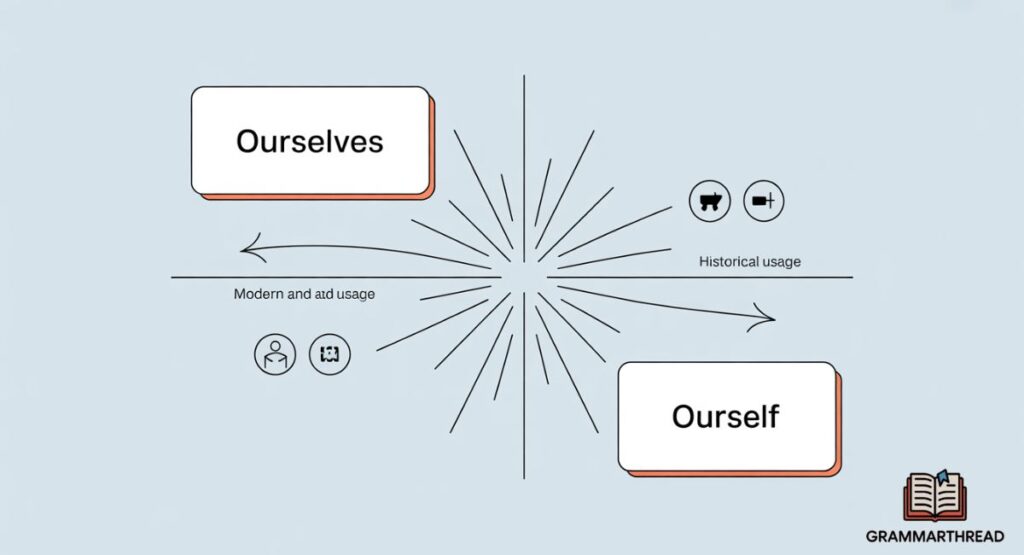
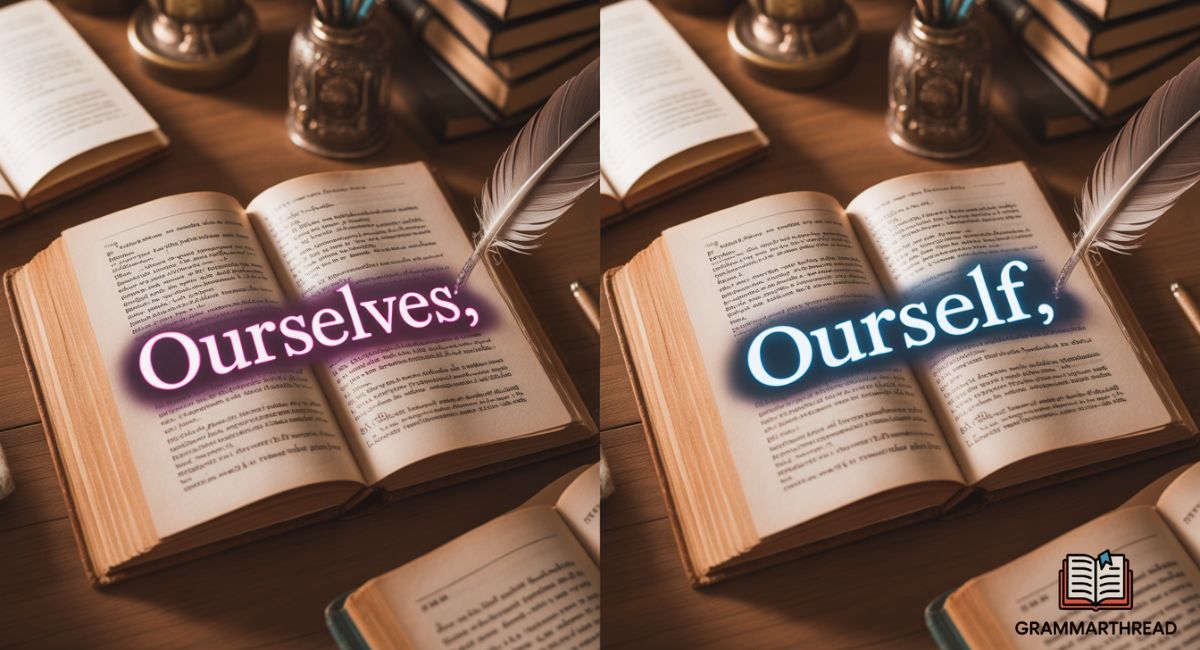
Let’s break this down. “Ourselves” and “ourself” are both reflexive pronouns that point back to the subject “we.” The main thing that sets them apart is whether you’re talking about one person or multiple people.
| Pronoun | Number | When to Use It | Example |
| Ourselves | Plural | Talking about two or more people | “We found ourselves lost in the city.” |
| Ourself | Singular | When one person uses “we” to speak | “We must hold ourself accountable for this decision.” |
Here’s the simple breakdown:
✅ Use “ourselves” when “we” represents a group of people.
✅ Use “ourself” only when a single individual speaks using “we” (like royalty or editors).
In normal, everyday conversation, “ourselves” is what you’ll need almost every single time. The singular “ourself” is rare and usually appears in formal or ceremonial contexts where one person refers to themselves as “we.” Think of it this way: unless you’re writing a royal decree or an editorial column where “we” means just you, stick with “ourselves.”
How “Ourself” and “Ourselves” Evolved Through History
Understanding the difference between “ourself” and “ourselves” becomes clearer when you look at where they came from.
Old English Roots
Early English had distinct terms for talking about yourself as one person versus multiple people:
- “Ure self” (meaning our self)
- “Us selfe” (meaning us self)
Over time, as the language transitioned through Middle English, these forms merged into “ourselves” combining our + selves into a single plural reflexive pronoun.
The Singular Reflexive “Ourself”
During the medieval period, monarchs and religious authorities started using “we” when referring to themselves individually as a way to convey power and collective representation. This practice created the need for “ourself”, a singular reflexive form matching this plural pronoun usage.
Throughout the 1600s, ourself showed up regularly in official royal correspondence, religious writings, and formal declarations. Here’s an example:
“We hereby declare and affirm this decree ourself.” Elizabeth I (1600)
Modern Decline
As the English language evolved into its modern form, ordinary speakers abandoned the practice of using “we” to refer to a single person. This shift caused ourself to gradually disappear from everyday language. These days, you’ll encounter it mainly in royal contexts, formal ceremonies, or when reading historical texts.
The Royal “We”: Understanding Why Monarchs Use “Ourself”
The Royal We, sometimes called the majestic plural, goes beyond just fancy language it carries deep symbolic meaning.
When a monarch declares “We have concluded…”, they aren’t speaking about a group. Instead, “we” represents:
- The ruler’s dual nature as both a person and an institution.
- The bond connecting the crown with its subjects.
- An expression of majesty, formality, and sovereign power.
Take this example:
“We intend to resolve this issue ourself.” Queen Victoria
In this case, “ourself” refers to a single individual (the Queen), but it’s expressed in plural form to capture both her personal identity and her official position as ruler.
You can still spot this tradition in certain ceremonial state papers and formal proclamations, though it’s become much less common in contemporary language. Modern monarchs tend to reserve it for the most formal occasions, making “ourself” a rarity even in royal circles today.
The Editorial and Institutional “We” Explained
The use of “we” isn’t limited to royalty. The editorial we appears regularly in publications, scholarly articles, and corporate communications.
Writers and organizations use it when speaking collectively or representing a broader group, creating a sense of objectivity or inclusiveness.
Here are some examples:
- “We find the data convincing and reliable.”
- “Our organization prides ourselves on transparency.”
In these situations, the plural “we” genuinely refers to multiple people or an entire entity, which means “ourselves” not “ourself” is the appropriate choice.
| Context | Correct Reflexive | Example |
| Editorial | Ourselves | “We view ourselves as impartial observers.” |
| Corporate | Ourselves | “We commit ourselves to ethical practices.” |
| Royal | Ourself | “We will attend to this matter ourself.” |
The key difference is that editorial and institutional uses of “we” actually represent groups of people working together, while the royal “we” represents a single person adopting plural language for ceremonial purposes.
Modern English Usage: Why “Ourselves” Is Your Go-To Choice
In today’s English, “ourselves” is the clear winner for everyday communication.
You’ll want to use it when:
- “We” refers to multiple people (two or more).
- You’re highlighting a joint action or collective experience.
- You’re making the subject refer back to itself.
Examples
✅ “We treated ourselves to dinner after the presentation.”
✅ “We managed to finish the project by ourselves.”
✅ “We pushed ourselves harder than ever before.”
In every one of these sentences, switching to “ourself” would sound awkward and grammatically wrong.
Grammar Tip
Here’s a simple test: Try swapping “we” with “I” and “ourselves” with “myself.” If the sentence still makes logical sense, you’ve got the structure right. This quick check helps confirm you’re using the plural reflexive form correctly when referring to a group.
When “Ourself” Still Shows Up Rare but Legitimate
While “ourself” may feel outdated, it hasn’t disappeared entirely from the English language.
You’ll occasionally find it in:
- Royal and ecclesiastical language: “We offer gratitude to Providence for directing ourself through this journey.”
- Formal organizational or ceremonial declarations: “As an institution, we must hold ourself accountable to the highest principles.”
These instances are deliberate, traditional, and carry symbolic weight. They’re technically correct within their specific contexts just don’t expect to hear them in everyday conversation.
Modern Example from Official Context
“We constantly remind ourself that compassion defines true leadership.” Address by a Bishop, 2020
Outside these specialized situations, choosing ourself will probably puzzle your audience or come across as unnecessarily formal. For virtually all standard writing and speaking, “ourselves” remains the natural and expected choice that communicates clearly without sounding like you’re addressing Parliament from the 1600s.
“Ourselves” and “Ourself” in Classic Literature and Dialogue
Renowned authors have long used “ourselves” and “ourself” strategically to create specific effects. Shakespeare, for example, employed both versions with clear intention.
| Source | Sentence | Word Used | Context |
| King Lear (1606) | “We do at this time proclaim ourself sovereign.” | Ourself | Royal declaration |
| Richard III | “We lose ourselves when passion clouds our judgment.” | Ourselves | Standard reflexive |
| Jane Austen (1813) | “We convince ourselves that our choices are always logical.” | Ourselves | Everyday English |
| Charles Dickens | “We ought to investigate for ourselves.” | Ourselves | Common usage |
These literary examples reveal how ourself historically conveyed authority and formal grandeur, while ourselves expressed collective identity or personal reflection without pretense. The distinction helped writers establish social hierarchy and tone through pronoun choice alone.
Common Misconceptions and Grammar Myths Debunked
Myth 1: “Ourself” Is Never Correct
Wrong. While uncommon, it’s perfectly valid when one person uses the royal or formal institutional “we.”
Myth 2: “Ourselves” Works for Singular Use
Incorrect. “Ourselves” only applies to plural subjects. Trying to use it for a single individual breaks grammatical rules and sounds clumsy.
Myth 3: You Can Swap Them Freely
Not even close. The choice between “ourselves” and “ourself” depends entirely on number and situation. Using the wrong one can completely alter your message’s formality and meaning.
Myth 4: “Ourself” Died with Shakespeare
Not quite. While uncommon, it survives in contemporary formal settings, particularly in ceremonial declarations and religious discourse. You won’t hear it at the coffee shop, but it hasn’t been retired from the language entirely.
How to Pick the Right Form Every Single Time
Follow this straightforward decision guide:
| Question | Answer | Use |
| Does “we” mean multiple people? | Yes | Ourselves |
| Are you using “we” for royal or ceremonial purposes? | Yes | Ourself |
| Are you writing on behalf of an organization (editorial, corporate)? | Yes | Ourselves |
| Are you one person speaking but using “we”? | Yes | Ourself |
| Still not sure? | Default to | Ourselves |
Quick Mnemonic
“When we means a group of two or more, ourselves is what you’re looking for.”
This simple memory trick works in nearly every situation you’ll encounter. Since the vast majority of English speakers use “we” to refer to actual groups, “ourselves” will be correct almost every time. Only in rare formal contexts where a single individual adopts the plural “we” would you ever need “ourself.”
Practical Grammar Tips for Better Usage
- Verify Number Consistency: When “we” refers to multiple individuals, stick with ourselves every time.
- Leverage Grammar Software Smartly: Apps like Grammarly or Microsoft Editor typically mark “ourself” as outdated or mismatched with modern style.
- Read Your Sentences Out Loud: If something sounds awkward when you say it, trust your instincts it likely needs fixing.
- Don’t Overcomplicate Things: Some people mistakenly choose “ourself” assuming it elevates their writing but it often backfires and sounds pretentious.
- Build Confidence Through Repetition: Experiment by writing the same sentence using both forms, then compare which version flows more naturally and fits your context better.
These practical strategies help you develop an intuitive sense for choosing correctly. The more you practice distinguishing between contexts where groups are speaking versus when one person adopts formal “we,” the easier this grammar decision becomes second nature.
Case Study: Real-World Applications Explained
Scenario 1 – Corporate Communication
A company representative announces:
“We pride ourself on customer satisfaction.”
❌ Incorrect – The organization consists of many people working together.
✅ Correct – “We pride ourselves on customer satisfaction.”
Scenario 2 – Royal Proclamation
A monarch declares:
“We shall oversee this ceremony ourself.”
✅ Correct – The single ruler appropriately employs the Royal We.
Scenario 3 – Research Publication
“We challenged ourselves to eliminate preconceived notions.”
✅ Correct – “We” refers to the research team of multiple authors.
These real examples show how context determines the right choice. In business and academic settings where “we” genuinely represents a group, “ourselves” is always appropriate. Only when a single authority figure adopts the ceremonial “we” does “ourself” become the grammatically sound option.
Shifts in Formal vs. Casual Writing: Where Each Form Fits Today
The way we use “ourselves” and “ourself” has shifted dramatically based on formality levels and writing context.
Casual Writing (Everyday Use)
In emails, text messages, social media, and informal conversations, “ourselves” dominates completely:
- “We treated ourselves to ice cream after work.”
- “Let’s give ourselves a break today.”
- “We can figure this out ourselves.”
Using “ourself” in casual settings would immediately sound strange and out of place like you’re pretending to be royalty at a pizza party.
Formal Writing (Professional Contexts)
Even in business reports, academic papers, and professional communications, “ourselves” remains the standard choice:
- “We committed ourselves to meeting the quarterly goals.”
- “We distinguished ourselves through innovative solutions.”
Ceremonial Writing (Highly Specialized)
Only in extremely formal, traditional contexts does “ourself” appear:
- Royal decrees and monarchical statements
- High-level religious proclamations
- Historical or ceremonial institutional documents
The Modern Reality
Today’s writing whether casual blog posts or corporate memos overwhelmingly favors “ourselves.” The shift reflects how language has democratized. We’ve moved away from hierarchical forms of address, making “ourself” a linguistic relic reserved for the most specialized ceremonial occasions. Unless you’re drafting a royal decree, “ourselves” fits naturally into both your casual tweets and your formal presentations.
Summary Table: Quick Reference Guide
| Context | Correct Word | Example | Register |
| Everyday English | Ourselves | “We organized ourselves efficiently.” | Standard |
| Royal/Religious Use | Ourself | “We pronounce this judgment ourself.” | Formal/Archaic |
| Editorial Writing | Ourselves | “We consider ourselves objective observers.” | Professional |
| Academic Writing | Ourselves | “We evaluated ourselves on critical thinking.” | Formal |
| Ceremonial Statement | Ourself | “We dedicate ourself to this mission.” | Traditional |
This quick reference table helps you identify the right choice instantly based on your writing situation. Notice how “ourselves” appears across most everyday, professional, and academic contexts reinforcing that it’s the default option for virtually all modern communication. “Ourself” remains confined to highly specialized traditional settings where singular authorities speak using plural pronouns for ceremonial effect.
Frequently Asked Question
Can I say ourself instead of ourselves
Use ourselves for normal group statements. Ourself appears only in rare formal or royal contexts.
When should I use ourselves in a sentence
Use ourselves when a group refers back to itself, like we taught ourselves.
Is ourself a real English word
Yes, but it is uncommon. It appears mainly in older writing or royal and institutional language.
Why do kings and queens say ourself
Monarchs use ourself as part of the royal we, a tradition of formal speech.
What is the simple difference between ourselves and ourself
Ourselves is the standard reflexive form. Ourself is limited to special formal contexts.
Can I use ourself at work or in emails
No. Stick with ourselves in all modern professional and casual writing.
Does ourself appear in modern English
It exists, but you will mostly see it in official statements from institutions or royalty.
Which one is grammatically correct today
Ourselves is the correct and accepted form for everyday use.
Conclusion
Choosing between ourselves or ourself really comes down to how the sentence is being used. Ourselves fits almost every modern situation because it reflects how groups speak today. Ourself has roots in older, formal English and still appears in royal or institutional language, but it is rarely needed in everyday writing.
If you’re unsure, the safest choice is almost always ourselves. It keeps your grammar clear and your message easy to follow.
Try using what you learned the next time you write an email or edit a paragraph. You’ll notice how much smoother your sentences feel once the right form becomes second nature.
Read Next: Swap vs Swop: The Real Difference Explained (Meaning, Usage & Examples) 2026

Welcome to GrammarThread. I am Julian Mercer, an AI-powered SEO and content writer with 4 years of experience. I help websites rank higher, grow traffic, and look amazing. My goal is to make SEO and website design simple and effective for everyone. Let’s achieve more together!