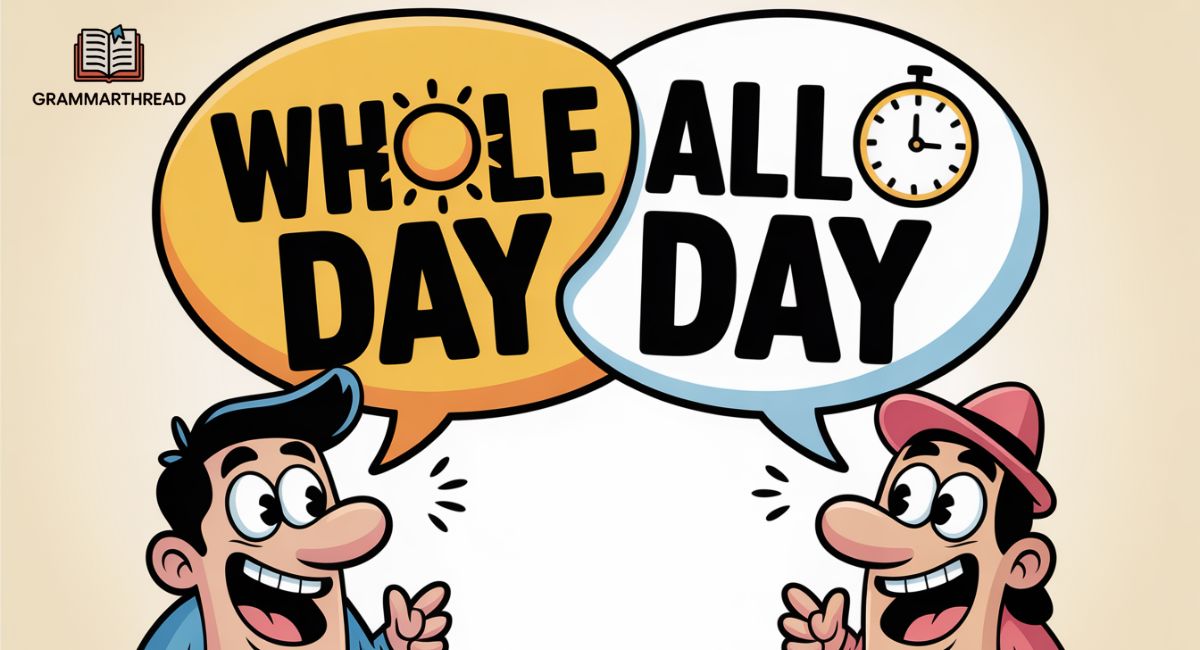
If you have ever paused mid sentence wondering whether to say Whole Day or All Day, you are not alone. These two phrases look simple, yet they often trip people up in daily conversations, emails, and even formal writing. I notice this confusion all the time when helping learners choose the most natural wording for real situations.
The difference matters because each phrase carries a slightly different feeling. One often points to duration and completeness, while the other highlights how time felt or was spent. Think about working nonstop, waiting endlessly, or laughing without breaks. This guide breaks it down with clear examples so you can choose confidently, sound natural, and express exactly what you mean without overthinking.
Understanding the Meaning of “All Day”
When you hear someone say “all day,” they’re putting emphasis on how long something lasts. It describes an activity or situation that stretches continuously throughout the day, from start to finish.
Here are some everyday examples:
- “She spent all day studying for her exam.”
- “The café is open all day during the summer.”
- “They drove all day to reach the beach.”
You’ll notice a pattern here the phrase highlights the entire time period. Whatever’s being described fills up most or all of the daylight hours.
In everyday American conversation, people tend to reach for “all day” rather than alternatives like “the whole day” or “the entire day.” It just sounds more natural and flows better when you’re describing duration. This makes it the go-to expression for talking about how long an event or activity went on.
Understanding the Meaning of “Whole Day”
In contrast, “whole day” puts the spotlight on completeness rather than duration. It treats the day as one complete unit of time. The focus isn’t so much on continuous action, but on the day in its entirety.
Take a look at these examples:
- “The whole day felt ruined after I missed my flight.”
- “He used the whole day to prepare for the presentation.”
- “They reserved the whole day for the family reunion.”
Notice the subtle difference the emphasis lands on totality. You’re stressing that every part of the day, from start to finish, was committed to something or affected by an event.
When people use “whole day” in conversation, it tends to carry more weight. It sounds a bit more emphatic or dramatic compared to “all day.” The phrase draws your attention to the fact that the complete day was consumed, leaving nothing left over.
Grammar and Structure Explained
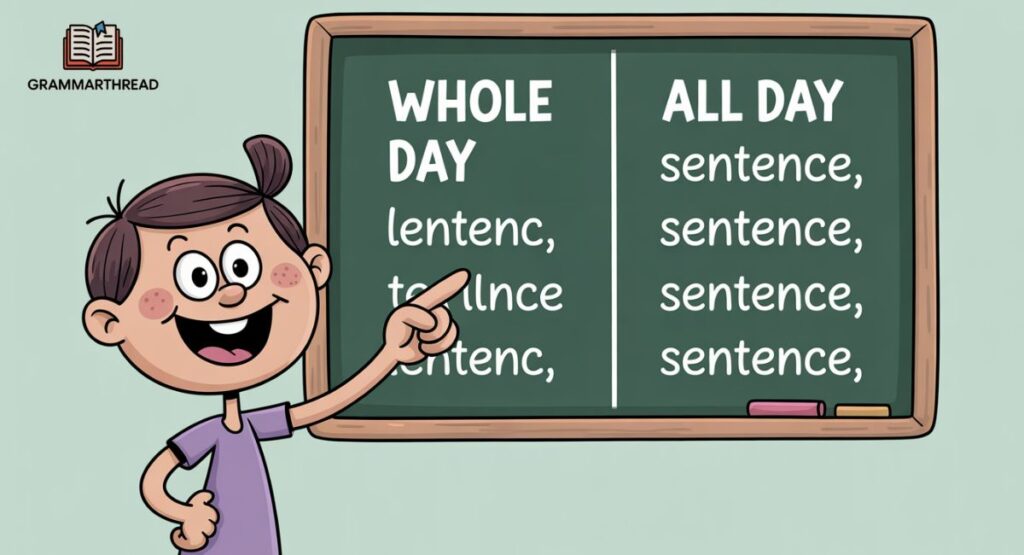
The difference between “whole day” and “all day” comes down to how each word functions grammatically.
- “All” works as a determiner. It refers to “every bit of” or “the complete span of” something.
- “Whole” operates as an adjective that describes a noun, emphasizing its completeness.
Here’s a direct comparison to make it clearer:
| Phrase | Grammatical Role | What It Emphasizes | Example Sentence |
| All day | Determiner | Duration (how long) | “She studied all day.” |
| Whole day | Adjective + noun | Completeness (entirety) | “The whole day felt endless.” |
Both expressions are perfectly correct in terms of grammar, but they create slightly different shades of meaning. Your choice between them shifts the focus of what you’re trying to say.
Context Matters: Choosing Between the Two
You can’t simply interchange “whole day” and “all day” in every situation. The context you’re in determines which one works better.
- Choose “all day” when describing an activity that continues without stopping.
- Example: “The baby cried all day.”
- Choose “whole day” when emphasizing that the complete day, as one block, was consumed or affected.
- Example: “She reserved the whole day for the wedding.”
Real World Examples
- Academic writing: A professor might write, “The experiment ran all day,” but to emphasize commitment, they’d say, “The whole day was dedicated to fieldwork.”
- Workplace communication: During a status update, someone could mention, “We coded all day to fix the bug.” Meanwhile, “The whole day was consumed by client calls” sounds more intense and highlights impact.
- Everyday conversation: You might tell a friend, “I binge watched shows all day.” But if you’re emphasizing how draining it felt, “The whole day just disappeared” carries stronger emotional weight.
Common Usage in American English
While both expressions show up regularly in American English, their usage rates aren’t the same.
“All day” dominates everyday speech, common idioms, and commercial language. “Whole day” appears less frequently and typically serves an emphatic purpose.
Common Idiomatic Phrases
“All day parking” (found at lots, garages, and transit stations) “All day long” (describes something happening continuously without breaks) “All day dining” (restaurants offering full menus from open to close)
You won’t find “whole day” locked into set idioms like these. It shows up in regular sentences where speakers want to add extra emphasis.
Usage Patterns in Written English
Data from Google Ngram Viewer shows that “all day” appears much more frequently across books, articles, and other published materials compared to “whole day.” This pattern mirrors the natural speaking preferences of American English users and reflects which phrase feels more instinctive in daily communication.
Cultural and Media References
These phrases also make their mark in popular culture and advertising.
- “All Day” in entertainment and branding: You’ll find it in hit songs (like Kanye West’s track “All Day”), catchy taglines (“Starbucks: Coffee All Day”), and promotional offers (“All Day Happy Hour”). Marketers love it because it’s brief, memorable, and has natural flow.
- “Whole Day” barely makes an appearance in commercial messaging or creative titles. It sounds too stiff and doesn’t have the same catchiness. Brands and content creators lean toward “all day” for its snappy rhythm and ease of recall.
This pattern helps explain why English learners encounter “all day” so frequently in movies, commercials, and song lyrics. It simply fits better into the informal, fast-paced language of modern media.
Everyday Scenarios and Practical Examples
To understand the difference better, let’s look at how these phrases work in everyday scenarios:
- Travel
- “They drove all day to reach the coast.” (ongoing activity)
- “The whole day was lost to flight cancellations.” (stressing that the day was wasted)
- Work/Study
- “She worked all day on the presentation.” (duration of effort)
- “The whole day was devoted to research.” (highlighting complete commitment)
- Casual Conversation
- “We chatted all day about our vacation ideas.”
- “The whole day revolved around planning the party.”
When Both Work Equally Well
Sometimes you can use either phrase without much change in meaning:
- “He stayed indoors all day.”
- “He stayed indoors the whole day.”
Both versions are grammatically sound and make sense, though “whole day” carries a bit more emphasis and weight.
Grammar in Action: Rules and Exceptions

English learners sometimes get confused about how to use these phrases correctly.
- You can’t write “an all day” because “all” serves as a determiner, not an adjective. Correct form: “an all-day workshop” (hyphenated when it modifies a noun as a compound adjective).
- You can write “a whole day” because “whole” functions as an adjective. Correct form: “I needed a whole day to finish.”
The Hyphenation Rule
When “all day” comes before a noun and describes it, you need to add a hyphen:
- “An all-day conference”
- “An all-day parking pass”
Meanwhile , “whole day” doesn’t require a hyphen because it rarely gets used as a compound modifier before nouns. It typically follows standard adjective-noun structure without special punctuation.
Tips to Remember the Difference
Here are some simple tricks to help you keep them straight:
- All day = duration (emphasizes the time span)
- Whole day = entirety (emphasizes the complete unit)
Memory Aid
Try thinking of it this way:
- “She studied all day = She kept studying continuously.”
- “The whole day = The complete day as one block.”
Quick Reference
| Expression | What It Highlights | Example |
| All day | Duration | “They traveled all day.” |
| Whole day | Entirety | “The whole day felt empty.” |
Subtle Tone Differences Native Speakers Notice
Native English speakers pick up on small tonal shifts between these phrases, even if they can’t always explain why.
“All day” sounds neutral and matter-of-fact. It’s the default choice when you’re simply stating how long something took.
“Whole day” carries more emotional weight. It often implies frustration, disappointment, or emphasis on significance.
Listen to the difference:
- “I waited all day for the package.” (neutral statement)
- “I wasted the whole day waiting for the package.” (frustration)
- “We played games all day.” (casual, descriptive)
- “We spent the whole day just playing games.” (slight judgment or surprise)
Tone in Different Contexts
The emotional coloring becomes especially clear in complaints or reflections. When someone says “the whole day was ruined,” they’re not just describing duration they’re expressing how they felt about it. Meanwhile, “it rained all day” is simply reporting a fact without added emotion.
This subtle difference is why native speakers instinctively reach for “whole day” when they want their words to land with more impact.
Frequently Asked Questions
What is the difference between Whole Day and All Day?
Whole Day refers to the complete duration from start to finish, while All Day focuses on something happening continuously during that time.
Can I use Whole Day and All Day interchangeably?
Sometimes yes in casual speech, but in precise writing the meaning and tone can change based on context.
Which is more correct in formal English, Whole Day or All Day?
Both are correct, but Whole Day sounds slightly more structured when emphasizing total duration.
When should I say All Day in daily conversation?
Use All Day when describing ongoing actions or feelings, like waiting, working, or feeling tired.
Is Whole Day grammatically correct in modern English?
Yes, Whole Day is grammatically correct and commonly used to stress completeness.
Does All Day sound more natural in spoken English?
Yes, All Day is more common in everyday speech and informal conversations.
Which phrase shows emotion more clearly, Whole Day or All Day?
All Day often conveys emotion better, such as excitement, boredom, or frustration.
Can Whole Day be used in professional writing?
Yes, Whole Day fits well in reports or formal sentences that focus on full time periods.
Conclusion
Understanding the difference between Whole Day or All Day may look minor, but it shapes how clear and natural your English sounds. One phrase focuses on completeness and time span, while the other often reflects feeling or continuous action. Knowing when and why each developed helps you choose the right one without hesitation.
Used correctly, these expressions improve tone in everyday talk and add precision to professional writing. The key is to think about context, intention, and emotion before you decide. Try noticing how native speakers use them in real life, then practice rewriting a few sentences on your own. Small choices like this quickly build confidence and polish your communication.
Read Next: Is It Correct to Say “Day Well Spent” Meaning

Welcome to GrammarThread. I am Julian Mercer, an AI-powered SEO and content writer with 4 years of experience. I help websites rank higher, grow traffic, and look amazing. My goal is to make SEO and website design simple and effective for everyone. Let’s achieve more together!